

Lebanon president accuses Hezbollah of working to ‘collapse’ state

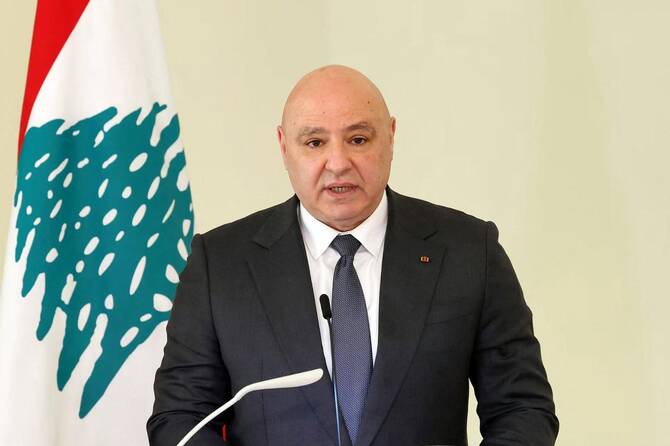
Lebanon’s President Joseph Aoun gives a joint-press conference with Germany’s president at the Presidential Palace in Baabda, east of Beirut, on February 16, 2026. (AFP)
Short Url
Updated 09 March 2026
Follow

Lebanon president accuses Hezbollah of working to ‘collapse’ state

  • Joseph Aoun: ‘Whoever launched those missiles wanted to bring about the collapse of the Lebanese state’
  • Ahmed Al-Sharaa: ‘We stand alongside Lebanese president Joseph Aoun in disarming Hezbollah’

BEIRUT, Lebanon: Lebanese President Joseph Aoun on Monday accused Hezbollah of working to “collapse” the state and expressed Beirut’s readiness for “direct negotiations” with Israel, drawing the backing of his Syrian counterpart for his goal of disarming the Iran-backed group.
Lashing out at Hezbollah over its March 2 attack against Israel, which has drawn a devastating Israeli retaliation, Aoun told European officials “Whoever launched those missiles wanted to bring about the collapse of the Lebanese state, plunging it into aggression and chaos... all for the sake of the Iranian regime’s calculations.”
To stop the war, the Lebanese president proposed a four-point initiative and called on the international community to help implement it.
The plan included “establishing a full truce” with Israel, “logistical support” for the army to disarm Hezbollah, and “direct negotiations (with Israel) under international auspices.”
Syrian President Ahmed Al-Sharaa endorsed his Lebanese counterpart on Monday saying, “We stand alongside Lebanese president Joseph Aoun in disarming Hezbollah.”
The statements came as the war between Israel and Hezbollah pushed into a second week, with Israel carrying out heavy strikes on a financial firm linked to the group.
Lebanon was drawn into the Middle East war last week when Iran-backed Hezbollah attacked Israel in response to the killing of Iranian supreme leader Ayatollah Ali Khamenei in US-Israeli strikes.
Lebanese authorities said on Monday that Israel’s attacks since March 2 have killed at least 486 people and wounded at least 1,313.
AFP has not been able to carry out a detailed breakdown of the figures.
According to the government, more than 660,000 people have registered as displaced, with 120,000 sleeping at official shelters as of Monday.

Evacuation warnings

Israel said it killed the head of Hezbollah’s Nasr unit operating in part of southern Lebanon, Abu Hussein Ragheb, on Monday.
Earlier, the Israeli military struck branches of Al-Qard Al-Hassan, a US-sanctioned financial firm, after issuing evacuation warnings, according to Lebanese state media and AFP correspondents.
The Israeli army said it was “striking Hezbollah infrastructure” in the southern suburbs.
An AFP photographer in the area witnessed a massive explosion, while an armed Hezbollah member fired warning shots into the air to encourage residents to evacuate from their homes.
The Israeli army renewed previous orders for people in the area to leave.
Al-Qard Al-Hassan is a lifeline for mainly Shia Muslim communities battling a years-long financial crisis in Lebanon that has locked people out of their bank deposits.
It says it has more than 30 branches nationwide, mainly in Hezbollah bastions such as Beirut’s southern suburbs, but also in central Beirut and other major cities.
In Lebanon’s southern city of Sidon, an area outside of Hezbollah’s traditional sphere of influence, an AFP correspondent saw ambulances and civil defense vehicles gather around a branch of Al-Qard Al-Hassan.
Israel also bombed the firm’s branches during its last war with Hezbollah in 2024, including the one in Sidon.
Israeli tank fire killed a priest in the Christian southern Lebanese town of Al-Qlayaa, according to state media and a medical source.

‘Path of allegiance’

Hezbollah on Monday celebrated the selection of Mojtaba Khamenei as Iran’s new supreme leader.
“We renew our pledge of loyalty to this blessed approach and our steadfastness on the path of allegiance,” the group said in a statement.
It also claimed responsibility for at least 10 previous attacks against Israel and its forces, including against troops advancing into Lebanese border towns, as well as a missile salvo on an air base in Haifa.
It said it targeted the Israeli Home Front Command base in Ramla, near Tel Aviv, with “advanced missiles.”
Earlier Monday, it also said it had fought Israeli troops who landed in eastern Lebanon by helicopter, the second such incident since the latest war began.
Israeli strikes on sites belonging to the Hezbollah-linked Islamic Health Committee in the Tyre and Jwaya areas in south Lebanon killed two paramedics and wounded six, the health ministry said, accusing Israel of “systematic targeting of rescue teams.”
Despite the bombing in Beirut, Lebanon’s parliament met on Monday and postponed legislative elections by two years due to the conflict.
The polls had been scheduled to take place in May.


Iranians fleeing cities under attack seek refuge in the countryside

Updated 5 sec ago
Follow

Iranians fleeing cities under attack seek refuge in the countryside

  • Tens of thousands of Iranians are fleeing Tehran and other cities as Israeli and US bombardment spreads fear
  • he UN refugee agency says that about 100,000 people left the Iran’s capital Tehran in the war’s first two days and that the level of displacement is surely much higher by now
BEIRUT: Terrified by explosions shaking their homes in Tehran and other cities, tens of thousands of Iranians have packed up and left, finding refuge in small, remote towns to wait out massive bombardment by Israel and the United States.
Pouya Akhgari, 22, is holed up in a family house with aunts and cousins in a village 200 kilometers (120 miles) from his home in the capital, Tehran. As snow falls in the mountainous countryside of Zanjan province, he mostly spends his days watching movies and TV shows and sometimes ventures out to the nearest main town.
The village has been spared strikes, but Akhgari’s friends in Tehran tell him about the blasts all around them.
“It just feels so chaotic. I thought it’d be very short but it’s dragging on,” he told The Associated Press by a messaging app. ”If it goes on like this, we’ll run out of money.”
The UN refugee agency said that in the first two days of the war, about 100,000 people fled Tehran, a city of around 9.7 million. It said that the scale of displacement is likely much higher, though it didn’t have figures for the days since, or on the flight from other cities.
A strawberry farm’s relative safety
A 39-year-old lawyer endured a day of explosions that shook her home in the city of Ahvaz, 800 kilometers (500 miles) southeast of Tehran. The next day, on March 2, she packed up her things and hit the road with her brother, sister and their families — and their dogs Coco and Maggie.
They went to their family’s strawberry farm in a small town several hours away. She and others reached by the AP spoke on condition of anonymity to prevent reprisals, and she asked that the town not be identified.
The town doesn’t have any military bases, so it feels relatively safe. Still, southern Iran has been the target of some of the most intense bombardment. She said that the next town over — which is even smaller — saw an explosion when a strike hit an ammunition site belonging to the Revolutionary Guard, the nation’s most powerful armed force.
She worries that strikes could target a gym used by Guard members a few hundred meters down the road from their farm. Airstrikes have hit a number of sports facilities around Iran, apparently because the Guard often uses such sites as gathering places. The gym is probably far enough away that it won’t affect them if it’s hit, she said, “but all the same, the danger exists.”
No one is going to work, and the kids are far from school. To pass the time and keep their minds off things, they walk the dogs, play board games and pick strawberries.
The peacefulness of the nature around them helps make the war feel distant — the clouds rolling across the green hills, the bleating of their neighbor’s goats at sunset. The brightest spot, the lawyer said, was when one of the two farm dogs, Maya, gave birth to a litter of puppies.
Still, uncertainty hangs over everything.
“From morning to night, we talk about what is happening, our worries, how everything gets more expensive every day, about how far our money will stretch,” she said.
“If this situation continues, we will have problems meeting basic needs.”
Between bombardment and the Revolutionary Guard
The US-Israeli campaign has struck heavy blows to Iran’s leadership, killing Supreme Leader Ayatollah Ali Khamenei and top military figures. It has also particularly targeted the Revolutionary Guard and paramilitary Basij, the forces that are tasked with protecting the cleric-led Islamic Republic and that have led the crushing of waves of anti-government protests, including ones in January,
The leadership has kept its hold. Khamenei’s son, Ayatollah Mojtaba Khamenei, was named the new supreme leader this week. The Guard and Basij have shown that their local networks are still in place so far.
The lawyer said that on the rare times she left the farm to go into town, she saw that members of the Basij were now more heavily armed in the streets.
“They are waiting for the slightest movement” showing dissent, she said.
She once campaigned against the mandatory hijab — in fact, she was briefly detained in the past — and stopped wearing it years ago. But since the war, she wears one when she leaves home for fear of provoking the Basij.
The town is traditionally considered pro-government, she said, and many residents have taken state positions or joined the Guard. Religious and patronage loyalties run deep in rural areas in particular, since the Islamic Republic brought basic services to Iran’s countryside and small towns.
Still, she has seen signs of growing discontent even here. Large crowds turned out in the town for January’s anti-government protests, she said, and observance of the state’s official mourning week for Khamenei has been muted, with few people wearing black as urged by authorities.
The ‘remarkable kindness’ of strangers
One man described how, before fleeing home in Tehran, explosions made his 6½-year-old son tremble in fear.
“You place him between you and your wife in bed, hoping he might feel safer,” he said, but he still screamed in his sleep. They decided it was time to leave.
As they drove through the capital, they saw cars on the roadside, their windows shattered from blasts. Leaving the city at the foothills of the Alborz Mountains north of Tehran, they saw columns of smoke rising from different parts of the city into the overcast sky.
“The scene made the city look frightening,” he said.
On the highway west out of Tehran, heavy with traffic, explosions shook their car, terrifying his son, he said. Finally they reached a family home in a small village on the other side of the mountains, northwest of the capital, overlooking the Caspian Sea.
There they spend their days in the house, surrounded by rice paddies, with snow-capped mountains in the distance. Each day, he and his wife take their son out for walks.
“Boys have so much energy, and in a village, there is not much fun for him,” he said. In the evenings, his wife’s mother and father, who also fled Tehran, visit.
Amid all the chaos, local residents show “remarkable kindness,” he said.
He said he went to the neighborhood bakery to buy bread and found a long line. When the baker realized he wasn’t from the area, he called him to the front of the line, then tried to refuse payment for the bread.
“The others in line were very friendly, asking whether I had a place to stay and whether I needed anything,” he said.
Leaving home isn’t an option for everyone.
One 53-year-old man in Tehran said that he can’t move his elderly parents and so is staying home. The strain is immense, he said.
“At night, I go down to the parking garage, sit inside my car and scream out loud,” he said. “I pray for calm and for quieter days.”