

Chinese vice-premier arrives in Pakistan for 10-year corridor project celebrations

In this handout photo taken and released by the Ministry of Interior, Pakistan, Chinese Vice Premier He Lifeng shakes hands with Pakistan Interior Minister Rana Sanaullah as he arrived in Islamabad on July to mark the 10th anniversary of the China-PakistanEconomic Corridor project. (Photo courtesy: Ministry of Interior)
Short Url
Updated 30 July 2023
Follow

Chinese vice-premier arrives in Pakistan for 10-year corridor project celebrations

  • He Lifeng was instrumental in the planning and execution of multiple CPEC projects in Pakistan
  • Authorities order closure of all schools, private firms and banks in Islamabad on Monday, Tuesday

ISLAMABAD: A top Chinese official arrived in Pakistan's capital on a three-day visit on Sunday to attend the 10-year celebrations of a joint corridor project launched by the two countries and interact with top leaders in Islamabad.

The China-Pakistan Economic Corridor (CPEC), a significant infrastructure development and regional connectivity project, was launched by the two countries to build a major trade route between the Gwadar Port in southwestern Pakistan and China’s northwestern region of Xinjiang.

While the two sides agreed to work on the multibillion-dollar CPEC projects in April 2015, they became central to China’s Belt and Road Initiative (BRI), which was first mentioned by President Xi Jinping during a visit to Kazakhstan in September 2013. The BRI aims to recreate the ancient Silk Route, though on a much larger level, to connect China with a number of countries in its immediate neighborhood and extend to various areas in Europe and Africa.

"Chinese Vice Premier He Lifeng arrives in Islamabad on Sunday, on a three-day visit to Pakistan," the state-run Associated Press of Pakistan (APP) said on Twitter.

"During the visit, he will attend the 10th-anniversary celebrations of China Pakistan Economic Corridor."

Pakistan's foreign office said earlier today, Sunday, that Lifeng would be in Pakistan till August during which he would call on Pakistan's president and prime minister.

 “He will also be the chief guest at an event celebrating the Decade of CPEC," the foreign office added. 

The foreign office said the Chinese vice premier played a prominent role in China’s international economic relations and implementation of the BRI, of which CPEC was a flagship project.

“As the Chairman of the National Development and Reform Commission (2017-23), he was instrumental in the planning and execution of multiple CPEC projects in Pakistan,” it added.

Meanwhile, the administration in the Pakistani capital of Islamabad announced the closure of all schools, colleges, universities, private firms, markets, and commercial banks on Monday and Tuesday.

The foreign office said the visit was part of regular high-level exchanges and dialogue between the two states, reflecting the importance Pakistan’s attributed to China which had always supported Islamabad’s core strategic interests.

China was also among the group of countries, including Saudi Arabia and the United Arab Emirates, which rescued Pakistan’s economy by depositing significant amounts in its central bank and rolling over billions of dollars of loans.

Prime Minister Shehbaz Sharif also praised the administration in Beijing for financially assisting Pakistan in a selfless manner during his recent visit to Gwadar.
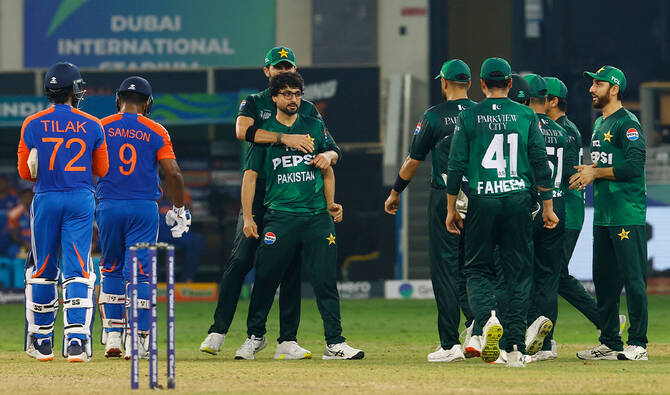

T20 World Cup: Pakistan’s India boycott splits fans as politics overshadows cricket

Updated 5 sec ago
Follow

T20 World Cup: Pakistan’s India boycott splits fans as politics overshadows cricket

  • The boycott has dealt a blow to the ICC’s marquee event, with India-Pakistan matches ‌the biggest drivers ‌of global viewership, revenue
  • On the streets, many Pakistani fans back the boycott as a response to what they see as India’s growing influence over cricket governance

KARACHI: Pakistan’s decision to boycott its Twenty20 World Cup match against India has drawn widespread support from fans ​and administrators who hailed the move as a long-overdue stand in a rivalry in which sport and geopolitics have collided.

The government on Sunday cleared Pakistan to take part in the tournament beginning February 7 but barred the team from playing India in a February 15 group match in Colombo, a decision the International Cricket Council (ICC) said was not in the interests of the global game.

The boycott deepened a long freeze in bilateral cricket between the nuclear-armed neighbors — who have not played a full series since 2012–13 and now meet largely at neutral venues — and dealt a blow to the ICC’s marquee event, with India-Pakistan matches ‌the biggest drivers ‌of global viewership and revenue.

’ENOUGH IS ENOUGH’

For many in Pakistan, however, ‌the ⁠boycott ​was less ‌about cricketing issues, with Pakistan forfeiting two points by skipping the match, and more about symbolism.

“Enough is enough,” former Pakistan Cricket Board (PCB) chairman Najam Sethi told Reuters, accusing India’s board of politicizing the ICC. “It’s time to challenge this duplicitous approach by exercising PCB’s options in alliance with Bangladesh.”

The Indian government, the Board of Control for Cricket in India (BCCI) and the International Cricket Council did not respond to requests for comment.

The ICC said it was still awaiting an official communication from the Pakistan Cricket Board (PCB) conveying their “position of selective participation.”

“While the ICC respects the roles ⁠of governments in matters of national policy, this decision is not in the interest of the global game or the welfare of fans ‌worldwide, including millions in Pakistan,” the Dubai-based body said in a ‍statement on Sunday.

The government has not publicly detailed ‍its reasoning, but Mosharraf Zaidi, a spokesperson for Prime Minister Shehbaz Sharif, linked the move to security ‍tensions with India.

“Nothing is more important than the memory of Pakistani citizens and troops murdered by Indian proxy terrorists over the weekend,” Zaidi said. “With funerals taking place today, this was the least that could be done.”

The remarks followed coordinated attacks by Baloch separatist militants across Pakistan’s southwestern Balochistan province over the weekend that killed nearly 50 people.

India’s ​foreign ministry rejected Pakistan’s accusations, calling them “baseless” and accusing Islamabad of deflecting attention from its own internal issues.

Pakistan’s World Cup jersey has been branded the “Markhor Edition,” after the national ⁠animal, a symbol of resilience also used in military iconography, Geo TV reported.

’LET CRICKET JUST BE A GAME’

On the streets of Pakistan’s major cities, many cricket fans backed the boycott as a response to what they see as India’s growing influence over global cricket governance.

“This arrogance of India should be broken a little,” said Mohammad Asghar, a fan in Karachi. “They should realize someone has come forward to challenge them.”

Others drew parallels with Bangladesh’s earlier withdrawal from the tournament over safety concerns, a move that led to Scotland replacing them, and questioned why Pakistan should be held to a different standard.

“If Bangladesh can boycott for one player’s safety, why can’t Pakistan take a stand?” said Ayaz Ahmed.

The decision also sparked heated debate on social media, with users divided between calls for “self-respect” and warnings that skipping the match could further isolate Pakistan in global cricket.

Former Pakistan captain Shahid Afridi agreed.

“Cricket ‌can open doors when politics closes them,” he wrote on X. “It’s regrettable that Pakistan won’t play India, but this is the moment for the ICC to prove it is impartial.”