

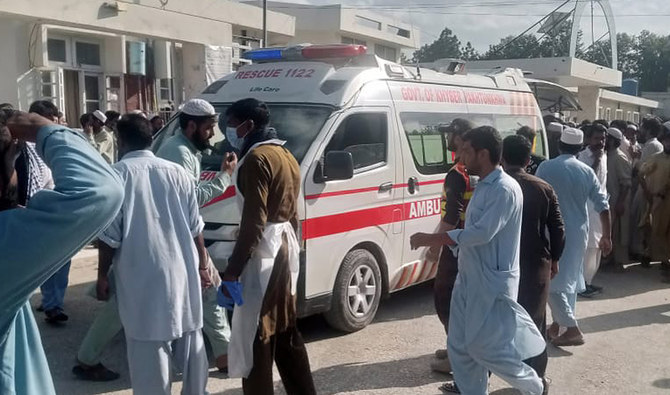

KHAR, Pakistan: A powerful bomb ripped through a political rally by supporters of a hard-line cleric and political leader on Sunday in Pakistan’s northwestern Bajur district, police and health officials said. At least 44 people were killed and nearly 200 wounded, including children, in one of the worst attacks in recent years.
Senior police officer Nazir Khan said the workers’ convention of Maulana Fazlur Rehman’s Jamiat Ulema Islam party was taking place on the outskirts of Khar, the capital of Bajur district, when the bomb went off. AP video showed wounded people being carried from the scene in the chaotic aftermath.
Bajur used to be a haven for Islamic militants. It is the former stronghold of the Pakistani Taliban, known as Tehreek-e-Taliban Pakistan, or TTP, a militant group that is a close ally of the Taliban government of Afghanistan. The TTP was in recent years evicted from the area as a result of operations by the Pakistani military.
The bombing came hours before the arrival of Chinese Vice Premier He Lifeng in Islamabad, where he was to participate in an event to mark a decade of the China-Pakistan Economic Corridor, or CPEC, a sprawling package under which Beijing has invested billions of dollars in Pakistan.
In recent months, China has helped Pakistan avoid a default on sovereign payments. However, some Chinese nationals have also been targeted by militants in northwestern Pakistan and elsewhere.
In a statement sent to The Associated Press, the TTP condemned the bombing, saying it was aimed at pitching Islamists against each other. Zabiullah Mujahid, a spokesman for the Afghan Taliban, also condemned the bombing. “Such crimes cannot be justified in any way,” he said in a message on the social media platform X, formerly known as Twitter.
Though a separate group, the TTP remains a close ally of the Afghan Taliban, who seized power in Afghanistan in mid-August 2021. The takeover emboldened the TTP. They unilaterally ended a cease-fire agreement with the Pakistani government last November and have since stepped up attacks across the country.
One of the victims, Adam Khan, 45, was hit by splinters in his leg and both hands. He said it was around 4 p.m. when the explosion knocked him to the ground.
“There was dust and smoke around, and I was under some injured people from where I could hardly stand up, only to see chaos and some scattered limbs,” he said.
Initially, police said 10 people were killed but later more bodies arrived at a local hospital, bringing the death toll to 40. Feroz Jamal, the provincial information minister, told The Associated Press that so far 40 people had been “martyred” and nearly 200 wounded in the bombing.
The JUI workers’ convention was arranged in a hall close to a market, but tents were later added because of the large number of supporters who turned out. The venue was being guarded by party volunteers with batons. The arrival of Abdul Rasheed, a senior party leader, was being announced when the bomb exploded.
The bombing was one of the four worst attacks in the northwest since 2014, when 147 people, mostly schoolchildren, were killed in a Taliban attack on an army-run school in Peshawar. In January, 74 people were killed in a bombing at a mosque in Peshawar. n February, more than 100 people, mostly policemen, died in a bombing at a mosque inside a high-security compound housing Peshawar police headquarters.
District health officer Dr. Faisal Khan said 40 bodies from the blast were at Khar’s main hospital. Some of the wounded were in critical condition and were being transferred to a facility in Peshawar and the adjoining district of Dir, including by army helicopters.
Prime Minister Sharif and President Arif Alvi condemned the attack and asked officials to provide all possible assistance to the wounded and the bereaved families.
Maulana Ziaullah, the local chief of Rehman’s party, was among the dead. JUI leaders Rasheed and former lawmaker Maulana Jamaluddin were also on the stage but escaped unhurt. Party officials said Rehman was not at the rally.
Rasheed, the regional chief of the party, said the attack was an attempt to remove JUI from the field before parliamentary elections in November, but he said such tactics would not work.
Rehman is considered to be a pro-Taliban cleric and his political party is part of the coalition government in Islamabad. Meetings are being organized across the country to mobilize supporters for the upcoming elections.
“Many of our fellows lost their lives and many more wounded in this incident. I will ask the federal and provincial administrations to fully investigate this incident and provide due compensation and medical facilities to the affected ones,” Rasheed said.
Mohammad Wali, another attendant at the rally, said he was listening to a speaker address the crowd when the huge explosion temporarily deafened him.
“I was near the water dispenser to fetch a glass of water when the bomb exploded, throwing me to the ground,” he said. “We came to the meeting with enthusiasm but ended up at the hospital seeing crying, wounded people and sobbing relatives taking the bodies of their loved ones.”


