

Pakistan inks MOUs with local and Chinese firms for Saudi-backed oil refinery

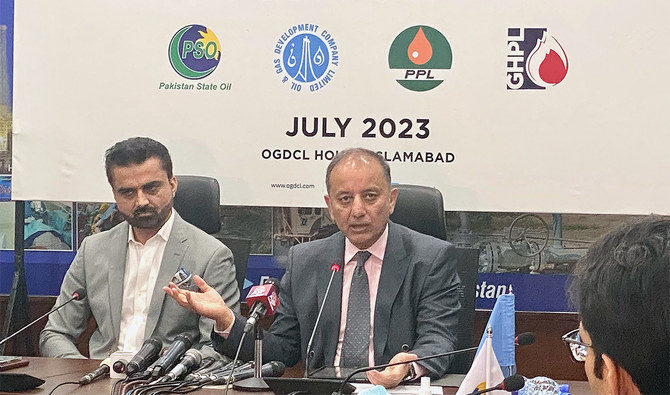
Pakistan’s minister of state for petroleum Dr. Musadik Malik (center) is pictured addressing a press conference in Islamabad, Pakistan, on July 27, 2023. (AN photo)
Short Url
Updated 27 July 2023
Follow

Pakistan inks MOUs with local and Chinese firms for Saudi-backed oil refinery

  • PSO, OGDCL, PPL and GHPL sign agreements to raise required local equity for $12 billion refinery
  • Engineering, procurement and construction contract signed with China National Offshore Oil Corporation

ISLAMABAD: Four Pakistani public entities have signed three memoranda of understanding (MOUs) to raise the necessary local equity for a multibillion-dollar Saudi refinery project and also inked an engineering, procurement and construction (EPC) contract with a Chinese firm, Pakistan’s minister of state for petroleum Dr. Musadik Malik said on Thursday.

The $12 billion Saudi project, with a capacity to process 350,000-450,000 barrels of crude oil per day, was initially agreed upon during a visit to Islamabad by Saudi Crown Prince Mohammed bin Salman in 2019.

Pakistan State Oil (PSO), Oil and Gas Development Company Limited (OGDCL), Pakistan Petroleum Limited (PPL), and Government Holdings Private Limited (GHPL) signed three MOUs to raise the required local equity, while the EPC agreement was inked with China National Offshore Oil Corporation (CNOOC) and Pakistan’s Monarch International.

“In our earlier discussions [with Saudi authorities] there were two issues, one was obviously, who are the other equity partners, so Pakistan firmly believed that if Pakistan thinks that this is a viable project, then Pakistan should put its own equity into the project,” Malik told Arab News on the sidelines of the MOU signing ceremony.

“So, we have put together equity partnerships in excess of 40 to 45 percent as of right now.”

Pakistan, Saudi Arabia and Aramco were “honored partners” and had held many rounds of talks to reach an agreement on the way forward, Malik said.

“As I said, we are in the final stages, means we basically are at the spreadsheet level, trying to take out all the wrinkles that are there or that are possible, so that a world-class refinery of about 300,000 barrels can be set in Pakistan,” he added.

“PSO is taking the lead in local equity with 25 percent and other firms also committed 5 to 10 percent which makes our equity share more than what is required.”

Malik said the Pakistan government had brought in the best Chinese company for the purpose of EPC contracts.

“We have already brought to the table world-class refinery EPC construction partners who are also going to take a position in the equity,” he said.

Malik added that after the announcement of the new refinery policy, the government had also initiated talks with the United Arab Emirates (UAE) and Azerbaijan for investment in the sector.



Pakistan minister calls for integrating ocean awareness into education to preserve ecosystems

Updated 31 January 2026
Follow

Pakistan minister calls for integrating ocean awareness into education to preserve ecosystems

  • Pakistan’s maritime sector posted a record $360 million profit in 2025 following a year of sweeping reforms
  • Junaid Anwar Chaudhry says education equips youth to make informed decisions, contribute to blue economy

KARACHI: Pakistan’s Maritime Affairs Minister Junaid Anwar Chaudhry has urged integrating ocean awareness into formal education systems and empowering youth as active partners in order to preserve marine ecosystems, his ministry said on Saturday.

Chaudhry said this at a meeting with Minister of State for Education and Professional Training, Wajiha Qamar, who called on him and discussed strategies for enhancing marine education, literacy, and youth engagement in sustainable ocean management.

Pakistan’s maritime sector posted a record Rs100 billion ($360 million) profit in 2025 following a year of sweeping reforms aimed at improving port efficiency, cost-cutting, and safeguarding marine ecosystems to boost the blue economy.

“Understanding our oceans is no longer optional, it is essential for climate resilience, sustainable development, and the long-term health of our maritime resources,” Chaudhry said, highlighting the critical role of marine literacy.

The minister said education equips youth to make informed decisions and actively contribute to marine conservation and the blue economy, urging inclusion of marine ecosystems, conservation and human-ocean interactions into curricula, teacher training and global citizenship programs.

“Initiatives like ‘Ocean Literacy for All’ can mainstream these elements in national policies, school programs, and community workshops to build proactive citizenship on marine challenges,” he added.

Ocean Literacy for All is a UNESCO Intergovernmental Oceanographic Commission–coordinated global initiative under the UN Ocean Decade (2021–2030) that promotes ocean awareness, education, and conservation.

Chaudhry announced reforms in maritime education, including granting degree-awarding status to the Pakistan Marine Academy, and the establishment of the Maritime Educational Endowment Fund (MEEF) to provide scholarships for deserving children from coastal communities.

“The scholarship program promotes inclusive development by enabling access to quality education for youth from over 70 coastal and fishing communities, particularly in Sindh and Balochistan,” he said.

The discussions underscored raising awareness about oceans, coastal ecosystems and marine resources, according to the Pakistani maritime affairs ministry. Both ministers stressed the need to integrate climate and marine education from classrooms

to community programs, addressing risks like rising sea temperatures, coastal erosion, biodiversity loss and pollution.

“Incorporating marine science and ocean literacy into curricula can help students connect local challenges with global trends,” Qamar said, underscoring education’s transformative power in building social resilience.

The meeting explored translating complex marine science into accessible public knowledge through sustained, solution-oriented awareness campaigns, according to the maritime affairs ministry.

With coastline facing pressures from climate change, pollution, and overexploitation, the ministers called for a coordinated approach blending formal education, informal learning and youth-led advocacy.

“A joint effort by the Ministries of Maritime Affairs and Education can cultivate an ocean-literate generation, transforming vulnerability into resilience and ensuring the long-term sustainability of coastal and marine ecosystems,” Chaudhry said.