

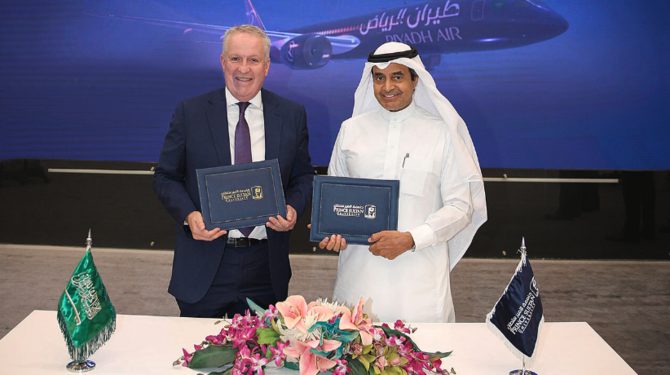
Riyadh Air partners with Prince Sultan University to build flight simulation center 

The MoU was signed in a ceremony at Prince Sultan University in Riyadh (Supplied)
Short Url
Updated 19 July 2023
Follow

Riyadh Air partners with Prince Sultan University to build flight simulation center 

RIYADH: Future pilots in Saudi Arabia will soon develop their flying skills in an immersive training environment, with Riyadh Air planning to build its first simulator center at Prince Sultan University. 

The airline signed a memorandum of understanding with the university on Wednesday to build a facility that trains aspiring pilots to fly Riyadh Air. 

“We believe that investing in the future of the aviation industry is vital for the joint success and growth of Riyadh Air and the Kingdom,” said Peter Bellew, chief operating officer of Riyadh Air, in a statement. 

The airline will work closely with the university to build a graduate program for future pilots. 

The two parties will also collaborate on short-term programs, including vocational training for cabin crew, ground crew and other management positions in finance, legal, IT, human resources and project management. 

“Our collaboration with Prince Sultan University marks another step in Riyadh Air’s efforts to offer unique learning platforms for local youth as they look to choose and develop their careers,” Bellew added. 

He added: “This program aims to create more jobs within Saudi Arabia, ensure sustainability, and qualify Saudi youth by launching initiatives that enable them to join the job market and contribute to the growth and competitiveness of the sector.” 

The MoU was signed at the Prince Sultan University campus in Riyadh. 

“The collaboration between our university and Riyadh Air comes from a mutual interest and care for the development and enrichment of the students who are interested in careers in the aviation sector,” said PSU President Ahmed Yamani. 

“Prince Sultan University prides itself on its graduate students that study at our university, which is ranked first Kingdom-wide in regard to employment after graduation,” Yamani added. 

Launched in March, Riyadh Air is wholly owned by the Public Investment Fund and is part of the Kingdom’s strategy to unlock the potential of its aviation sector. 

In June, the airline finalized a deal for 90 GEnx-1B engines to propel its upcoming fleet, with the agreement also including spare engines and a TrueChoice services package.

The deal follows the Saudi airline’s wide-body order for 39 Boeing 787-9 Dreamliner aircraft.


Aramco’s 13% rally helps Saudi stocks post second weekly gain

Updated 12 March 2026
Follow

Aramco’s 13% rally helps Saudi stocks post second weekly gain

RIYADH: Saudi Aramco extended its year-to-date rally to nearly 13 percent on Thursday, helping the Kingdom’s benchmark stock index secure a second straight weekly gain despite a weaker final trading session.  

Saudi Aramco shares, which carry the heaviest weighting on the Saudi Exchange, closed at SR26.86 ($7.16), leaving the stock 12.72 percent higher since the start of 2026. The stock also remained 3.09 percent above last week’s close, even after falling 1.1 percent in Thursday’s session.

The rise in energy shares came as escalating tensions in the Middle East pushed oil prices above $100 a barrel, after attacks on tankers in the Gulf and the Strait of Hormuz heightened concerns over supply disruptions.

The Tadawul All Share Index maintained its weekly uptrend, rising nearly 1.07 percent week on week to close at 10,778.32, despite falling 0.45 percent in Thursday’s session. Compared with the first trading day of the year, the index has gained 4.01 percent.

Total trading turnover on the benchmark index reached SR5.05 billion at Thursday’s close, with 88 stocks advancing and 176 declining.

Aramco’s performance continued to anchor sentiment after the company reported adjusted net income of $104.7 billion for 2025 earlier this week, while net profit fell 12.1 percent year on year to $93.39 billion, compared with $106.25 billion in 2024, as lower crude prices weighed on earnings despite higher sales volumes across oil, gas and refined products.

On a March 10 earnings call, Aramco CEO Amin Nasser warned that prolonged disruption in the Strait of Hormuz could have severe implications for global energy markets. Roughly 20 percent of the world’s oil normally passes through the waterway each day, but shipments have been largely blocked.

“There would be catastrophic consequences for the world’s oil markets and the longer the disruption goes on ... the more drastic the consequences for the global economy,” he said.

“While we have faced disruptions in the past, this one by far is the biggest crisis the region’s oil and gas industry has faced.”

Saudi equities showed mixed performance in Thursday’s session. The MSCI Tadawul Index fell 5.99 points, or 0.40 percent, to close at 1,476.76.

The Kingdom’s parallel market Nomu gained 132.47 points, or 0.6 percent, to close at 22,370.4, with 38 stocks advancing and 34 declining.

On March 11, the International Energy Agency announced the release of 400 million barrels of oil from its reserves, the largest such move in its history. As part of that, the US said it would release 172 million barrels starting next week.