

Pakistan cuts petrol, diesel prices as rupee strengthens against dollar 

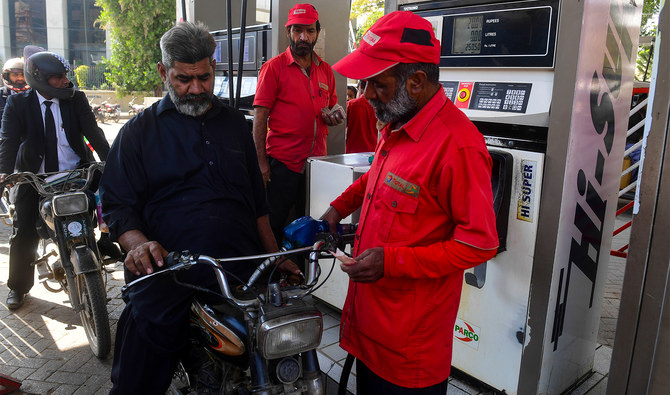
This picture taken on January 30, 2023, shows a man filling petrol in his motorcycle at a gasoline station in Pakistan's port city of Karachi. (AFP/File)
Short Url
Updated 16 July 2023
Follow

Pakistan cuts petrol, diesel prices as rupee strengthens against dollar 

  • Finance Minister Ishaq Dar says government decreased prices following rupee’s recovery against dollar 
  • The greenback closed at Rs277.59 in the interbank market on Friday at the close of the weekend session 

ISLAMABAD: The Pakistani government has reduced the prices of petrol and high-speed diesel by Rs9 per liter, Finance Minister Ishaq Dar announced late Saturday after the local currency gained some lost ground against the US dollar. 

The South Asian country revises the prices of petroleum products every fortnight and has increased the rates over the last year to comply with tough conditionalities imposed by the International Monetary Fund (IMF) for a bailout package. 

The increase in petroleum prices, along with global supply chain constraints and an economic meltdown, pushed inflation to historic highs in Pakistan, which eased to 29.4 percent in June for the first time in the last several months. 

Finance Minister Dar announced late Saturday the government had decreased the price of petrol and high-speed diesel following the rupee’s gains against the greenback. 

“In the international market... there was a decline in [the price of] one item and increase in the other,” he said in a televised address. “This has been compensated [by] the Pakistani rupee which has improved in the last 15 days.” 

After the reduction in prices, a liter of petrol was now available for Rs253, while that of high-speed diesel was Rs253.5, the minister added. 

The development comes amid some recovery in the value of rupee on the back of Pakistan’s $3 billion bailout deal with the IMF. 

The greenback closed at Rs277.59 in the interbank market on Friday at the close of the weekend session. 


Pakistan launches double-decker buses in Karachi after 65 years to tackle transport woes

Updated 11 sec ago
Follow

Pakistan launches double-decker buses in Karachi after 65 years to tackle transport woes

  • Karachi citizens will be able to travel in double-decker buses from Jan. 1, says Sindh government
  • City faces mounting transport challenges such as lack of buses, traffic congestion, poorly built roads

ISLAMABAD: The government in Sindh province on Wednesday launched double-decker buses in the provincial capital of Karachi after a gap of 65 years, vowing to improve public transport facilities in the metropolis. 

Double-decker buses are designed to carry more passengers than single-deck vehicles without taking up extra road space. The development takes place amid increasing criticism against the Sindh government regarding Karachi’s mounting public transport challenges and poor infrastructural problems. 

Pakistan’s largest city by population faces severe transportation challenges due to overcrowding in buses, traffic congestion and limited bus options. Commuters, as a result, rely on private vehicles or unregulated transport options that are often unsafe and expensive.

“Double-decker buses have once again been introduced for the people of Karachi after 65 years,” a statement issued by the Sindh information ministry said. 

Sindh Transportation Minister Sharjeel Inam Memon and Local Government Minister Syed Nasir Hussain Shah inaugurated the bus service. The ministry said the facility will be available to the public starting Jan. 1. 

The statement highlighted that new electric bus routes will also be launched across the entire province starting next week. It added that the aim of introducing air-conditioned buses, low-fare services, and fare subsidies is to make public transport more accessible to the people.

The ministry noted that approximately 1.5 million people travel daily in Karachi using the People’s Bus Service, while around 75,000 passengers use the Orange Line and Green Line BRT services.

“With the integration of these routes, efforts are being made to benefit up to 100,000 additional people,” the ministry said.