

Pakistan invites Chinese companies to become part of ‘National Solar Energy Initiative’

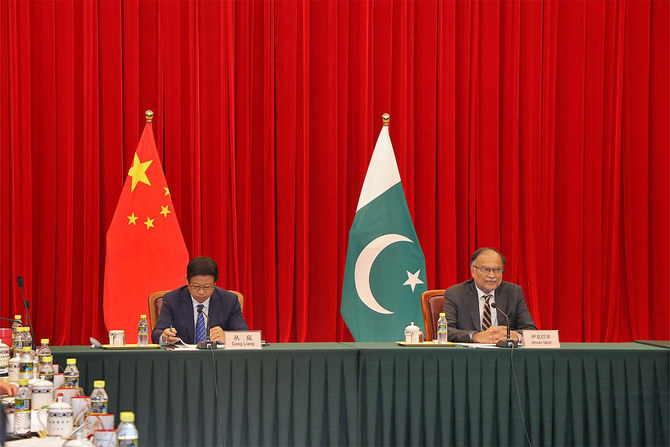
Pakistan's Planning Minister Ahsan Iqbal and Vice Chairman, National Development & Reform Commission (NDRC), China Mr, Cong Liang are pictured during 12th (Special) Joint Cooperation Committee (JCC) of the China-Pakistan Economic Corridor (CPEC) in Islamabad, Pakistan, on July 12, 2023. (@PakinChina_/Twitter)
Short Url
Updated 11 July 2023
Follow

Pakistan invites Chinese companies to become part of ‘National Solar Energy Initiative’

  • Program to help generate 10,000 MW solar power, “substitute costly energy with cheap solar power”
  • Pakistan has vowed to produce 60 percent of its electricity from renewable energy sources by 2030

ISLAMABAD: Minister for Planning Ahsan Iqbal on Tuesday met senior Chinese business officials and invited them to become part of a new ‘National Solar Energy Initiative,’ state media reported.

Pakistani Prime Minister Shehbaz Sharif announced the initiative in September last year, saying the program would help generate 10,000 MW solar power and “substitute costly energy with cheap solar power, which will provide massive relief to people and save precious foreign exchange.” 

The solar initiative aims to start off by switching government buildings and tube wells from diesel to solar power, while power plants operating on diesel, coal and furnace oil will also be partially replaced.

“Iqbal briefed the Chinese companies about Prime Minister’ ‘solar energy initiative’ for which foreign investors were offered special incentives,” the APP news agency reported about the planning minister’s meeting with Chen Diming, chairman of the China Apollo Holding Group, and Xu Hao, a senior representative of the China Ocean Engineering Construction Company.

“The minister invited the Chinese companies to benefit from this new policy.”

“He underscored the importance of energy projects which have enabled Pakistan to overcome its energy shortages and urged them to invest in solar power generation and establishment of solar manufacturing plants in Pakistan to achieve better efficiency and wider distribution of cheaper electricity,” APP added.

Pakistan’s current energy mix is about 58 percent fossil fuels, 30 percent hydropower and 10 percent renewables and nuclear power. Pakistan has vowed to produce 60 percent of its electricity from renewable sources by 2030.

Last month, Pakistan and China signed a $4.8 billion deal to build a 1,200-megawatt nuclear power plant, the Chashma 5 project.

Pakistan's total nuclear energy production capacity rose to 1,400 MW when the country's sixth nuclear power plant opened two years ago. Located in the southern port city of Karachi, that 1,100 mw plant was also constructed with Chinese assistance.

Since 2015, Beijing has pledged $65 billion in infrastructure and energy projects for Pakistan under its Belt and Road Initiative.


Pakistan minister orders measures to ease port congestion, speed up sugar and cement handling

Updated 7 sec ago
Follow

Pakistan minister orders measures to ease port congestion, speed up sugar and cement handling

  • Meeting in Islamabad reviewed congestion at Port Qasim and its impact on export shipments
  • Ports directed to enforce first-come, first-served berthing and penalize unnecessary delays

KARACHI: Pakistan’s Maritime Affairs Minister Junaid Anwar Chaudhry on Saturday directed authorities to streamline sugar and cement operations at Port Qasim after reports of severe congestion caused by the slow unloading of sugar consignments disrupted export activities.

The government has been working to ease port bottlenecks that have delayed shipments and raised logistics costs for exporters, particularly in the cement and clinker sectors. The initiative is part of a broader effort to improve operational efficiency and align port management with national trade and logistics priorities.

“Improving operational efficiency is vital to prevent port congestion, which can cause delays, raise costs, and disrupt the supply chain,” Chaudhry told a high-level meeting attended by senior officials from the maritime and commerce ministries, port authorities and the Trading Corporation of Pakistan.

The meeting was informed that sugar was being unloaded at a rate below Port Qasim’s potential capacity. The minister instructed the Port Qasim Authority to optimize discharge operations in line with its daily capacity of about 4,000 to 4,500 tons.

Participants also reviewed directives from the Prime Minister’s Office calling for up to 60 percent of sugar imports to be redirected to Gwadar Port to ease the load on Karachi terminals.

Officials said all vessels at Port Qasim and Karachi Port would now be berthed on a first-come, first-served basis, with penalties to be applied for unnecessary delays.

The TCP was told to improve operational planning and coordinate vessel arrivals more closely with port authorities.

Chaudhry commended the engagement of all participants and said consistent adherence to performance standards was essential to sustaining port efficiency and preventing a recurrence of logistical disruptions.