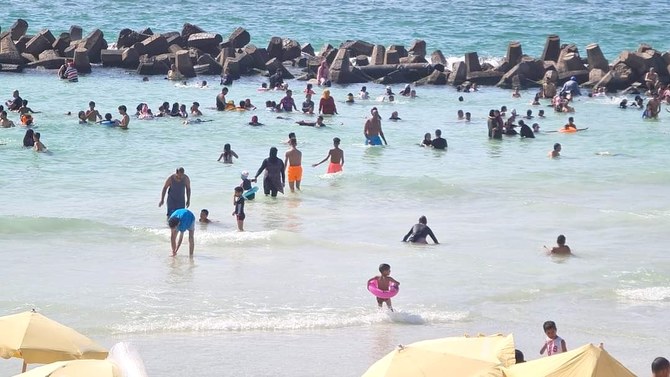

CAIRO: Egypt’s infamous “death beach” has reopened in Al-Ajami, Alexandria governorate, after three years of closure.
Known officially as Palm Beach, this notorious site earned its grim moniker due to the significant number of drowning incidents witnessed annually.
The surge in fatalities forced Egyptian authorities to shut down the beach three years ago.
However, the beach’s reopening this summer has been facilitated by new safety regulations, field supervision, and adherence to standards set by the Egyptian Diving and Rescue Federation.
The beach was permitted to reopen after the successful implementation of new regulations.
Dr. Mohamed Abdel Razek, head of the central administration for tourism and resorts, discussed the safety provisions with Arab News.
“We instructed for immediate rescue facilities, such as jet skis, to be stationed within the water rather than the shore, along with lifeguards stationed along the beachfront,” he said.
Abdel Razek emphasized strict restrictions on swimming outside designated areas.
“There will be no leniency on this matter,” he said.
“If necessary, we will forcibly remove anyone breaching these rules to safeguard lives. The public has shown good compliance with these instructions.”
Abdel Razek warned that any violation or laxity regarding the instructions would result in the immediate closure of the beach.
“The lives of beachgoers are a red line we will not cross,” he said.
In previous years, Palm Beach was notorious for posing a significant risk to holidaymakers.
It consistently reported the highest percentage of drowning incidents among Alexandria’s beaches every summer.
Osama Ali, director general of the General Administration of Resorts, shared some insights.
He said: “Theories have emerged suggesting that the breakwaters placed along the beach create dangerous whirlpools, particularly hazardous for inexperienced swimmers.”
The crisis escalated until the beach’s closure in 2020.
The Council of Ministers and the Public Prosecution ordered the closure following a series of mass drowning incidents.
The main routes to the corniche and the beach were sealed off with barbed wire stretching more than 1,600 meters following the Public Prosecution’s decision.
Signs were displayed, highlighting that the beach was closed by Public Prosecution’s order and entry was strictly prohibited.
Ali said: “With the summer of 2023 upon us, the Central Administration for Tourism and Resorts in Alexandria announced Palm Beach’s reopening, having set up all the requirements to ensure visitors’ safety and security.”
The measures include certified lifeguards, stationed at both the breakwaters in the sea and the watchtowers on the beach, and teams patrolling along the sandy shore.
Additionally, three or four jet skis were to be permanently present at sea to secure the beach length. Rescue tools approved by regulatory standards were also provided.
Ali added that four ambulance points, fully equipped for emergency cases, had been distributed along the beach.
A control tower has been set up on the sand, located before the first breakwater from the eastern side, and another after the last barrier — the seventh barrier, he said.
Each tower is assigned a rescuer at its top and another at the bottom, with warning signs placed in areas between checkpoints prohibiting public access.
The Palm Beach crisis began several years ago when drowning incidents started to surge, peaking at 16 cases in a single day in 2018.
The recovery of bodies was often a challenging task that could take weeks.
The alarming trend caught the attention of the executive bodies, leading to investigations into the causes and the development of scientific solutions to mitigate drowning incidents on the beach.
Ahmed Fawaz, a vacationer at Palm Beach, expressed optimism to Arab News.
“The situation this summer has significantly improved.”
Most drowning incidents occured before or after official working hours, he said.
The beach regulations specify operating hours from sunrise to sunset.
Swimming at dawn or after sunset is particularly dangerous due to poor visibility in dark waters and the absence of lifeguards.