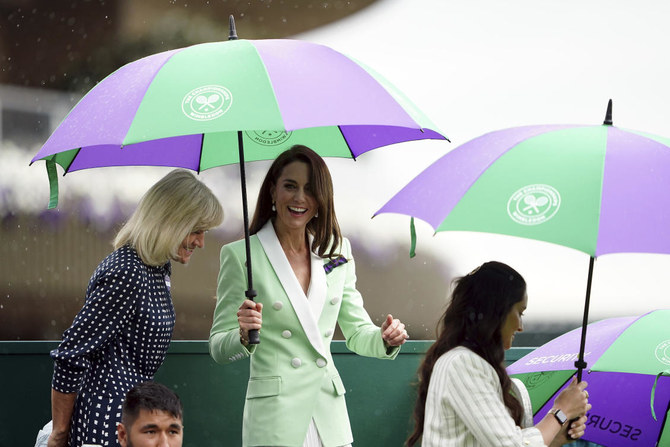
WIMBLEDON: Kate, the Princess of Wales, had the best seat in the house Tuesday on Center Court at Wimbledon — in the front row of the Royal Box and right next to Roger Federer.
The future queen, wearing a mint green blazer, made her way down to her seat only moments before Federer was feted ahead of the opening match on Day 2 of the grass-court tournament.
Federer, an eight-time champion at the All England Club, sat between the princess and his wife, Mirka.
The first match on a wet second day of Wimbledon — with the retractable roof closed — featured Elena Rybakina against American opponent Shelby Rogers. As is tradition at the most traditional of all tennis tournaments, Rybakina opened play on Tuesday as the defending women’s champion.
Kate has been somewhat of a regular visitor to Wimbledon since marrying Prince William. The late Queen Elizabeth II, William’s grandmother, made only a handful of trips to the All England Club during her 70-year reign. Her last appearance in the Royal Box was in 2010.
King Charles III has taken his seat in the Royal Box at times but not since taking over as monarch from his mother. Elizabeth died last September and Charles had his coronation in May.

Princess Kate takes her seat in Royal Box at Wimbledon, right next to Roger Federer

https://arab.news/mznkp
Princess Kate takes her seat in Royal Box at Wimbledon, right next to Roger Federer

- Kate has been somewhat of a regular visitor to Wimbledon since marrying Prince William
- The future queen wore a mint green blazer and white skirt
Archeologists discover world’s oldest artwork in Indonesia’s Sulawesi
- Newly dated artworks are believed to have been created by ancestors of indigenous Australians
- Discovery shows Sulawesi as one of world’s oldest centers of artistic culture, researcher says
JAKARTA: Hand stencils found in a cave in Indonesia’s Sulawesi are the world’s oldest known artworks, Indonesian and Australian archeologists have said in a new study that dates the drawings back to at least 67,800 years ago.
Sulawesi hosts some of the world’s earliest cave art, including the oldest known example of visual storytelling — a cave painting depicting human-like figures interacting with a wild pig. Found in 2019, it dates back at least 51,200 years.
On Muna, an island off the province’s southeast, researchers have discovered new artworks which are faint and partially obscured by a more recent motif on the wall. They used a new dating technique to determine their age.
The cave art is of two faded hand stencils, one at least 60,900 years old and another dating back at least 67,800 years. This makes it the oldest art to be found on cave walls, authors of the study, which was published this week, said in the journal Nature.
Adhi Agus Oktaviana, a researcher at the National Research and Innovation Agency, or BRIN, and co-author, said this hand stencil was 16,600 years older than the rock art previously documented in the Maros-Pangkep caves in Sulawesi, and about 1,100 years older than stencils found in Spain believed to have been drawn by Neanderthals.
The discovery “places Indonesia as one of the most important centers in the early history of symbolic art and modern human seafaring. This discovery is the oldest reliably dated rock art and provides direct evidence that humans have been intentionally crossing the ocean since almost 70,000 years ago,” Oktaviana said on Wednesday.
The stencils are located in Liang Metanduno, a limestone cave on Muna that has been a tourist destination known for cave paintings that are about 4,000 years old.
“This discovery demonstrates that Sulawesi is one of the oldest and most continuous centers of artistic culture in the world, with roots dating back to the earliest phases of human habitation in the region,” said Prof. Maxime Aubert of Australia, another of the study’s co-authors.
To figure out the stencils’ ages, researchers used a technique called laser-ablation uranium-series dating, which allows for the accurate dating of ocher-based rock art. The method uses a laser to collect and analyze a tiny amount of mineral crusts that had formed on top of the art.
The study also explored how and when Australia first became settled, with the researchers saying the stencil was most likely created by the ancestors of indigenous Australians.