

General election will happen on time, Pakistani interior minister says

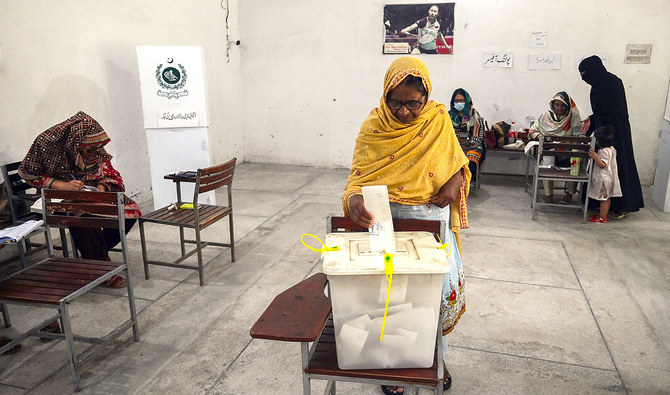
Voters cast their ballot at a polling station during the by-election in Punjab province assembly seat in Lahore on July 17, 2022. (AFP/File)
Short Url
Updated 16 June 2023
Follow

General election will happen on time, Pakistani interior minister says

  • Rana Sanaullah’s comments came as Pakistan is engulfed in a months-long political crisis
  • If National Assembly is dissolved on time, elections must be held no later than October 14

ISLAMABAD: Interior Minister Rana Sanaullah has said general elections in Pakistan would he held on time, with the vote scheduled for mid-October this year.

Sanaullah’s comments in an interview to Independent Urdu came as Pakistan is engulfed in a months-long political crisis, which reached a crescendo last month with deadly clashes between supporters of former Prime Minister Imran Khan and police after Pakistan’s anti-corruption agency arrested the opposition politician on May 9. 

Khan is out on bail but thousands of his supporters remain under arrest and over 100 members of his party have since jumped ship. The government has also threatened to ban Khan’s Pakistan Tehreek-e-Insaf party while the military has started military trials of those rioters that attacked military installations.

“Absolutely, elections should be on time and it seems they will happen on time and their taking place on time is very important,” Sanaullah said. “This is important for this country’s political and societal stability. And god willing they will happen.”

He said the government had even allocated finances for elections in the budget for fiscal year 2023-24.

Asked about reports that the government could extend the tenure of the National Assembly, which is set to dissolve on August 13, 2023 upon completing its five year term, Sanaullah said there was no point of extending parliament’s tenure for a few months.

“There should be elections and a fresh mandate,” he said.

If the National Assembly is dissolved on time, general elections are to be held no later than October 14, 2023, as constitutionally they need to be held less than 60 days after the dissolution of parliament.

The rupture in Pakistan’s febrile politics comes as the 230-million-population nation faces its worst economic crisis in decades, with dwindling reserves and a stalled $6.5 billion IMF program that is expiring in June and scarce other financing sources in sight.

The turmoil since Khan was ousted from the office of the prime minister in a parliamentary no-trust vote in April last year has scarred the country’s economy and markets.

Pakistan’s rupee has lost nearly 50 percent over the past 12 months. The main stock index has suffered a double-digit decline over the same period.


Pakistan secures $1.2 billion as IMF clears reviews, flags gains on stability and reforms

Updated 9 sec ago
Follow

Pakistan secures $1.2 billion as IMF clears reviews, flags gains on stability and reforms

  • IMF praises Pakistan’s policy implementation despite challenging global environment and climate-driven shocks
  • The Executive Board urges faster energy, SOE and governance reforms for macroeconomic and fiscal sustainability

KARACHI: The International Monetary Fund (IMF) approved Pakistan’s second review under its Extended Fund Facility (EFF) and the first review of its Resilience and Sustainability Facility (RSF), said a statement on Tuesday, unlocking about $1.2 billion in new financing while praising the country’s progress in stabilizing the economy despite recent floods.

The decision taken by the IMF Executive Board allows Islamabad to draw $1 billion under the EFF and $200 million under the RSF, bringing total disbursements under both arrangements to about $3.3 billion. The Fund said Pakistan’s policy implementation had improved financing conditions, strengthened reserves and preserved stability even as the country faced a challenging global environment and climate-driven shocks.

Under the 37-month EFF, approved last year in September, the IMF noted strong fiscal performance, including a primary surplus of 1.3 percent of GDP, a rebound in gross reserves to $14.5 billion by end-FY25 from $9.4 billion a year earlier and progress on rebuilding confidence. It noted a surge in inflation due to flood-related food price spikes but said it was expected to ease.

“Pakistan’s reform implementation under the EFF arrangement has helped preserve macroeconomic stability in the face of several recent shocks,” IMF Deputy Managing Director Nigel Clarke said. “Real GDP growth has accelerated, inflation expectations have remained anchored, and fiscal and external imbalances have continued to moderate.”

Clarke said Islamabad’s commitment to meeting its FY26 primary balance target while also addressing urgent post-flood relief signaled strong fiscal intent. He urged continued tax policy simplification and base broadening to build space for climate resilience, social protection and public investment.

The IMF official maintained a tight monetary stance should be continued to keep inflation within the State Bank Pakistan’s target range, while allowing exchange-rate flexibility and deepening the interbank market.

Additionally, he said financial regulation enforcement and capital market development were essential for a resilient financial sector.

The IMF also flagged energy sector reforms as “critical to safeguarding viability,” noting that timely tariff adjustments had helped curb circular debt but that Pakistan must now focus on reducing electricity production and distribution costs and addressing operational inefficiencies in both the power and gas sectors.

The statement also welcomed the publication of Pakistan’s Governance and Corruption Diagnostic report, a detailed IMF-supported assessment that maps out where government systems are vulnerable to inefficiency or misuse and recommends reforms to improve transparency, accountability and service delivery.

Further priorities include the privatization of state-owned enterprises and strengthening economic data quality.
Clarke said reducing Pakistan’s climate vulnerability was vital for long-term stability, referring to the RSF, a financing tool that provides long-term, low-cost loans to help countries address climate risks.

“The RSF arrangement is supporting efforts to strengthen natural disaster response and financing coordination, improve the use of scarce water resources, raise climate considerations in project selection and budgeting, and improve the information on climate-related risks in financing decisions,” he said.

Pakistan faced a prolonged economic crisis in recent years before it began implementing stringent IMF-recommended reforms, which have driven a gradual improvement in macroeconomic indicators over the past two years.

The country also remains one of the world’s most climate-vulnerable nations despite contributing less than one percent of global greenhouse-gas emissions.

It has endured a series of extreme weather events in recent years, most notably the 2022 super-floods that submerged one-third of the country, displaced millions and caused an estimated $30 billion in losses.

This year’s floods killed over 1,000 people and caused at least $2.9 billion in damage to agriculture and infrastructure, underscoring the scale of climate pressures facing the economy.

Economic experts told Arab News a day earlier that the Fund’s disbursements under the two loan programs would support the cash-strapped nation, which has relied heavily on financing from bilateral partners such as Saudi Arabia, China and the United Arab Emirates, as well as multilateral lenders.

“It obviously will help strengthen the external sector, the balance of payments,” said Samiullah Tariq, group head of research at Pakistan Kuwait Investment Company.

Another analyst, Shankar Talreja, head of research at Karachi-based Topline Securities, said the move was likely to send a positive signal to domestic and international investors about the government’s commitment to its reform agenda.

“This will help strengthen reserves and will eventually help a rating upgrade going forward,” he said.