

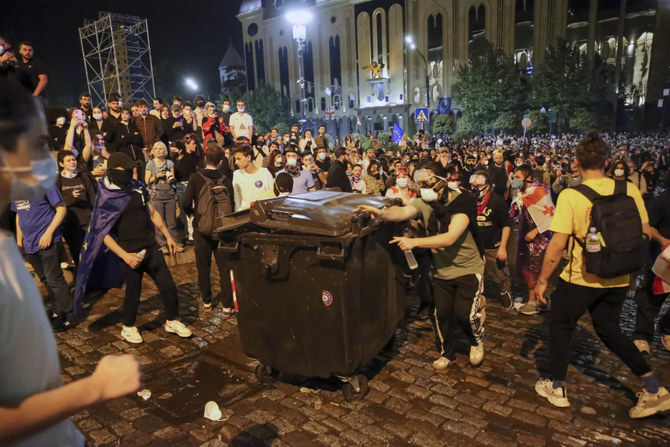
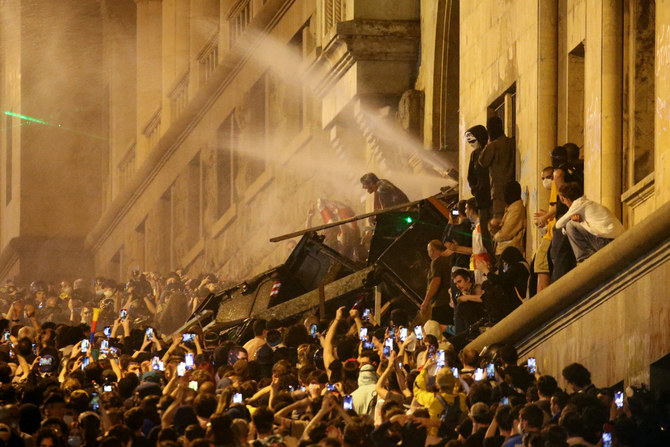

TBILISI: Georgia’s parliament on Wednesday approved the second reading of a bill on “foreign agents” that has been criticized as Kremlin-inspired, as police fired tear gas and stun grenades to clear a large crowd of protesters opposed to the draft law.
The bill, which would require organizations receiving more than 20 percent of their funding from abroad to register as agents of foreign influence, has sparked a rolling political crisis in the South Caucasus country.
Ever-growing numbers of protesters have been taking to the street nightly for almost a month, with a heaving crowd tens of thousands strong shutting down central Tbilisi on Wednesday, the largest anti-government demonstration yet.
Georgia’s Health Ministry, in a bulletin quoted by Georgian media, said 11 people, including six police officers, had received hospital treatment after Wednesday’s altercations.
Deputy Interior Minister Aleksandre Darakhvelidze, quoted by Georgian media, said protesters had tried to push their way into parliament using various objects and were attacking policemen.
Darakhvelidze said police action on Tuesday resulted in 63 arrests and six police officers injured.
President says to look to the election
Georgian President Salome Zourabichvili, who opposes the bill but has only largely ceremonial powers, told protesters in a video posted on social media to show restraint. The real task, she said, was to oust the government in an October election.
“Our fate will not be determined by this law,” she said in comments quoted by media. “This fight will take place in the forthcoming parliamentary election after which (this) law and many others will be rescinded.”
Georgian media cited the country’s Orthodox Church, one of its most respected institutions, as calling for the government and protesters to hold talks to resolve a “political crisis.”
Protester Sergi Kapanadze said that for him the protest movement amounted to a struggle for Georgia’s national survival.
“What are we afraid of more?” he told Reuters. “Being gassed, being beaten up, or losing the country?“
Georgian critics have dubbed the bill “the Russian law,” saying it is inspired by laws used to suppress dissent in Vladimir Putin’s Russia. Russia is unpopular among many citizens of Georgia, which lost a brief war with Moscow in 2008.
Both the head of the European Commission, Ursula von der Leyen, and the EU’s foreign policy chief, Josep Borrell, condemned the violence. The EU gave Georgia candidate member status in December but has said the bill could halt its integration into the bloc.
Police cleared the crowd by the parliament building using tear gas and stun grenades fired from within the fortress-like complex. Water cannon were also deployed.
Protesters regrouped, with some lighting a bonfire outside parliament, and others attempting to build makeshift barricades to block key roads. A Reuters eyewitness saw at least one man carried away from the action, his face bloodied.
The protests have pitched the ruling Georgian Dream party against a coalition of opposition parties, civil society groups, celebrities and the president.
Parliament, controlled by Georgian Dream and its allies, voted to advance the bill, prompting a boos from protesters outside. The bill must pass one more vote before becoming law.
Wednesday’s parliamentary debate was tense, with opposition members expelled and scuffles between legislators, a not uncommon occurrence in Georgia’s often-rowdy parliament.
One pro-government deputy was seen throwing a book at opposition legislators, while others shouted and physically confronted opponents.
Levan Khabeishvili, leader of the United National Movement party, Georgia’s largest opposition bloc, spoke in parliament with his face heavily bandaged. His party said he was beaten by police at the previous day’s protest, leaving him with concussion, broken facial bones, and missing four teeth.
The bill’s supporters, including Bidzina Ivanishvili, the billionaire founder of Georgian Dream and former prime minister, say the law would bolster sovereignty amid what he said were Western attempts to pit Georgia against Russia.


