

Pakistan’s Sindh to step up efforts against street crime after dozens killed in Karachi

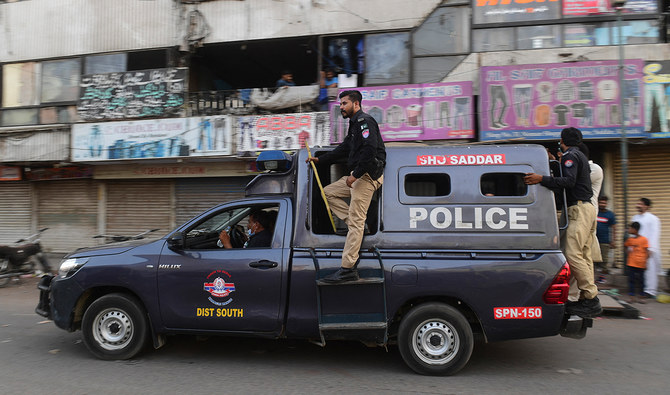
Police patrol in a market area after the authorities imposed an evening lockdown to curb the spread of the Covid-19 coronavirus in Karachi on May 24, 2021. (AFP/File)
Short Url
Updated 22 April 2024
Follow

Pakistan’s Sindh to step up efforts against street crime after dozens killed in Karachi

  • Karachi, the country’s commercial hub, has reported nearly one murder every other day since the start of this year
  • At least 18 killings, including that of an army major, occurred during muggings in the holy fasting month of Ramadan

KARACHI: The government in Pakistan’s southern Sindh province on Monday decided to intensify its efforts against rampant street crime, following the killing of dozens of people in muggings and other violent crimes in the provincial capital this year.

The decision was made at a law and order meeting held at the Chief Minister’s House, which was attended by members of the provincial cabinet, top bureaucrats, provincial and city police chiefs, Karachi Corps Commander Lt Gen Babar Iftikhar and Sindh Rangers Director-General Maj Gen Azhar Waqas.

The development comes after the killing of at least 57 people in Karachi, the country’s commercial hub and home to roughly 30 million people, averaging nearly one murder every other day since the start of this year, according to a tally collected from media reports.

At least 18 of the killings, including that of an army major who was assigned with the Coast Guard, occurred during the holy fasting month of Ramadan. The officer was shot by muggers on March 30 and died after being hospitalized for a week.

“Meeting has decided to take measures to monitor the sale of stolen or snatched mobile phones and vehicles as spare parts or in their complete form in the markets of Karachi,” read a statement issued from the CM House after the huddle.

Officials informed the participants that the police had 467 encounters with criminals this year, in which 67 suspects were killed, 489 were injured and 1,766 were arrested.

Additionally, the police were directed to revamp Madadgar-15 service for reporting crimes.

“The Home Minister announced that an additional 168 vehicles, including 120 motorbikes, would be deployed to enhance the police force’s capabilities,” the statement read.

“The Chief Minister instructed the Inspector General (IG) of police to initiate the E-tagging of repeat offenders.”


Pakistan says it is moving toward phased crypto regulation after Binance, HTX approvals

Updated 8 sec ago
Follow

Pakistan says it is moving toward phased crypto regulation after Binance, HTX approvals

  • The country is among the world’s largest crypto adoption markets, with nearly 40 million users
  • Bilal bin Saqib says the government is not promoting crypto but moving to regulate the sector

ISLAMABAD: Pakistan’s top virtual asset regulatory official said on Sunday the country was laying the foundation for a phased and tightly supervised crypto framework after granting conditional approvals to two global exchanges, signaling a shift from years of regulatory ambiguity toward formal oversight of digital assets.

The Pakistan Virtual Assets Regulatory Authority (PVARA) said this week it had issued no objection certificates (NOCs) to global crypto exchanges Binance and Huobi (HTX). Pakistan has also signed a memorandum of understanding with them to explore what the finance ministry described as the “tokenization” of up to $2 billion in sovereign bonds, treasury bills and commodity reserves, an initiative aimed at boosting liquidity and attracting investors.

“The no objection certificate given to Binance and Huobi is the first practical step of this new thinking,” PVARA chief Bilal bin Saqib said at a briefing. “Let me make it clear that this NOC is not a shortcut. This is not a blanket approval.”

He said the approvals marked the start of a risk-mitigated, phased and supervised entry framework, adding that platforms would be subject to strict anti-money laundering and counter-terrorism financing requirements, ownership transparency checks and enforcement-linked licensing timelines.

“This is not a new experiment,” he said, pointing to phased regulatory approaches adopted in financial centers such as Dubai, the United Kingdom and Singapore, where firms are first brought under supervision before being allowed to expand operations.

Pakistan is among the world’s largest crypto adoption markets, with estimates putting the number of users between 30 and 40 million, despite the absence of a comprehensive regulatory framework. Saqib said ignoring the sector was no longer viable, warning that unregulated adoption posed greater risks to the economy and consumers.

“We don’t want to promote crypto,” he said. “We want to regulate crypto. Adoption is already there.”

​He said the framework was designed to prepare Pakistan for longer-term developments in digital finance, including tokenized assets, compliance technology, blockchain analytics and digital payment infrastructure, while ensuring that local talent is channeled into regulated and productive use.

“For the international community, the message is clear,” Saqib said. “Pakistan is not running away from innovation. Pakistan is welcoming innovation. Pakistan is regulating innovation.”