

President Zardari directs Sindh to launch ‘large-scale operation’ against criminals in Karachi

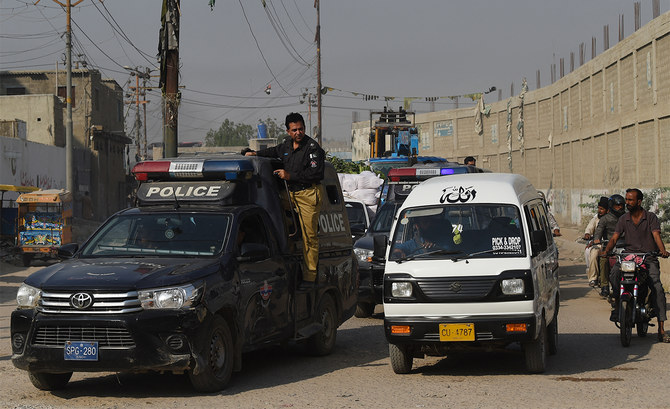
Policemen patrol along a street in Karachi on November 2, 2023. (AFP/File)
Short Url
Updated 01 May 2024
Follow

President Zardari directs Sindh to launch ‘large-scale operation’ against criminals in Karachi

  • President Zardari chairs high-level meeting attended by interior minister, provincial ministers in Karachi
  • Zardari asks chief ministers to provide security to foreign nationals in Sindh, curb street crimes in Karachi

KARACHI: President Asif Ali Zardari on Wednesday directed Sindh Chief Minister Syed Murad Ali Shah to launch a “large-scale operation” against criminals in Karachi and Sindh, amid a surge in street crimes and incidences of kidnapping in Pakistan’s southern province. 

The president issued these directions while he chaired a meeting on the deteriorating law-and-order situation in Sindh. The meeting was also attended by Interior Minister Mohsin Naqvi and Minister of Science and Technology Khalid Maqbool Siddiqui. Provincial ministers Sharjeel Inam Memon, Nasir Shah and Ziaul Hasan Linjar, Inspector General Police Sindh Ghulam Nabi Memon and others also participated in the huddle. 

Karachi, a metropolis of 20 million that hosts the stock exchange and central bank, has for decades been beset by armed violence. While an armed campaign by the military, with help from police, paramilitary Rangers and intelligence agencies, against armed gangs and suspected militants in the city brought down murder rates after 2013, street crimes have been on the rise again since last year, with shooting deaths in muggings and robberies once again becoming a daily headline. 

Street crimes saw an increase during the first four months of 2024, particularly during the Islamic holy month of Ramadan, driving fear into the hearts of the city’s citizens. 

“President of Pakistan Asif Ali Zardari presiding over a special law & order meeting at CM House directed the Sindh Chief Minister Syed Murad Ali Shah to launch a large-scale operation against street criminals in Karachi,” the Chief Minister’s House said. 


President Asif Ali Zardari (left) chairs a meeting special meeting on the law and order situation in Karachi, Pakistan on May 1, 2024. (CM House)

It added that the president ordered strict action be taken against dacoits in Sindh and drug traffickers throughout the province in close coordination with other provinces.

Zardari urged the chief minister to provide a posting tenure to police officers, monitor their performance, and remove them when they fail to deliver, the statement added. The president asked Shah to ensure foreign nationals living and working in Sindh were guaranteed security.

“He emphasized the need to particularly look after the Chinese nationals working on CPEC-related projects,” the CM House said. 

Memon briefed the president that in total 5,357 crimes were reported in Sindh during the first four months of the year, corresponding with 5,259 incidents in the corresponding period last year.

Zardari was told that in January, 252.32 street crime cases were reported in Karachi while in February the number decreased to 251.96. 

“The trend of street crime decreased in March and April when 243.35 and 166.2 cases were reported respectively,” the statement said.

The Sindh IG disclosed that 49 people were killed in 48 street crimes in Karachi this year, adding that in these cases 43 accused have been arrested while 13 were killed in encounters. 

President Zardari directed the chief minister to control street crimes in the province by launching a result-oriented special operation. 

“The operation must deliver results so that confidence of the citizens could be developed,” Zardari was quoted as saying by the CM House. 

President Zardari lamented that stolen/snatched vehicles and mobile phones were sold in the city’s market in parts, adding that this was known to police and others. 

“Why the police were not taking operations against the markets and people involved in the business of stolen/snatched vehicles and mobile sets,” he asked. 

The president directed Shah to ensure the Karachi Safe City Project, an initiative to install surveillance cameras in key parts of the city to monitor crime, was completed on a “war footing.”


Pakistan making diplomatic efforts to de-escalate Middle East tensions, FM says

Updated 4 sec ago
Follow

Pakistan making diplomatic efforts to de-escalate Middle East tensions, FM says

  • The statement came as Iran pressed on with a third day of strikes in the Gulf in response to US-Israeli air raids
  • Pakistan’s position is clear that all countries must abide by principles of UN Charter, international law, FM says

ISLAMABAD: Pakistan is making diplomatic efforts to de-escalate heightened tensions in the Middle East, Foreign Minister Ishaq Dar said on Monday, amid US-Israeli strikes on Iran and Tehran’s counterstrikes against US bases in Gulf countries.

Tensions escalated across the Middle East on Saturday after coordinated US-Israel strikes killed Supreme Leader Ali Khamenei among other senior Iranian officials. Tehran responded by targeting US military bases in the UAE, Bahrain, Qatar, Kuwait and Jordan. Saudi Arabia said Iran also launched attacks targeting Riyadh and the Eastern Province.

The Iranian missile and drone strikes continued on Monday in retaliation for the ongoing US-Israeli air raids, casting uncertainty over the future of the Islamic republic and heightening the risk of broader instability in the already volatile region.

Speaking at a press conference, FM Dar, who recently returned from Saudi Arabia where he attended an Organization of Islamic Cooperation OIC) meeting on Palestine, said Pakistan is very closely monitoring the evolving situation in Iran and the tensions which are building up in the region.

“These serious developments have taken place at a time when diplomatic efforts were underway to reach a peaceful and negotiated solution to [Iran nuclear program],” he said.

“We are making our full diplomatic efforts and, you know, requesting all parties to de-escalate and to refrain.”

Dar said Islamabad was concerned over a violation of the norms and international law, and the age-old tradition that the heads of state and the government should not be targeted.

“Post-World War II, we all know that these institutions were created to create some international, you know, law and order, and that’s why there was a UN Charter. There are certain conventions which we all are supposed to follow,” he said.

“But things are on ground moving very differently, which obviously is worrisome... The international law must prevail and the conventions must be respected.”

The statement came hours after the Ras Tanura oil refinery in Saudi Arabia sustained limited damage as a result of debris from the interception of two drones in its vicinity, the Saudi Press Agency reported, citing an official source at the Saudi Ministry of Energy.

Several American warplanes crashed in Kuwait on Monday morning but their crew survived, Kuwait’s defense ministry said, as Iran pressed on with a third day of strikes in the Gulf.

Dar said Pakistan’s position has been clear and persistent that all countries must abide by the principles of UN Charter and international law, including respect for the sovereignty and territorial integrity of other states as well as international humanitarian law.

“In my latest conversation with [Iranian] Foreign Minister Abbas Araqshi on 28th of February, I conveyed Pakistan’s condemnation of the attacks and called for restraint and diplomacy and dialogue, which he positively responded,” he shared.

“But on ground, we are seeing that things are not yet settling or easing out.”

Pakistan stands in full solidarity with all its brotherly countries and underscores the need to exercise maximum restraint, according to FM Dar.

“This is a message we have been giving to whosoever prime minister speaks, whosoever I speak, or whosoever Field Marshal Asim Munir speaks to, his counterparts on the defense side,” he said.