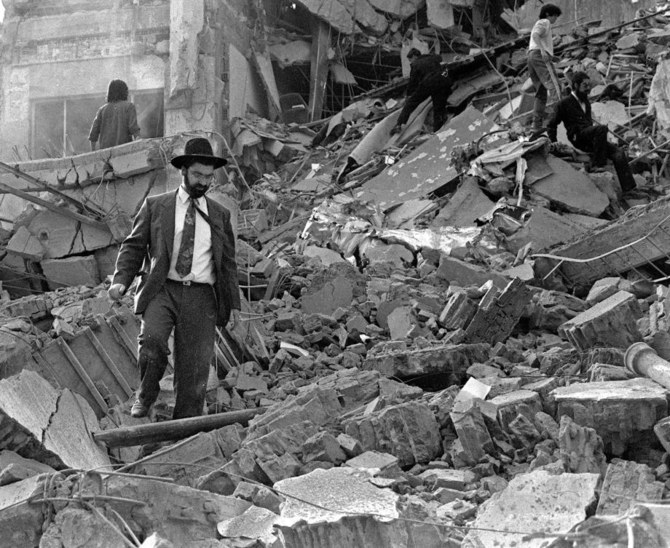
BUENOS AIRES, Argentina: A federal judge in Argentina has called on Interpol to detain four Lebanese citizens, so they can be questioned for their suspected role in the 1994 bombing of the AMIA Jewish community center that killed 85 people.
“Regarding these individuals, there are well-founded suspicions that they are collaborators or operational agents of the … armed wing of Hezbollah,” judge Daniel Rafecas wrote in a resolution dated June 13 that the Associated Press obtained Thursday.
Argentine prosecutors have long alleged that Iranian officials used the Lebanon-based militant group Hezbollah to carry out the deadly attack. Iran has long denied any involvement in the incident.
Both the United States and Argentina have designated Hezbollah as a terrorist organization.
Most of the Lebanese citizens now being sought by Rafecas have ties to the porous tri-border region that connects Argentina, Brazil and Paraguay and that the United States has long said is a hub for terrorism financing.
Rafecas has called for the detention of Hussein Mounir Mouzannar, who has a Paraguayan national ID and could be living either in Paraguay or Brazil, as well as Farouk Abdul Hay Omairi, a naturalized Brazilian citizen whose last known address was on the Brazilian side of the tri-border region.
The other two people who are sought for questioning are Ali Hussein Abdallah, a naturalized Brazilian citizen who has both Brazilian and Paraguayan passports, and Abdallah Salman, who is believed to be living in Beirut.

Argentine judge calls for detention of four Lebanese citizens in AMIA bombing probe
https://arab.news/p34tj
Argentine judge calls for detention of four Lebanese citizens in AMIA bombing probe
- “Regarding these individuals, there are well-founded suspicions that they are collaborators or operational agents of the … armed wing of Hezbollah,” judge Daniel Rafecas wrote
- Argentine prosecutors have long alleged that Iranian officials used the Lebanon-based militant group Hezbollah to carry out the deadly attack
Ethiopia accuses Eritrea of arming rebels in escalating war of words
- The charge by Ethiopia’s federal police escalates a feud between Ethiopia and Eritrea
- The two countries fought a three-year border war that broke out in 1998
ADDIS ABABA: Ethiopian police said they had seized thousands of rounds of ammunition sent by Eritrea to rebels in Ethiopia’s Amhara region, an allegation Eritrea dismissed as a falsehood intended to justify starting a war.
The charge by Ethiopia’s federal police escalates a feud between Ethiopia and Eritrea, longstanding foes who reached a peace deal in 2018 that has since given way to renewed threats and acrimony.
The police said in a statement late on Wednesday they had seized 56,000 rounds of ammunition and arrested two suspects this week in the Amhara region, where Fano rebels have waged an insurgency since 2023.
“The preliminary investigation conducted on the two suspects who were caught red-handed has confirmed that the ammunition was sent by the Shabiya government,” the statement said, using a term for Eritrea’s ruling party.
Eritrea’s Information Minister Yemane Gebremeskel told Reuters that Ethiopian Prime Minister Abiy Ahmed’s Prosperity Party (PP) was looking for a pretext to attack.
“The PP regime is floating false flags to justify the war that it has been itching to unleash for two long years,” he said.
In an interview earlier this week with state-run media, Eritrean President Isaias Afwerki said the Prosperity Party had declared war on his country. He said Eritrea did not want war, but added: “We know how to defend our nation.”
The two countries fought a three-year border war that broke out in 1998, five years after Eritrea won its independence from Ethiopia. They signed a historic agreement to normalize relations in 2018 that won Ethiopia’s Abiy the Nobel Peace Prize the following year. Eritrean troops then fought in support of Ethiopia’s army during a 2020-22 civil war in Ethiopia’s northern Tigray region.
But relations soured after Asmara was frozen out of the peace deal that ended that conflict. Since then, Eritrea has bristled at repeated public declarations by Abiy that landlocked Ethiopia has a right to sea access — comments many in Eritrea, which lies on the Red Sea, view as an implicit threat of military action.
Abiy has said Ethiopia does not seek conflict with Eritrea and wants to address the issue of sea access through dialogue.


