

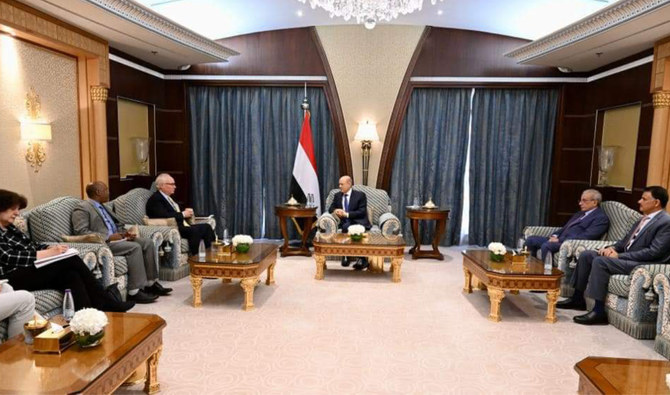

AL-MUKALLA, Yemen: Rashad Al-Alimi, chairman of Yemen’s Presidential Leadership Council, called on Wednesday for joint international efforts, primarily from the US, to pressure the Iran-backed Houthis to stop attacking oil facilities, which has cost the Yemeni government billions of riyals in oil revenues.
During a meeting with US Yemen Envoy Tim Lenderking in Riyadh, Al-Alimi said the Houthi attacks on oil facilities, ban on goods from government-controlled areas entering their territories, and harassment of the banking sector threatened to exacerbate the humanitarian crisis and prevent the government from paying its employees.
“He informed him of the need for the international community, and the US in particular, to assume their responsibilities in the face of these attacks, which threaten (to provoke) an extensive humanitarian crisis, including the potential inability to pay employees’ salaries beginning this month,” a Yemeni government official, who preferred anonymity, told Arab News.
Similarly, Sultan Al-Arada, a presidential council member, said that the Yemeni government would review its facilities for commercial flights from Sanaa airport, as well as the arrival of ships at Hodeidah port, if the Houthis continued their attacks on oil facilities and their ban on goods and cooking gas from government-controlled areas.
“All procedures relating to the port of Hodeidah and Sanaa airport will be examined if militias continue to use them for military objectives at the expense of people’s suffering,” Al-Arada said.
The Houthis have prohibited traders in regions under their control from importing products through Aden port or other government-controlled ports, forcing them to import commodities only through Hodeidah port.
They have also barred products from entering their territories from government areas via land and have recently barred hundreds of cooking gas truck tankers from entering their territories from the central city of Marib.
The Yemeni government termed the Houthi actions as a war intended to drain the government of money and force it to surrender and share oil earnings with the militia, as well as pay public employees in areas under their control.
Meanwhile, Ahmed bin Ahmed Ghaleb, the governor of Yemen’s central bank, said the Yemeni government lost billions of riyals in revenue as a result of the intensifying economic measures taken by the Houthis against the government, including the suspension of crude exports.
In an interview with the country’s national television, Ghaleb said the government lost $1 billion from oil export suspension and more than 700 billion riyals ($2.80 billion) from taxes and customs since the start of the UN-brokered ceasefire in April last year when traders abandoned government ports in favor of the Houthi-controlled ports.
“We lost a lot of resources. We have lost tax and customs resources as a result of the truce,” he said, citing losses amounting to 700 billion riyals, or 50 billion riyals per month, a sum he said is equal to the salaries of the army and security forces.
“We lost $1 billion of our oil exports. And now, because the Houthis have prevented accessing gas from areas they still control, we are losing revenue from gas sales,” Ghaleb said, noting that only 30 percent of the government's current expenses were covered by its resources.
Despite diminishing resources, the central bank governor said the bank has maintained “good” foreign currency reserves both within and outside the country, including investment portfolios in Swiss institutions and gold at the US Federal Reserve.
“The central bank has more reserves than you can imagine. The central bank has enough reserves to carry out its functions to maintain prices and the currency. We have deposits. We have investment portfolios.” he said.


