UN says insurance coverage secured to salvage rusting oil tanker off Yemen

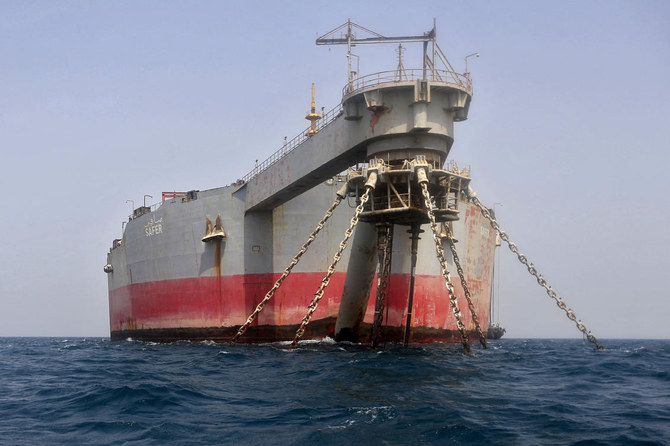
Beleaguered FSO Safer oil tanker in the Red Sea, off the coast of Yemen's rebel-held Ras Issa port in the western Hodeida province, during operations to remove more than a million barrels of oil from the tanker vessel. (AFP)
Short Url
Updated 13 June 2023
Follow

UN says insurance coverage secured to salvage rusting oil tanker off Yemen

  • UNDP described the insurance as ‘a pivotal milestone’ in a yearslong effort to evacuate the cargo of FSO Safer

CAIRO: The United Nations has secured an insurance coverage to start a ship-to-ship transfer of 1.1 barrels of crude from a rusting tanker moored off the coast of war-torn Yemen — oil that could cause a major environmental disaster.
The United Nations Development Program described the insurance is “a pivotal milestone” in a yearslong effort to evacuate the cargo of the FSO Safer, which is at risk of rupture or exploding.
The UNDP has been trying to start a salvage operation to avert what it says could amount to “one of the world’s largest, man-made disasters in history.” It secured tens of millions of dollars in pledges for the operation, which started late in May with experts pumping inert gas to remove atmospheric oxygen from the oil chambers of the vessel.
“Insurance became a critical element of enabling this salvage operation to proceed. Without it, the mission could not go forward,” said Achim Steiner, a UNDP administrator.
Transferring the stored oil is expected to start later this month, according to David Gressly, the UN humanitarian coordinator for Yemen. After completing the transfer of oil, Safer would eventually be towed away and scrapped, he has said.
“Work is progressing well,” Gressly told the Yemen International Forum on Monday at The Hague.
The tanker was built in Japan in 1980, and the Yemeni government purchased it in 1980s to store up to 3 million barrels of oil pumped from fields in Marib, a province in the Arabian Peninsula country’s east.
Yemen, the Arab world’s most impoverished country, has been engulfed in civil war since 2014, when the Iran-backed Houthi militia seized the capital, Sanaa, and much of the country’s north, forcing the government to flee to the south.
The following year, a Saudi-led coalition entered the war to fight the Houthis and try to restore the internationally recognized government to power.
The Safer is 360 meters (1,181 feet) long with 34 storage tanks. It has not been maintained since 2015, and in recent years, seawater entered its engine compartment, causing damage to pipes and increasing the risk of sinking.
Rust has covered parts of the tanker and the inert gas that prevents the tanks from gathering inflammable gases has leaked out.


Iran says can fight intense war for months

Updated 3 sec ago
Follow

Iran says can fight intense war for months

  • Iran’s security chief accuses Trump administration of seeking to replicate a scenario similar to Venezuela
  • Analysts warn there is still no clear path to ending a conflict that could last a month or longer
TEHRAN: Iran’s Revolutionary Guards said Sunday that the country’s forces could fight an intense war for six months against the United States and Israel.
Israeli Prime Minister Benjamin Netanyahu has vowed to press on with the war against Iran “with all our force,” with a plan to eradicate the country’s leadership after joint US-Israeli raids killed supreme leader Ayatollah Ali Khamenei last week, sparking the regional conflict.
Despite the threat, the Revolutionary Guards said Sunday that the Islamic republic’s forces could wage an “intense war” for six months at the current speed of fighting.
Guards spokesman Ali Mohammad Naini said Iran had so far used “first and second generation” missiles, but will use “advanced and less-used long-range missiles” in the coming days.
‘Trapped’
The widening reach of the war and Iran’s ability to inflict damage and harm were underscored by US President Donald Trump attending the return of six American service members killed in a drone strike on a US base in Kuwait last Sunday.
Iran’s security chief Ali Larijani accused the Trump administration of seeking to replicate a scenario similar to Venezuela where it ousted leader Nicolas Maduro.
“Their perception was that it would be like Venezuela — they would strike, take control and it would be over — but now they are trapped,” he said in a pre-recorded interview broadcast on state TV on Saturday.
Iran’s hardline judiciary chief Gholamhossein Mohseni Ejei also warned Middle East neighbors which are “openly and covertly at the disposal of the enemy” that “the heavy attacks on these targets will continue.”
Iranian President Masoud Pezeshkian said Sunday that Tehran “will be forced to respond” if a neighboring country were to be used as a launchpad for any attack or invasion attempt.
Tehran had vowed to go after US assets in the region, and Saudi Arabia, Qatar, the United Arab Emirates and Kuwait on Sunday all reported new attacks.
No clear way out
Analysts warn there is still no clear path to ending a conflict that US and Israeli officials say could last a month or longer.
Trump has suggested Iran’s economy could be rebuilt if a leader “acceptable” to Washington replaces the late supreme leader, which Tehran has rejected.
China and Russia have largely stayed on the sidelines despite close ties with Tehran.
China’s top diplomat Wang Yi said on Sunday that the war in the Middle East should “never have happened.”
“This is a war that should never have happened,” he told a press conference in Beijing, adding that “a strong fist does not mean strong reason. The world cannot return to the law of the jungle.”