Aden authorities seize hidden drone components intended for Houthis

1 / 2
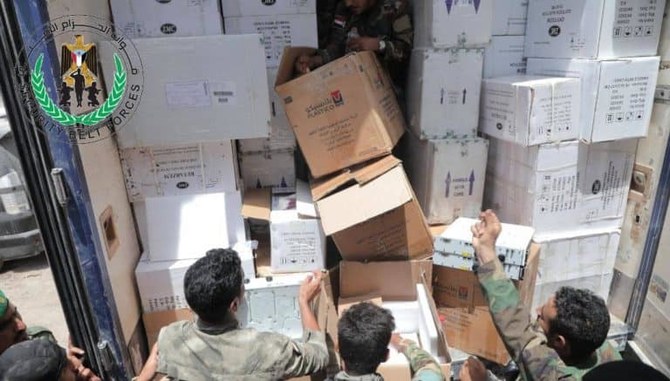
Aden security forces seized ‘modern’ communication equipment that guided drones and were hidden inside medical equipment. (Security Belt Forces Facebook page)
2 / 2
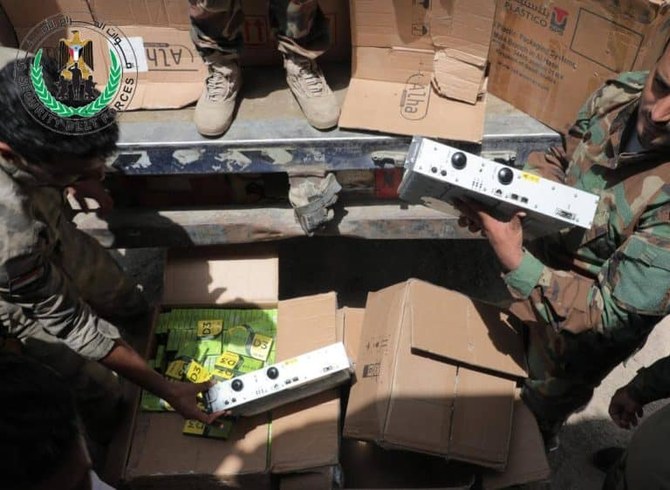
Aden security forces seized ‘modern’ communication equipment that guided drones and were hidden inside medical equipment. (Security Belt Forces Facebook page)
Short Url
Updated 12 June 2023
Follow

Aden authorities seize hidden drone components intended for Houthis

  • Yemeni observers believe that flow of weapons to Houthis suggests militia is preparing for operations
  • The seizure of drone-related material comes nearly a week after another security force in neighboring Lahj province seized a shipment of drone components

AL-MUKALLA: Security forces in Yemen’s southern port city of Aden, the interim capital of Yemen, have seized a new consignment of drone components intended for the Iran-backed Houthis.
Security Belt Forces in Aden said in a statement that their forces recovered a number of sealed boxes containing telecommunication equipment meant to guide drones hidden in a truck in Aden’s Al-Mansoura district traveling to Houthi-controlled regions.
The cartons were disguised as medical supplies, according to security commander Jalal Al-Rubai, and the detained men admitted to loading the boxes from a warehouse for a local medical company in Aden.
The seizure of drone-related material comes nearly a week after another security force in neighboring Lahj province seized a shipment of drone components — including motors, batteries and cameras — in a van that was hidden beneath toys and covered with motorcycles.
Yemeni observers believe that the continued flow of weapons, including drones, to the Houthis indicates that the militia is preparing for military operations across the country, even as international mediators press them and the Yemeni government to renew the UN-brokered truce and reach a peace agreement to end the war.
Meanwhile, Yemeni military officials said that the Houthis launched a number of explosive-equipped and reconnaissance drones at government-controlled regions in Marib, Taiz, Lahj, and Shabwa.
Abdul Basit Al-Baher, a Yemeni military officer in Taiz, told Arab News on Monday that an explosive-laden drone fired by the Houthis shelled army positions on Han Mountain and also hit villages in Al-Dhabab, west of Taiz, on Sunday and that the Houthis have recently intensified drone and ground attacks on government troops as they repositioned new forces outside the besieged city of Taiz.
“Houthi actions demonstrate that they are not advancing toward peace but rather preparing for a more aggressive escalation,” Al-Baher said.
To counter the influx of weaponry to the Houthis through government territories, Al-Baher suggested that various military and security forces from provinces led by the government should be unified under a single command.
“Military and security formations should be merged to prevent the security lapses that permitted the Houthis to smuggle weapons into the country,” he said.


Trump tells Iranians ‘help on its way’

Updated 4 sec ago
Follow

Trump tells Iranians ‘help on its way’

  • US president says Iranians should 'keep protesting' and that he canceled all meetings with Iranian officials
  • Successive nights of mass protests nationwide may have killed thousands, NGO says
PARIS: US President Donald Trump urged Iranians on Tuesday to keep protesting against the country’s theocratic leadership, telling them “help is on its way” as international outrage grows over a crackdown one rights group said has likely killed thousands.
Iranian authorities insisted they had regained control after successive nights of mass protests nationwide since Thursday that have posed one of the biggest challenges to the clerical leadership since the 1979 Islamic revolution that ousted the shah.
Rights groups accuse the government of fatally shooting protesters and masking the scale of the crackdown with an Internet blackout that has now lasted almost five days.
New videos on social media, whose location AFP verified, showed bodies lined up in the Kahrizak morgue just south of the Iranian capital, with the corpses wrapped in black bags and distraught relatives searching for loved ones.
International phone links were restored on Tuesday, but only for outgoing calls, according to an AFP journalist, and the quality remains spotty, with frequent interruptions.
Trump, who has repeatedly threatened Iran with military intervention, said Iranians should continue their nationwide protests, take over institutions and record the names of “killers and abusers.”
“Iranian Patriots, KEEP PROTESTING,” Trump wrote on his Truth Social platform. “I have canceled all meetings with Iranian Officials until the senseless killing of protesters STOPS. HELP IS ON ITS WAY.”
It was not immediately clear what meetings he was referring to or what the nature of the help would be.
European nations also signalled their anger, with France, Germany and the United Kingdom among the countries that summoned their Iranian ambassadors to protest what French Foreign Minister Jean-Noel Barrot called “state violence unquestioningly unleashed on peaceful protesters.”
“The rising number of casualties in Iran is horrifying,” said EU chief Ursula von der Leyen, vowing further sanctions against those responsible.

- ‘In the thousands’ -

The Norway-based NGO Iran Human Rights (IHR) said it had confirmed 734 people killed during the protests, including nine minors, but warned the death toll was likely far higher.
“The figures we publish are based on information received from fewer than half of the country’s provinces and fewer than 10 percent of Iran’s hospitals. The real number of those killed is likely in the thousands,” the director of Norway-based NGO Iran Human Rights (IHR) Mahmood Amiry-Moghaddam said.
Fears have also grown that the Islamic republic could use the death penalty to crack down on the protests after Tehran prosecutors said Iranian authorities will press capital charges of “moharebeh,” or “waging war against God,” against some suspects arrested over recent demonstrations.
“Concerns are mounting that authorities will once again resort to swift trials and arbitrary executions to crush and deter dissent,” Amnesty International said.
IHR highlighted the case of Erfan Soltani, 26, who was arrested last week in the Tehran satellite city of Karaj and who, according to a family source, has already been sentenced to death and is due to be executed as early as Wednesday.
Iranian state media has said dozens of members of the security forces have been killed, with their funerals turning into large pro-government rallies. Authorities have declared three days of national mourning for those killed.
Amir, an Iraqi computer scientist, returned to Baghdad on Monday and described dramatic scenes in Tehran.
“On Thursday night, my friends and I saw protesters in Tehran’s Sarsabz neighborhood amid a heavy military presence. The police were firing rubber bullets,” he told AFP in Iraq.

‘Last days’

The government on Monday sought to regain control of the streets with mass nationwide rallies that supreme leader Ayatollah Ali Khamenei hailed as proof that the protest movement was defeated, calling them a “warning” to the United States.
In power since 1989 and now 86, Khamenei has faced significant challenges, most recently the 12-day war in June against Israel, which resulted in the killing of top security officials and forced him to go into hiding.
“When a regime can only hold on to power through violence, then it is effectively finished,” said German Chancellor Friedrich Merz during a trip to India. “I believe that we are now witnessing the last days and weeks of this regime.”
Analysts, however, have cautioned that it is premature to predict the immediate demise of the theocratic system, pointing to the repressive levers the leadership has, including the Revolutionary Guards Corps (IRGC), which are charged with safeguarding the Islamic revolution.
“These protests arguably represent the most serious challenge to the Islamic republic in years, both in scale and in their increasingly explicit political demands,” Nicole Grajewski, professor at the Sciences Po Center for International Studies in Paris, told AFP.
She said it was unclear if the protests would unseat the leadership, pointing to “the sheer depth and resilience of Iran’s repressive apparatus.”