

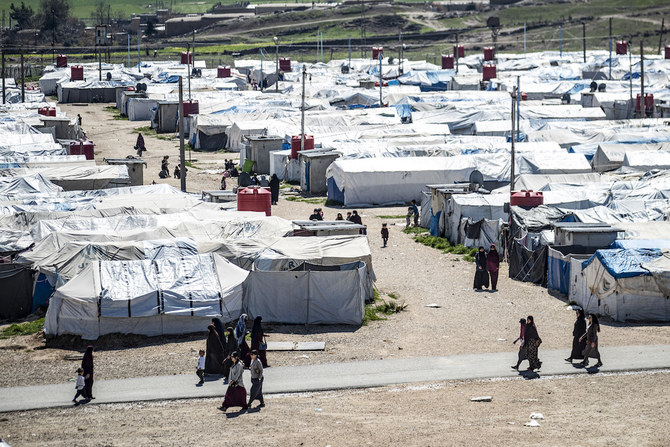

LONDON: An Australian child stuck in a Syrian detention camp has written to Prime Minister Anthony Albanese, pleading to be brought home, the Guardian reported on Thursday.
The child, who is less than 10 years old, told Albanese “please don’t leave me behind,” after the government rescued a second group of Australians from the camps more than seven months ago and promised to repatriate others left behind.
Around 40 Australians, including 10 women and 30 children, remain detained inside the Roj camp in north-east Syria, the Guardian reported. They are the wives, widows and children of dead or jailed Daesh fighters. Most have been in the camp for more than four years.
Some of the children born in the camp have never left. Many of the women claim their husbands coerced or manipulated them into traveling to Syria.
“I am one of the children left behind in Roj camp and I have spent half my life in a tent closed off by gates like a prison. “I have never been to school, laid in grass or climbed a tree,” the child said to the prime minister.
“When my friends left, I thought I was going to go to Australia too. I had so much hope and was looking forward to Australia saving me from this place. But it’s been seven months, we are still here.”
A UN expert panel has repeatedly expressed “deep concerns about the deteriorating security and humanitarian conditions of detention in Roj camp”. It has warned that boys separated from their families are at risk of being “forcibly disappeared, and subject to sale, exploitation, abuse (and) torture.”
In the message, the child said: “I am very sick. I took lots of needles. There is no hospital here to help us. I am always scared that the soldiers will walk into our tent and take me or my sisters or my mum.”
The child pleaded not to be left in Syria. “I just want to feel safe, live in a house and be a normal kid. Please, can you save me like you save the other Australian children that you took back. Please don’t leave me behind.”
Australia has carried out two repatriation operations from Syrian camps.
In 2019, eight orphaned children including a pregnant teenager were returned to New South Wales. In October, four women and 13 children were also rescued from Roj.
That rescue mission was politically controversial, with Australian opposition leader Peter Dutton saying he had “grave concerns” that those repatriated posed a “significant risk … that can’t be mitigated”.
Mat Tinkler, chief executive of Save the Children Australia, said that the Roj camp was “one of the worst places in the world to be a child.”
“They have untreated shrapnel wounds from conflict, medical conditions that could be treated but they can’t access sufficient care, severe dental decay meaning they are malnourished, and psycho-social illnesses: these kids are in a really fragile state, and we hold grave concerns that some may not survive,” Tinkler said.
“These are innocent kids, these are Australian citizens, and they have an entitlement to return to their home country. If we don’t make the decision to bring them home to safety, inevitably a child will be injured or killed as a result.”



