

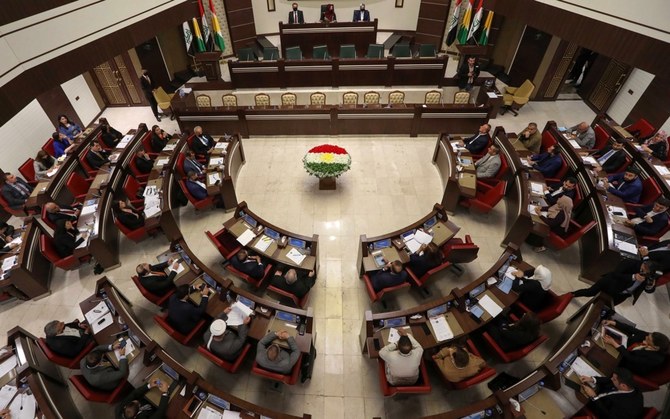
Iraq’s Kurd regional government opposes changes in budget

KRG said it would not abide by any other decision outside the agreement signed with Al-Sudani’s government. (AFP/File)
Short Url
Updated 26 May 2023
Follow

Iraq’s Kurd regional government opposes changes in budget

DUBAI: Iraq’s semi-autonomous Kurdistan regional government said on Friday it opposed changes in the draft Iraqi federal budget that infringe on the rights of the Kurdish people.

The Kurdistan Regional Government’s opposition poses a challenge to the prime minister of Iraq’s federal government, Mohammed Al-Sudani, in adopting a three-year budget, a flagship policy of his government that came to power late last year backed by a coalition of Shiite, Sunni and Kurdish parties.

KRG said it would not abide by any other decision outside the agreement signed with Al-Sudani’s government, which appeared to be a reference to a deal between the two governments setting a framework for the resumption of oil flows from the northern Iraqi region via Turkiye.

Before Al-Sudani formed his government, he struck a deal with the powerful Kurdish Democratic Party, which dominates the administration in Irbil, capital of the semi-autonomous region in northern Iraq. The agreement included ending a long-running dispute over budget transfers to Irbil and oil revenue sharing between the national government and Kurdistan, according to three Kurdish officials.

Under the Iraqi constitution, the Kurdish region is entitled to a portion of the national budget. But the arrangement collapsed in 2014 when the Kurds began selling crude independently from Kurdistan.

In 2017, Iraqi forces retook disputed territories including the oil city of Kirkuk. Baghdad resumed some budget payments, but they have been sporadic.

KRG called the changes in the draft budget, introduced by members of the parliament’s finance committee, unconstitutional and “inconsistent with the agreement signed between the regional government and the federal government.”

In March, Al-Sudani’s Cabinet approved the 2023 draft budget of 197.828 trillion Iraqi dinars ($135.6 billion) that would be referred to parliament for approval.
Volatile security blocks UN from Syria Daesh-linked camp

Updated 6 sec ago
Follow

Volatile security blocks UN from Syria Daesh-linked camp

  • Schmitt said: “UNHCR was able to reach Al-Hol for the past three days but has not yet been able to enter inside the camp due to the volatile security situation“
  • A former employee said most associations withdrew on Tuesday “due to the deteriorating security situation“

RAQQA, Syria: Poor security at a camp in Syria housing thousands of suspected relatives of Daesh group militants has prevented UN agency staff from entering, days after Kurdish forces withdrew and the army deployed at the site.
Two former employees at the Al-Hol desert camp told AFP on Friday that some of its residents had escaped during an hours-long security vacuum.
Thousands of suspected militants and their families, including foreigners, have been held in prisons and camps in northeast Syria since 2019, when the Kurdish-led Syrian Democratic Forces (SDF) defeated Daesh with the support of a US-led coalition.
This year, the SDF had to relinquish to Syrian government control swathes of territory they had seized during their fight against Daesh, and on Tuesday withdrew from Al-Hol.
In Raqqa province, Kurdish forces who formerly controlled a prison housing Daesh detainees were bussed out on Friday under a deal with the government, as a four-day truce neared expiry.

- Returning today -

Celine Schmitt, the UN refugee agency’s spokesperson in Syria, told AFP that “UNHCR was able to reach Al-Hol for the past three days but has not yet been able to enter inside the camp due to the volatile security situation.”
“UNHCR is returning to Al-Hol today, with the hope of resuming the bread delivery that had stopped for the past three days,” she said.
On Sunday, Syrian President Ahmed Al-Sharaa announced a deal with SDF chief Mazloum Abdi that included a ceasefire and the integration of the Kurds’ administration into the state, which will take responsibility for Daesh prisoners.
A former employee of a local humanitarian organization that operated in Al-Hol told AFP on condition of anonymity that most associations withdrew on Tuesday “due to the deteriorating security situation.”
Some camp residents fled during the “security vacuum” between when the SDF withdrew and the army took control, they said, without providing a number.
A former employee at another organization working there said “escapes were reported, but the exact number is unknown.”
“The camp is fenced, but without security, anyone can easily cross it and flee,” they said, also requesting anonymity.
Both ex-employees said camp residents torched centers belonging to aid organizations operating in the camp, where humanitarian conditions are dire.
Before the turmoil, the camp housed some 23,000 people — mostly Syrians but also including around 2,200 Iraqis and 6,200 other foreign women and children of various nationalities, the camp’s former administration told AFP.
Roj, a smaller camp in the northeast still under Kurdish control, holds some 2,300 people, mostly foreigners.
The Kurds and the United States have repeatedly urged countries to repatriate their citizens but foreign governments have generally allowed home only a trickle.

- Al-Aqtan prison -

The SDF has withdrawn to parts of Hasakah province, its stronghold in northeast Syria.
A fresh four-day ceasefire was announced on Tuesday, while the following day the United States said it had launched an operation that could see 7,000 Daesh militant detainees moved from Syria to Iraq, with 150 transferred so far.
US envoy Tom Barrack, who has said the purpose of Washington’s alliance with SDF has now largely expired, held talks this week with Abdi and senior Kurdish official Elham Ahmad.
On Friday, Syria transferred Kurdish fighters away from the Al-Aqtan prison on the outskirts of Raqqa city.
An AFP correspondent in Raqqa saw buses and cars heading away from the Al-Aqtan prison, escorted by government vehicles.
Syrian state television reported the transfer came “after five days of negotiations” and that the fighters would go to the Kurdish-held city of Ain Al-Arab, also known as Kobani, on the northern border with Turkiye.
The SDF later said that with coalition support, all the fighters had been transferred “to safe locations,” while the interior ministry said authorities had taken control of the facility.
A government source told state television that around 800 SDF fighters were to leave, while Daesh detainees would be managed “according to Syrian law.”
The army said the Al-Aqtan transfer was “the first step in implementing the January 18 agreement.”