

Constable who shot school van in Swat confesses to crime, says ‘devil made him do it’

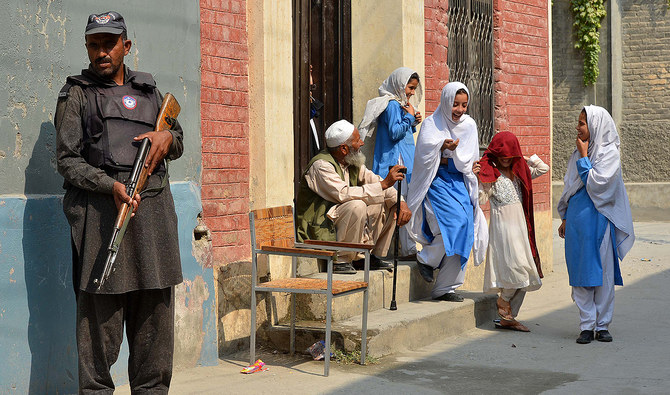
In this file picture, taken on October 9, 2013, a Pakistani security official stands guard as girls leave a school in Mingora, a town in Swat valley. (Photo courtesy: AFP/File)
Short Url
Updated 20 May 2023
Follow

Constable who shot school van in Swat confesses to crime, says ‘devil made him do it’

  • A five-year-old girl was killed in the shooting incident while seven others were injured
  • Relatives of deceased playgroup student say they are seeking justice for everyone

SWAT: A police constable, who was arrested for using firearm to target a school van in an incident that killed a five-year-old girl and injured seven others in scenic town in Pakistan’s northwest on Tuesday, confessed to his crime and said “devil made him do it,” police officials confirmed on Friday.

The incident took place in Swat which was once a stronghold of the Pakistani Taliban, formally called the Tehreek-e-Taliban Pakistan (TTP), before security forces launched a military operation in 2009 to reclaim the area. Pakistani Nobel laureate Malala Yousafzai also survived an assassination attempt in the same valley after she was shot in the head by a TTP militant in 2012.

The police constable, identified as Alam Khan, was deployed to provide security to a public school before the shooting incident. The provincial administration of Khyber Pakhtunkhwa (KP), where Swat is located, constituted an inquiry committee to investigate Khan’s motives and run a background check on him to see if he had links with any banned militant outfits.

“Constable Alam Khan has confessed to the crime twice, once during the initial police investigation and the second time when he was brought before a judicial magistrate,” Swat’s district police officer (DPO) Shafiullah Gandapur told Arab News.

“He told the judicial magistrate and the police that some evil thoughts had crept into his mind and it was devil who made him do it.”

Gandapur added the inquiry committee constituted by the KP government visited Swat to probe the case during this week.

“The committee has almost completed its investigation and the draft of its findings will soon be submitted to the Khyber Pakhtunkhwa administration,” he said.

The DPO informed Khan would also undergo a psychological evaluation.

“This is a high-profile case and we want to investigate it fairly and transparently,” he added.

Meanwhile, the family of Ayesha Abid, who lost her life in the shooting incident, expressed shock at the senseless act of violence.

“On that day, my niece was making excuses since she did not want to go to the school, but her mother forcibly sent her,” Hayat Ali, Abid’s uncle, told Arab News.

He informed the five-year-old had been enrolled in playgroup at the Sangota Public School only a few months ago.

“She was alive while she was taken to hospital,” he added. “[I cannot imagine what] pain she was going through while she was on her way to the Saidu Teaching Hospital.”

“We don’t want justice only for ourselves but for everyone,” Ali said. “We have lost our child, and she will not return even if [the police] kill the person who is in their custody.”

The KP government ordered the police to carry out psychological evaluation of all law enforcement personnel on security duties following the incident, adding the procedure must be repeated twice a year.

Gun violence targeting children is rare in Pakistan.

However, nearly 150 people, mostly students, were killed in 2014 when TTP militants attacked a school in Peshawar, the capital of KP province.

Since then, the authorities have deployed police at schools across the country, especially in the volatile northwest where the Pakistani Taliban have stepped up attacks on security forces in recent months.


Pakistan welcomes Afghan scholars’ reported resolution against use of soil for cross-border attacks

Updated 5 sec ago
Follow

Pakistan welcomes Afghan scholars’ reported resolution against use of soil for cross-border attacks

  • Around 1,000 Afghan scholars passed a resolution this week prohibiting use of Afghan soil for cross-border attacks against another country, Afghan media reported
  • Development takes place as tensions persist between Pakistan and Afghanistan amid Islamabad’s allegations of Taliban supporting cross-border attacks against it 

ISLAMABAD: Pakistan’s foreign office spokesperson on Thursday welcomed a resolution reportedly passed by Afghan scholars against allowing the use of Afghan soil for attacks against any other country, but still demanded written assurances of the same from the Afghan leadership. 

According to a report published by Afghan news channel Tolo News, around 1,000 Afghan scholars gathered in Kabul on Wednesday to pass a resolution that, among other things, said no one will be allowed to use Afghanistan’s soil against other countries for attacks. The resolution also said that if anyone fails to comply with this decision, the Afghan government has the right to take action against them.

The development takes place as tensions persist between Afghanistan and Pakistan. Both countries have engaged in border clashes since October, with Islamabad accusing Kabul of harboring militants that launch attacks on Pakistan.

Afghanistan denies the allegation and says it cannot be held responsible for Pakistan’s security. 

Speaking to reporters during a weekly press briefing, Foreign Office spokesperson Tahir Andrabi said he had not seen the full text of the resolution. 

“Any developments with regards to the fact that Afghan leadership, the segment of Afghan society, realized the gravity of the situation that their soil is being used by not just TTP, but also by their own nationals to perpetrate terrorism in Pakistan — any realization to this effect is positive and one would certainly welcome it,” Andrabi said.

However, he said similar commitments by Kabul on preventing cross-border attacks have been made in the past but were not honored. 

Pakistan and Kabul engaged in a series of peace talks in Istanbul and Doha recently after their deadly border clashes in October. Andrabi pointed out that Islamabad had insisted on getting written assurances from the Afghan leadership that they would prevent Afghan soil from being used by the Pakistani Taliban and other militant groups. However, he said Islamabad had not received any. 

He said the resolution by Afghan scholars does not qualify as a proper written assurance from Kabul as it does not explicitly mention Pakistan or the Pakistani Taliban.

’NO FORMAL EXTRADITION TREATY’

Commenting on media reports of Islamabad seeking extradition of certain individuals from the UK, Andrabi confirmed that there exists no formal extradition treaty between Pakistan and the UK. However, he said cases can still be processed individually.

“In the absence of a formal treaty, the extradition cases can be processed on a case-to-case basis,” the FO spokesperson said. “And certain cases were submitted to the British High Commission in Islamabad for their consideration.”

Pakistan last week asked the UK to extradite two prominent pro-Imran Khan figures, former accountability aide Shehzad Akbar and YouTuber-commentator Adil Raja, saying they were wanted on charges of anti-state propaganda.

The issue had been brought up during Pakistan Interior Minister Mohsin Naqvi’s meeting with British High Commissioner Jane Marriott in Islamabad. The Interior Ministry said Naqvi had formally handed over Pakistan’s extradition documents, requesting that Raja and Akbar be returned to Pakistan without delay.