

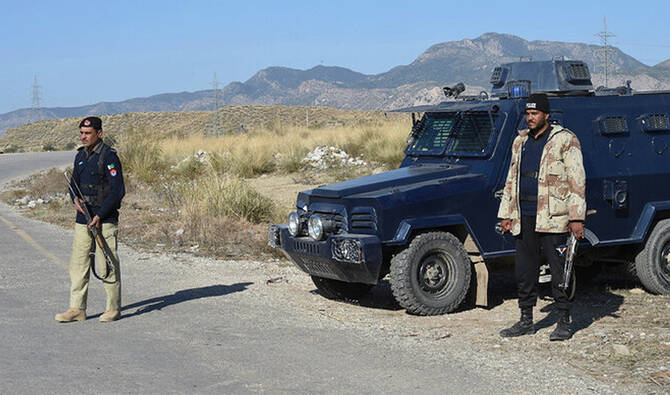
Pakistan police say 27 cops killed in 134 attacks in restive Bannu district in 2025

Policemen stand guard along a road in a village in Karak district in Pakistan on December 31, 2020. (AFP/File)
Short Url
Updated 25 December 2025
Follow

Pakistan police say 27 cops killed in 134 attacks in restive Bannu district in 2025

  • Bannu is a restive district in northwestern Pakistan where militants frequently attack law enforcers
  • Police say at least 20 drone attacks by militants killed nine civilians, injured 19 cops during the year

PESHAWAR: Police in Pakistan’s northwestern Bannu district said this week that at least 27 police personnel were killed in 134 attacks while 53 militants were killed during various security operations in the volatile area during the year, as Islamabad grapples with a surge in militancy. 

Bannu district in Khyber Pakhtunkhwa (KP) province is one of Pakistan’s most dangerous districts, where militants affiliated with the Tehreek-e-Taliban Pakistan (TTP) frequently target law enforcers in attacks. 

Regional Police Officer Sajjad Khan told reporters during a press briefing on Wednesday that at least 134 “terrorist attacks” were recorded in Bannu district during 2025 that targeted police stations, posts, checkpoints, police mobiles and police parties.

“As a result of these attacks, 27 police personnel were martyred and 79 were injured,” a statement issued by Bannu Police said on Wednesday. 

It said at least 168 intelligence-based operations were conducted by police across the district during the year, in which 105 militants were arrested and 65 were killed. 

Khan informed media that militants carried out 20 drone attacks targeting police installations and civilian areas in 2025, killing nine civilians and injuring 19 police personnel. 

“However, following the installation of an anti-drone system in Bannu district on Jul. 18, 2025, the situation improved significantly,” the statement said. “More than 300 drone attacks were thwarted, and four drones were struck/spoofed.”

He said the Bannu police force has been equipped with drones, anti-drone guns, sniper rifles, armored personnel carriers (APCs), thermal imaging systems, tactical helmets and bulletproof vehicles. 

“Bannu police reiterates its resolve to continue its struggle to maintain law and order in the district, completely eliminate terrorism and protect the lives and property of the public,” the statement concluded. 

Pakistan blames the Afghan government for facilitating TTP attacks inside its territory, a charge Kabul denies. The surge in militant attacks has strained ties between Pakistan and Afghanistan, leading to deadly border clashes in October that saw dozens killed and several wounded on both sides. 


Pakistan mulls enforcing remote work, online classes rules to conserve energy amid Mideast crisis

Updated 5 sec ago
Follow

Pakistan mulls enforcing remote work, online classes rules to conserve energy amid Mideast crisis

  • Government committee reviews contingency plans as Iran closes Strait of Hormuz, disrupting global oil supply
  • Petroleum Division official warns fuel costs may rise if Pakistan is forced to import oil from longer routes

ISLAMABAD: Pakistan is considering a range of options to conserve energy which include ordering corporate offices to ensure work-from-home facility for staff and directing universities to shift classes online, a senior official confirmed on Thursday as the ongoing Middle East conflict threatens to disrupt the global supply of petroleum products. 

These proposals were discussed by a cabinet committee constituted by Prime Minister Shehbaz Sharif to monitor petroleum prices on Wednesday. The committee meets daily to review the stock of petroleum products in Pakistan and assess the evolving regional situation.

Tensions in the Middle East have surged since Saturday after the US and Israel’s coordinated strikes against Iran and Tehran’s retaliatory attacks against both and Gulf nations. Iran has closed the crucial Strait of Hormuz waterway, through which roughly 20 percent of global oil and gas supply passes through. 

Pakistan relies heavily on Middle Eastern crude oil, with the majority of its energy imports typically transiting through the strait, making any disruption a major risk to domestic fuel supplies.

“Yes, proposals such as work-from-home for corporate offices and online classes for higher education institutions were discussed in the high-level committee,” a senior official of the finance ministry told Arab News on condition of anonymity, as he was not authorized to speak to the media.

“However, final decisions will be taken in a couple of days after the action plan is finalized based on priority areas.”

The official said the government may also advise the public to avoid unnecessary travel, adding that fuel supplies would be ensured for various industries and other critical sectors.

Meanwhile, Pakistani authorities have imposed a ban on the export of petroleum condensate, a chemical used by oil refineries, to secure its domestic supply in case the Middle East crisis worsens further.

A senior official from Pakistan’s Petroleum Division told a Senate committee on Wednesday that the country currently has petroleum reserves sufficient to last around one month.

“The country has around one month of refined petroleum products available, along with more than ten days’ worth of crude oil stocks,” the official said, also requesting anonymity. 

He added that the government is working on contingency planning to meet future energy requirements if the conflict continues.

“Pakistan is exploring options to import fuel from Saudi Arabia through the Red Sea to ensure uninterrupted supplies,” he said. 

Pakistan’s petroleum ministry confirmed the same in a statement on Wednesday, following Petroleum Minister Ali Pervaiz Malik’s meeting with Saudi Ambassador Nawaf bin Said Al-Malki. 

The official warned that petroleum product prices may rise in line with global market trends, particularly if supplies have to be transported through alternative, longer routes.

He added that in the event of a prolonged conflict, Pakistan may consider importing fuel from the US and other countries.