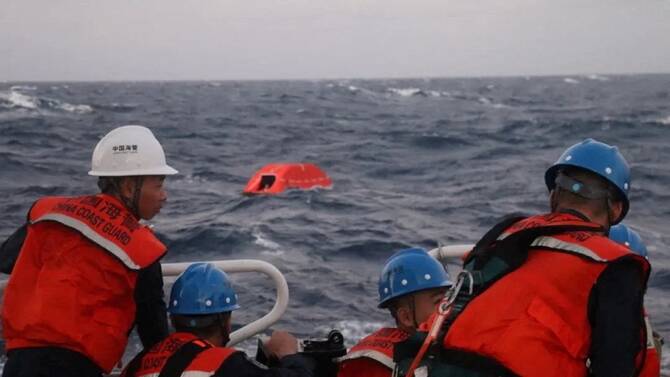
MANILA: A ferry with more than 350 people onboard sank early Monday in choppy seas off the southern Philippines, killing at least 18 and leaving 24 still missing, the coast guard said.
The MV Trisha Kerstin 3 issued a distress signal around 1:50 am (1750 GMT Sunday), a bit over four hours after it departed the Port of Zamboanga City on the southwestern tip of Mindanao, the coast guard said in a statement.
Video released by the governor of Basilan province showed barefoot survivors being wrapped in blankets and placed on gurneys, while victims of the sinking were carried past in body bags.
The triple-decker vessel went down on nearly the same route where 31 people died in 2023 after a fire aboard the Lady Mary Joy 3 ferry. Both ships were owned by locally based Aleson Shipping Lines.
At least 317 people have so far been rescued, according to the most recent tally by the Philippine Coast Guard, with 18 confirmed dead and 24 still unaccounted for amid an ongoing search-and-rescue operation.
Sheryl Balondo, a rescuer in Isabela City, one of two municipalities where survivors were being taken, said their office had received more than 100 phone calls from concerned family members.
"There's a tug in our hearts whenever we pick up a call. Their voices sounded worried," she said. "What we can only say is that, as of now, we don't have the final list (of names), because the search and retrieval operation is ongoing."
The 44-metre (144-foot) ferry went down about five kilometres east of Baluk-Baluk Island, part of the Basilan province chain of islands off the Zamboanga peninsula.
"Based on the account of some survivors, the waters in the area were rough at the time," Philippine Coast Guard spokeswoman Noemie Cayabyab said in a televised interview.
Short-staffed rescuers
Basilan emergency responder Ronalyn Perez told AFP that rescuers were struggling to handle the influx of survivors.
"The challenge really is the number of patients that are coming in. We are short-staffed at the moment," Perez said in an interview, adding that at least 18 had been brought to one local hospital.
Video released by the Philippine Coast Guard showed survivors being plucked from the water and receiving medical attention.
Some could be heard shouting for help in the dark in a live video on Facebook.
"We cannot say for now the reason of the sinking, but we were instructed to conduct a marine casualty investigation to determine the cause," Romel Dua, a coast guard commander from southern Mindanao, told AFP. "As of now, we are focused on the rescue."
Survivors were being brought to the coast guard stations in Zamboanga and Isabela City, he added.
In its statement, the coast guard said the ferry had not been overloaded.
"Our thoughts and hearts are with everyone who was on board," Aleson Shipping Lines said in a statement, adding they were "working tirelessly" in close coordination with the coast guard.
The archipelago nation of 116 million has a long history of disasters involving the inter-island ferries that ply its seas.
Many rely on cheap and poorly regulated boats and ships for transport between the country's more than 7,000 islands, despite regular accidents.
A 2015 ferry capsizing off the western coast of Leyte Island resulted in more than 60 deaths.
In 1987, the Dona Paz ferry collided with an oil tanker in a pre-Christmas accident that claimed more than 4,000 lives. It was the world's worst peacetime disaster at sea.

Ferry sinking kills 18, leaves 24 missing in south Philippines
Short Url
https://arab.news/95c25
Ferry sinking kills 18, leaves 24 missing in south Philippines
- The triple-decker vessel went down on nearly the same route where 31 people died in 2023 after a fire aboard the Lady Mary Joy 3 ferry
India’s prime minister says it has reached a free trade deal with the EU
- It touches a whopping 2 billion people and is one of the biggest bilateral engagements on commerce
- The timing comes as Washington targets both India and the EU with steep import tariffs
NEW DELHI: Prime Minister Narendra Modi said Tuesday that India and the European Union have reached a free trade agreement to deepen their economic and strategic ties.
The accord, which touches a whopping 2 billion people, was concluded after nearly two decades of negotiations. It was dubbed the “mother of all deals” by both sides.
It is one of the biggest bilateral engagements on commerce. The timing comes as Washington targets both India and the EU with steep import tariffs.
“This agreement will bring major opportunities for the people of India and Europe. It represents 25 percent of the global GDP and one-third of global trade,” Modi said while virtually addressing an energy conference.
The deal comes at a time when Washington is targeting both India and the EU with steep tariffs, disrupting established trade flows and pushing major economies to seek alternate partnerships.
Modi was scheduled to meet with European Commission President Ursula von der Leyen later Tuesday to jointly announce the agreement.
India has stepped up efforts to diversify its export destinations as part of a broader strategy to offset the impact of higher US tariffs.
The tariffs include an extra 25 percent levy on Indian goods for its unabated purchases of discounted Russian oil, bringing the combined tariffs imposed by the United States on its ally to 50 percent.
The deal gives the EU expanded access to one of the world’s fastest-growing major economies, helping European exporters and investors to reduce their reliance on more volatile markets.
Bilateral trade between India and EU stood at $136.5 billion in 2024-25. The two sides hope to increase that to about $200 billion by 2030, India’s Trade Ministry officials said.
“Ultimately, the agreement is about creating a stable commercial corridor between two major markets at a time the global trading system is fragmenting,” said Indian trade analyst Ajay Srivastava.
The EU is still reeling from the aggressive approach of its once-stalwart ally across the Atlantic. There’s a widespread sense of betrayal across the 27-nation bloc from US President Donald Trump’s onslaught of higher tariffs, embrace of far-right parties, and belligerence over Greenland.
Brussels has accelerated its outreach to markets around the world: Over the past year, von der Leyen has signed deals with Japan, Indonesia, Mexico, and South America under the catchphrase “strategic autonomy,” which in practice is akin to decoupling from a US seen by most European leaders as erratic.
“We are showing a fractured world that another way is possible,” she posted on X after arriving in India on Sunday.
The accord, which touches a whopping 2 billion people, was concluded after nearly two decades of negotiations. It was dubbed the “mother of all deals” by both sides.
It is one of the biggest bilateral engagements on commerce. The timing comes as Washington targets both India and the EU with steep import tariffs.
“This agreement will bring major opportunities for the people of India and Europe. It represents 25 percent of the global GDP and one-third of global trade,” Modi said while virtually addressing an energy conference.
The deal comes at a time when Washington is targeting both India and the EU with steep tariffs, disrupting established trade flows and pushing major economies to seek alternate partnerships.
Modi was scheduled to meet with European Commission President Ursula von der Leyen later Tuesday to jointly announce the agreement.
India has stepped up efforts to diversify its export destinations as part of a broader strategy to offset the impact of higher US tariffs.
The tariffs include an extra 25 percent levy on Indian goods for its unabated purchases of discounted Russian oil, bringing the combined tariffs imposed by the United States on its ally to 50 percent.
The deal gives the EU expanded access to one of the world’s fastest-growing major economies, helping European exporters and investors to reduce their reliance on more volatile markets.
Bilateral trade between India and EU stood at $136.5 billion in 2024-25. The two sides hope to increase that to about $200 billion by 2030, India’s Trade Ministry officials said.
“Ultimately, the agreement is about creating a stable commercial corridor between two major markets at a time the global trading system is fragmenting,” said Indian trade analyst Ajay Srivastava.
The EU is still reeling from the aggressive approach of its once-stalwart ally across the Atlantic. There’s a widespread sense of betrayal across the 27-nation bloc from US President Donald Trump’s onslaught of higher tariffs, embrace of far-right parties, and belligerence over Greenland.
Brussels has accelerated its outreach to markets around the world: Over the past year, von der Leyen has signed deals with Japan, Indonesia, Mexico, and South America under the catchphrase “strategic autonomy,” which in practice is akin to decoupling from a US seen by most European leaders as erratic.
“We are showing a fractured world that another way is possible,” she posted on X after arriving in India on Sunday.
© 2026 SAUDI RESEARCH & PUBLISHING COMPANY, All Rights Reserved And subject to Terms of Use Agreement.