

Pakistan denies reports army ordered ‘depopulation’ in Tirah Valley ahead of anti-militant operation

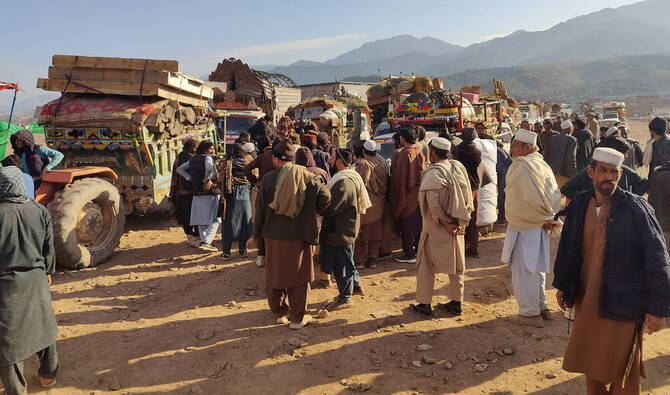
Families load their belongings onto vehicles in Pakistan’s Tirah Valley on January 15, 2026. (AN photo)
Short Url
Updated 25 January 2026
Follow

Pakistan denies reports army ordered ‘depopulation’ in Tirah Valley ahead of anti-militant operation

  • Tirah Valley residents started fleeing homes this month ahead of a planned military operation against militants
  • Reports aimed at creating alarm among public, disinformation against security institutions, says information ministry

ISLAMABAD: Pakistan’s information ministry on Sunday denied reports the army has ordered depopulation in the northwestern Tirah Valley ahead of a planned anti-militant offensive, stating that any movement of residents from the area is voluntary. 

The denial from the government comes as residents of Tirah Valley in Pakistan’s northwestern Khyber Pakhtunkhwa (KP) province bordering Afghanistan flee their homes ahead of a planned military operation by the army against militants, particularly the Tehreek-e-Taliban Pakistan (TTP) group. 

Despite major military operations in the mid-2010s, Tirah Valley has remained a stronghold for insurgents, prompting authorities to plan what they describe as a targeted clearance.

“The government has taken notice of misleading claims in circulation regarding alleged ‘depopulation’ from Tirah Valley on the orders of the Army,” the Ministry of Information and Broadcasting (MoIB) said in a statement on Sunday. 

“These assertions are baseless, malicious, and driven by ulterior motives aimed at creating alarm among the public, disinformation against security institutions and furthering vested political interest.”

The ministry said Pakistan’s federal government and the armed forces had not issued directives for any such depopulation of the territory. It clarified that law enforcement agencies are “routinely conducting targeted, intelligence-based operations strictly against terrorist elements” with care to avoid disruption to peaceful civilian life. 

It said locals are increasingly concerned over presence of the “khawarij,” a term the military and government frequently use for the TTP, in Tirah Valley and desire peace and stability in the area.

The information ministry mentioned that the Khyber Pakhtunkhwa Relief, Rehabilitation and Resettlement Department issued a notification on Dec. 26 last year for the release of funds, reportedly Rs4 billion [$14.24 million], for the “anticipated temporary and voluntary movement of population from certain localities of Tirah.”
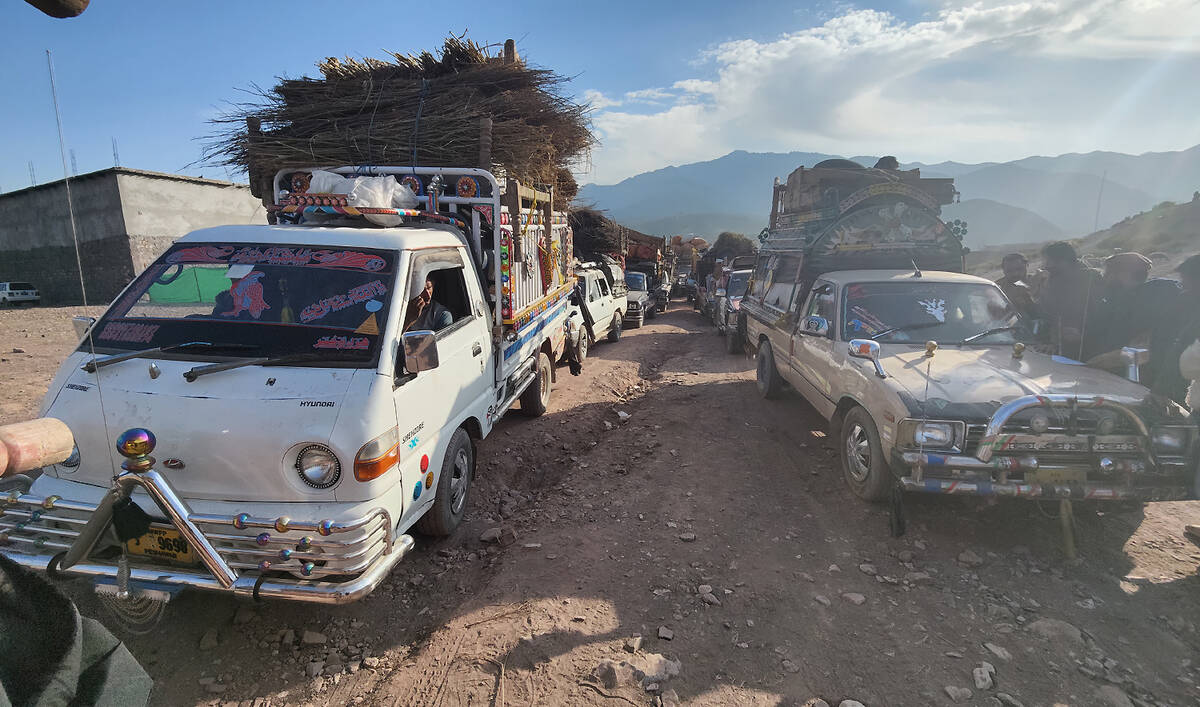


Families load their belongings onto vehicles in Pakistan’s Tirah Valley on January 15, 2026. (AN photo)

It also said that the notification mentioned that the deputy commissioner of Khyber District, where Tirah Valley is located, said the voluntary movement of people reflects the views of the local population articulated through a jirga at the district level. 

“Hence any stated position of the Provincial Government or their officials being conveyed to media that the said migration has anything to do with the Armed Forces is false and fabricated,” the information ministry said. 

“Given with malafide intent to gain political capital and unfortunately malign security institutions and therefore highly regrettable.”

The evacuation has exposed tensions between the provincial government, run by former prime minister Imran Khan’s Pakistan Tehreek-e-Insaf (PTI) party, and the military establishment over the use of force in the region.

Special assistant to KP chief minister on information Shafi Jan said the federal government's statement about the displacement of people from Tirah Valley is “baseless, fabricated, contrary to facts.”

“Chief Minister Sohail Afridi has repeatedly made his position clear regarding the Tirah Valley operation. In this regard, during the peace jirga in the provincial assembly, all political parties had also opposed the operation,” Jan said in a statement issued from his office.

“The federal government should have taken the Khyber Pakhtunkhwa government, all political parties, and other stakeholders into confidence but unfortunately, the federal government is imposing its decisions on the nation, while on the other hand, the affected people have been left alone in difficult times.”

Pakistan military spokesperson Lt. Gen. Ahmed Shareef Chaudhry has previously defended security operations as necessary as militant attacks surge in the country. 

In a recent briefing, Chaudhry said security forces carried out 75,175 intelligence-based operations nationwide last year, including more than 14,000 in Khyber Pakhtunkhwa, attributing the surge in violence to what he described as a “politically conducive environment” for militants.


Pakistan finance minister highlights economic stability, improving debt outlook at AlUla Conference

Updated 6 sec ago
Follow

Pakistan finance minister highlights economic stability, improving debt outlook at AlUla Conference

  • Global public debt remains at historic highs, exerting pressure on emerging countries, says Pakistani finance minister
  • Muhammad Aurangzeb says Pakistan’s debt-to-GDP ratio has declined to 70 percent from 74 percent over three years

ISLAMABAD: Pakistan’s Finance Minister Muhammad Aurangzeb highlighted the country’s improving debt outlook and efforts to restore economic stability at the AlUla Conference for Emerging Market Economies on Monday, calling for enhanced global coordination to address sovereign debt vulnerabilities. 

The second edition of the annual AlUla conference was launched by the Saudi Arabia’s Ministry of Finance and the International Monetary Fund (IMF) on Sunday. The conference brings together economic decision-makers, finance ministers, central bank governors, leaders of international financial institutions and a select group of experts and specialists from around the world.

This year’s conference highlights the rapid transformations in the global economy and challenges and the opportunities they present for emerging market economies, particularly in international trade, monetary and financial systems. 

Speaking at a roundtable titled: ‘Addressing Sovereign Debt Vulnerabilities,’ Aurangzeb noted that global public debt remains at historic highs, exerting pressure on emerging and developing economies through higher debt servicing costs, tighter financing conditions and constrained fiscal space, the Finance Division said. 

“The finance minister highlighted that Pakistan has made initial but meaningful progress in restoring stability through disciplined macroeconomic policies, institutional reforms, and proactive debt management, while acknowledging that the reform journey remains ongoing,” the Finance Division said. 

The minister said Pakistan remains on track to contain and better manage public debt, extending maturities, reducing costs and undertaking early debt repayments. Aurangzeb noted that these efforts have contributed to a decline in the debt-to-GDP ratio to around 70 percent from about 74 percent over the past three years.

Aurnagzeb also spoke about Pakistan’s progress in domestic resource mobilization, noting that Islamabad has raised its tax-to-GDP ratio, adding that it is now moving to the figure of 12 percent from single-digit levels in earlier years. The minister cited by tax reforms, digitization and base-broadening measures as reasons for the improvement.

“Concluding his remarks, the finance minister stressed that addressing sovereign debt vulnerabilities requires early action, strong institutions, transparency, and credible policy frameworks, supported by enhanced global coordination,” the statement said. 

“Strengthening creditor cooperation, expanding the effective use of liability management operations, and integrating climate resilience into debt frameworks, he noted, will be essential to help emerging economies manage debt sustainably while preserving growth and development priorities.”

Pakistan has recently undertaken reforms mandated by the IMF under its $7 billion loan program to strengthen its fragile economy. While the IMF has acknowledged progress on Islamabad’s part, it has also cautioned that the country’s recovery remains fragile and warned that high public debt, fiscal pressures and exposure to external shocks continue to pose risks to long-term stability.

Pakistan faced a prolonged economic crisis in recent years, marked by fiscal pressure, high debt levels and balance-of-payments difficulties, and subsequently entered an IMF-supported program to stabilize the economy.

Pakistani officials say decreasing levels of inflation and higher foreign exchange reserves reflect the government’s prudent fiscal policies and debt management.