

Indian fishermen released from Pakistani jail express joy, call for improved relations

Indian fishermen boarding a train after their release from prison in Karachi on May 11, 2023. (AN Photo)
Short Url
Updated 12 May 2023
Follow

Indian fishermen released from Pakistani jail express joy, call for improved relations

  • Another 300 Indian fishermen are expected to return home in coming weeks, says head of a Pakistani charity
  • Development comes days after the death of two Indian fishermen and as 200 Pakistanis languish in Indian jails

KARACHI: Authorities on Thursday released around 200 Indian fishermen from a prison in southern Pakistan, with the detainees expressing joy over their release and calling for improvement in ties between the two nuclear-armed neighbors.

Indian and Pakistani fishermen are routinely detained by both maritime agencies on charges of illegally entering each other’s territorial waters. The nuclear-armed nations’ borders are not clearly defined in the Arabian Sea and many fishing boats lack the technology to steer clear of any intrusion.

Some 198 Indian fishermen were brought from the Landhi prison to the Karachi Cantt railway station on Thursday evening where Faisal Edhi, chairman of the Edhi Foundation charity organization, saw them off with gifts ahead of their journey back home through the Wagah border crossing near the eastern Pakistani city of Lahore. 

Expressing joy over his release, Mohsin Qasim, a fisherman from the Indian state of Gujarat who was detained in 2018, said fisher folk routinely got caught due to invisible boundaries in the sea. 

“[Land] borders are known, but one cannot see border in the sea,” Qasim said, urging for improvement in bilateral ties.

“If [bilateral] relations are good everyone will benefit. The masses of both countries will be benefited.”

Hameed Suleman, another fisherman from Gujarat, said he was very happy to return home where he would be able to see his daughters after a long time.

“I haven’t seen the faces of my daughters for the last three, four years,” he said, with a smile on his face. “I will be very happy when I meet my daughters.”
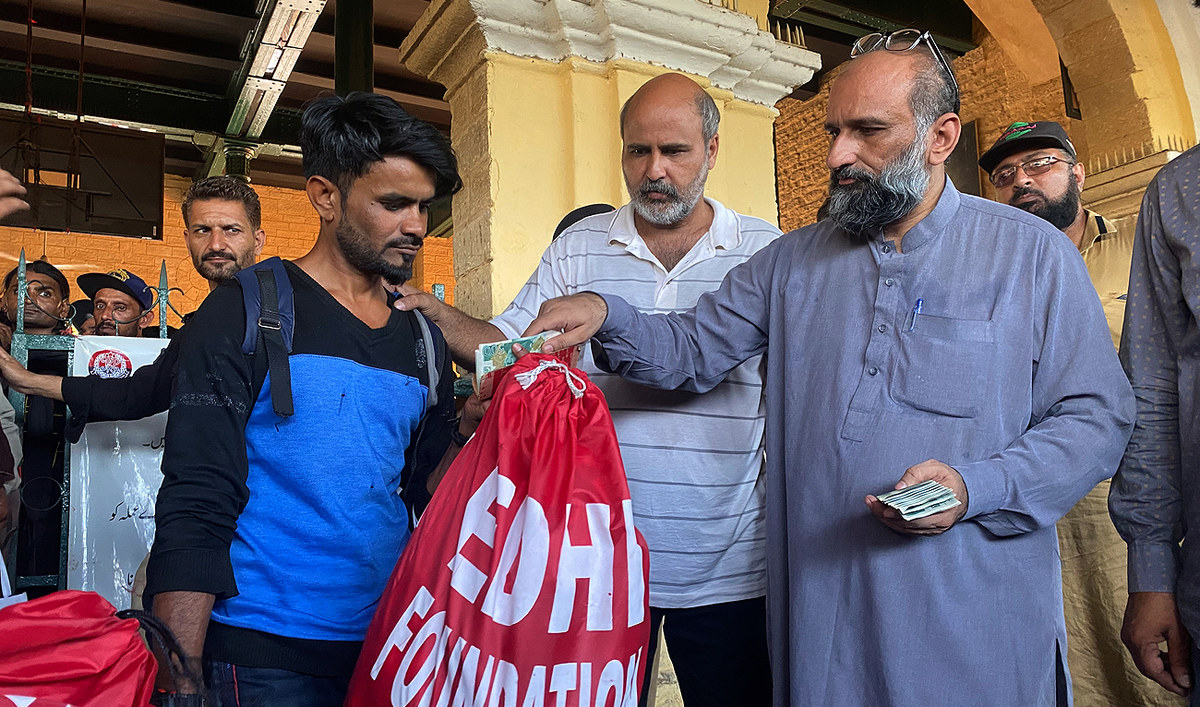


Chairman of the Edhi Foundation charity organization, Faisal Edhi, distributes cash and gifts to the Indian fishermen ahead of boarding a train after their release from prison in Karachi on May 11, 2023. (AN Photo)

Pakistan was to originally release 200 Indian fishermen, however, two of them died this month owing to their health conditions.

Edhi said bodies of the deceased Indian fishermen were kept at the Edhi morgue and the process to transport them was underway.

“We will take them to Wagah as soon as we get permission,” he said.

Edhi said another 300 Indian fishermen were expected to be released soon and urged New Delhi to release around 200 Pakistani fishermen detained at Indian prisons.
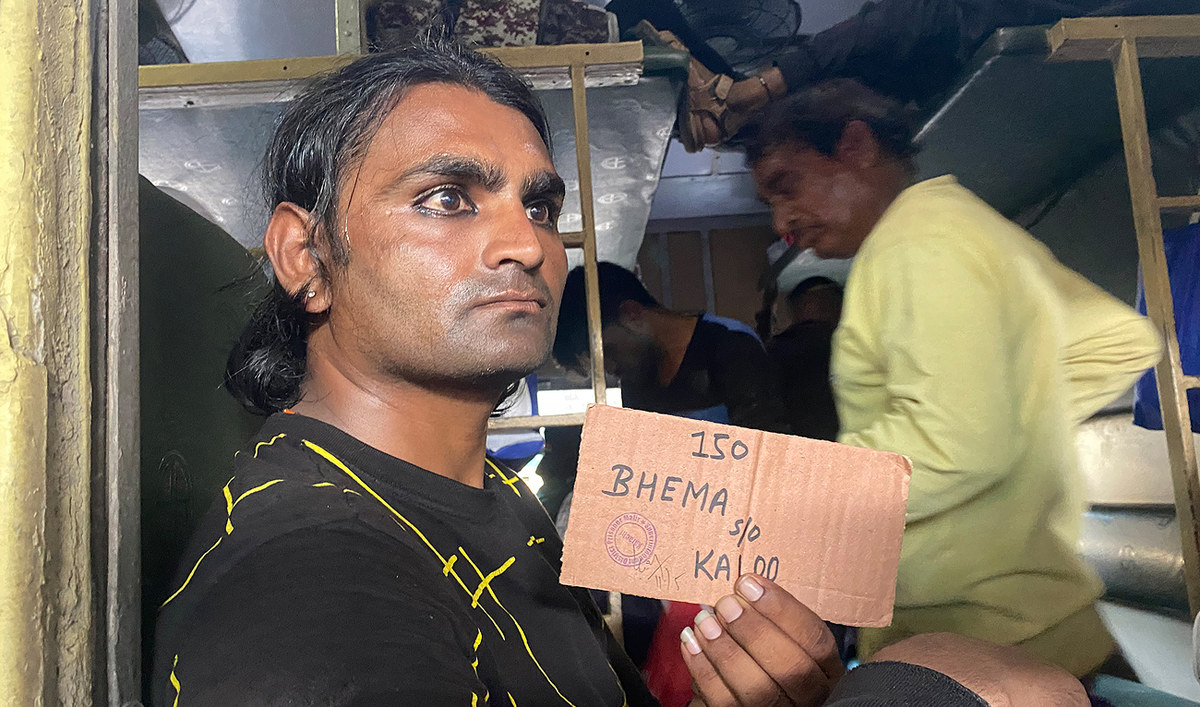


Indian fisherman, Bhema, carries his identity after boarding a train following his release from prison in Karachi on May 11, 2023. (AN Photo)


Pakistan moves to digitize payments for 10 million women under flagship poverty initiative

Updated 5 sec ago
Follow

Pakistan moves to digitize payments for 10 million women under flagship poverty initiative

  • BISP Official says accounts will be linked to phones to boost financial inclusion and curb payment deductions
  • Over 1.9 million SIMs issued as the nationwide rollout continues across provinces ahead of the March deadline

ISLAMABAD: Pakistan’s flagship poverty alleviation initiative, the Benazir Income Support Program (BISP), plans to equip 10 million women with digital bank accounts linked to their phone numbers within four months in one of the largest such exercises in the world, one of its top officials said on Wednesday.

Launched in 2008, the initiative is named after the late former prime minister Benazir Bhutto and has a budget of Rs716 billion ($2.5 billion) during the current fiscal year. Through its Benazir Kafaalat — or financial assistance — program, BISP provides quarterly stipends of Rs13,500 ($48) to around 10 million women.

In an exclusive interview with Arab News, BISP Secretary Amir Ali Ahmed said the opening of digital bank accounts for the beneficiaries was part of Prime Minister Shehbaz Sharif’s initiative related to a cashless economy and digital transformation of the country.

“I’m glad to share that 10 million bank accounts, wallet accounts were created,” he said. “This is a follow-up of the same exercise whereby now 10 million SIMs are being distributed.

“It is significant to share that the entire beneficiary network that we have is female-centric,” he continued. “So these are 10 million female accounts that have been created.”

Ahmed said the process of issuing mobile phone SIM cards to BISP beneficiaries had started on November 17 and would be completed by March next year.

“Let me share that this is one of the largest such exercises to be conducted in the world which is female-centric, linked with financial inclusion and financial empowerment.”

The BISP official added that out of the more than 10 million beneficiaries, only five to 10 percent had bank accounts, but nearly 90 to 95 percent were excluded from the system.

He said they were being linked to the banking system with cellphone SIMs that are being distributed with the help of the IT ministry, Pakistan Telecommunication Authority, National Database and Registration Authority and telecom companies across the country.

“We feel that this initiative of the government of Pakistan will not only result in financial empowerment of our beneficiaries, it will also result in financial inclusion of a segment which was not part of the banking sector in Pakistan,” he said, adding that the move will also lead to transparency.

In the past, there have been complaints of women not getting their full payment from bank officials in the absence of their own accounts, but Ahmed said this was going to change.

“They will be free from any exploitation at the agent networks, the queues that one would witness, the complaints of corruption or deductions that would emerge,” he continued.

According to official data, more than 1.9 million SIMs have so far been issued for BISP beneficiaries across the country.

The province of Punjab leads the rollout with 810,597 SIMs, followed by Sindh with 523,629 and Khyber Pakhtunkhwa with 371,427 SIMs.

In other regions, Azad Jammu and Kashmir has received 59,617, Balochistan 82,826, Gilgit-Baltistan 45,184, and Islamabad 4,508 SIMs.