



KARACHI: A former Pakistani detainee at the Guantánamo Bay US detention facility, who returned to his home country this year and is exhibiting his work at a gallery in Karachi, told Arab News his paintings depicted the “pain, anguish, blood and tears” of years spent in confinement without ever being charged.
According to the global legal action non-profit Reprieve, Ahmed Rabbani was a taxi driver in Pakistan who intelligence services mistook for a known extremist. He endured 545 days of torture in CIA custody before being rendered to Guantánamo, where he was held from 2004 onwards. He was never charged with a crime and never had a trial.
Rabbani and his brother, who was also at Guantánamo, returned to Pakistan in February. His wife was pregnant at the time he was picked up and just five months later gave birth to their son who, now 17, had never met his father before February this year. His parents and sister passed away while he was incarcerated.
An exhibition of Rabbani’s artwork, entitled ‘The Unforgotten Moon: Liberating Art from Guantánamo Bay,’ is on display at Karachi’s Indus Valley School of Art and Architecture until May 15.
“People ask me what colors I have used. I tell them I haven’t used colors, I have used pain, I have used anguish, I have used blood, I have used tears,” Rabbani told Arab News at his exhibition.
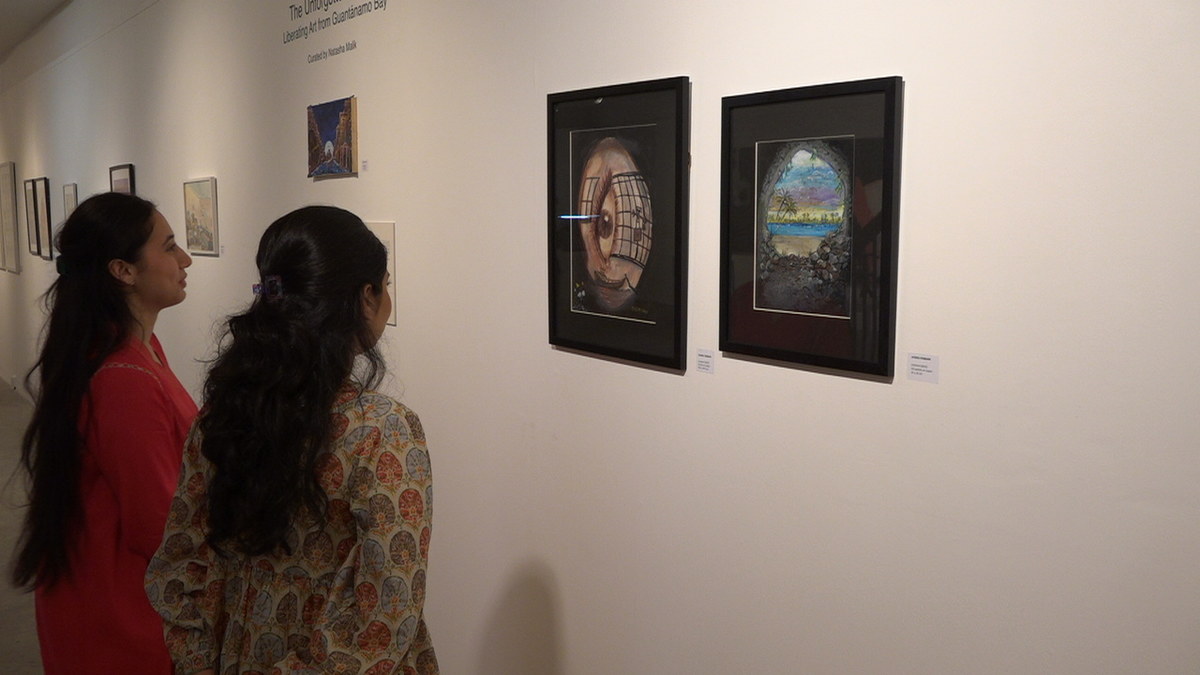
People observe the paintings made by former Guantanamo Bay detainees at art exhibition at Indus Valley School of Art and Architecture in Karachi, Pakistan, on May 4, 2023. (AN Photo)
“My pain of 20, 21 years, that’s what I used. I don’t know what these colors are. This is my pain.”
Rabbani said he began painting while in prison but many of his artworks were confiscated by his captors. The few works that made it out are on display at the Karachi exhibition, as well as the work of ten contemporary Pakistani artists who are responding to Rabbani’s work.
“The one that I made about my torture, they did not let go of it,” he added. “We had no human rights.”
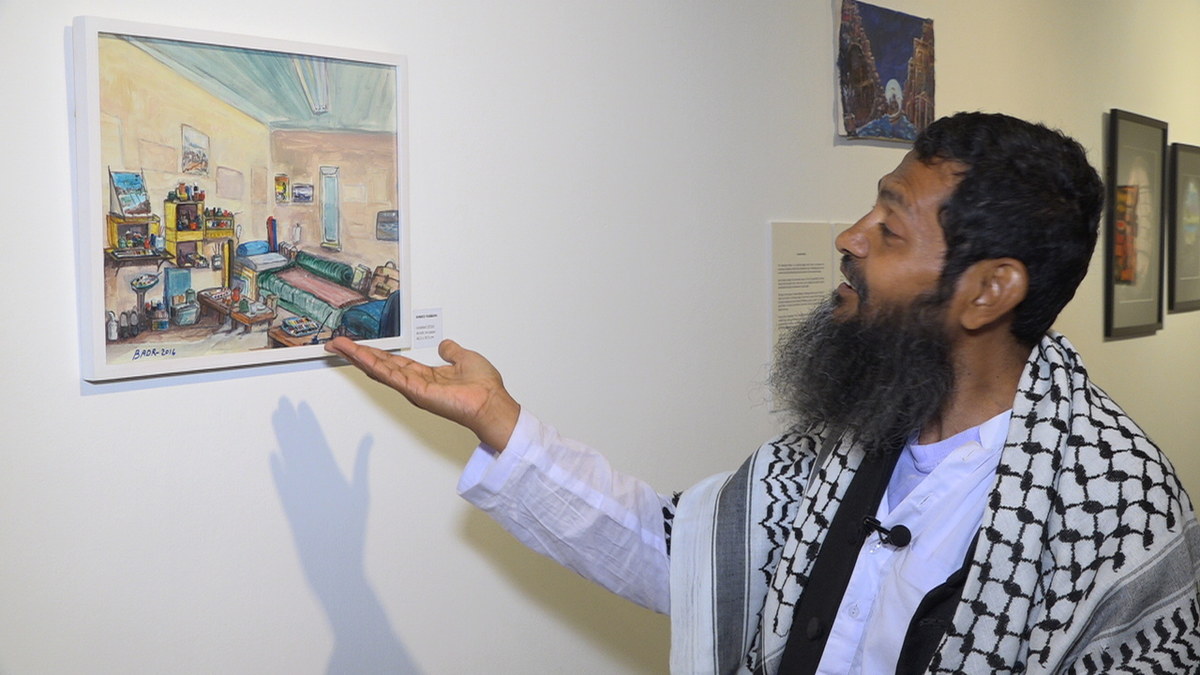
Muhammad Ahmed Ghulam Rabbani, a former Guantanamo Bay ditainee his art exhibition at Indus Valley School of Art and Architecture in Karachi, Pakistan, on May 4, 2023. (AN Photo)
Remembering how he started painting, Rabbani said he requested Guantánamo prison authorities to allow painting class in the prison around 2006. It took up to four years to be supplied with some materials.
“After three, four years they started it [allowing painting] and they would give one color and we would work from it,” Rabbani said. “They would take the first one and give us another color. Like this they pestered us and like this, one or two years went by.”
“After 2011, they started giving some pastel colors. Then in 2015 or 2016 acrylic colors came. Canvas cloth we got in 2016. Before this, there were papers.”
Natasha Malik, the artist who curated Rabbani’s exhibition, described the experience as “eye-opening.”
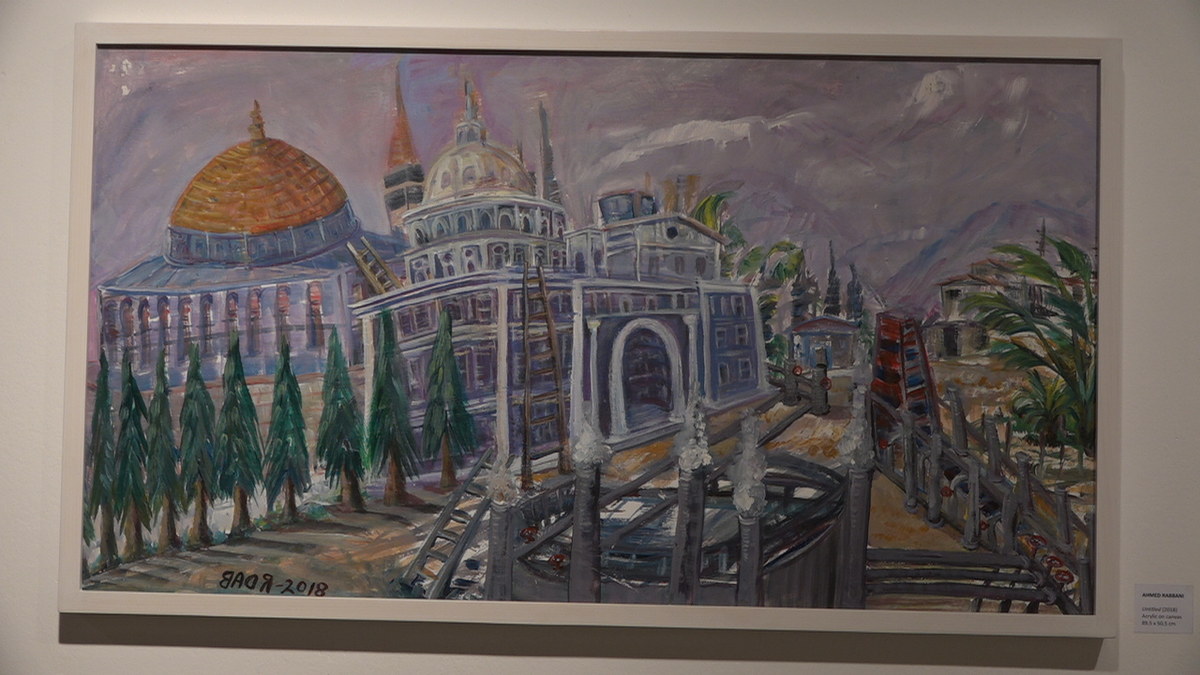
a painting made by a former Guantanamo Bay ditainee displayed at an art exhibition at Indus Valley School of Art and Architecture in Karachi, Pakistan, on May 4, 2023. (AN Photo)
“It has been harrowing, it has been incredibly difficult to do a show like this because you see very up close how much suffering and how much pain Ahmed has gone through,” Malik told Arab News. “The time that he has lost, 20 years he’s lost, it’s tragic. It’s heartbreaking and it’s completely unjust.”
Malik is one of the ten artists who are responding to Rabbani’s work and creating some of his confiscated paintings based on descriptions provided by his lawyer Clive Stafford Smith.
“There is a series of censored paintings, which have been confiscated by the US military, which Ahmed had made during his incarceration in Guantánamo,” Malik said.
“Clive is the only one who has seen these paintings and he provided the artists, through [author] Fatima Bhutto, who has also written about Ahmed Rabbani, textual descriptions and the artists have illustrated those descriptions or, a better word is, responded to those descriptions. So, this is our work and we are exhibiting it alongside Ahmed Rabbani’s uncensored paintings.”
The exhibition, Malik said, would not just bring visibility to Rabbani’s story but the proceeds from the sale of the works would go toward the rehabilitation of his family.
“We have about 21, 22 pieces of Ahmed Rabbani’s original artworks with us here today. But there are six censored pieces which are still in Guantánamo.”
Another artist exhibiting is Amra Khan, who has recreated a painting called Strappado. Explaining the background to the painting, Rabbani said it described him being kept in Karachi for 47 days before being moved to Islamabad to be handed over to the Americans, who he described as tearing off his clothes and taping his eyes and mouth shut.
Rabbani said he was then moved to a cell in the Afghan city of Kabul where he was hung from his shoulders, and made to stand on his toes for a week while his hands were chained. Sometimes water was given but no food.
“I would scream the whole day but no one was there to listen,” he said.
“But this, whoever made this, it is a really good one,” he said about Khan’s painting, adding: “If someone is painting something with happiness, there will be a difference from someone who paints in grief.”
But Rabbani has resolved to recreate his lost works.
“Most paintings that they [US authorities] have confiscated from me,” he said, “I will god willing repaint them all again.”


