- The court sought record of proceedings while hearing petitions challenging a law limiting the top judge’s powers
- Pakistan’s defense minister says parliamentarians will have to fight this ‘war’ for the supremacy of their institution
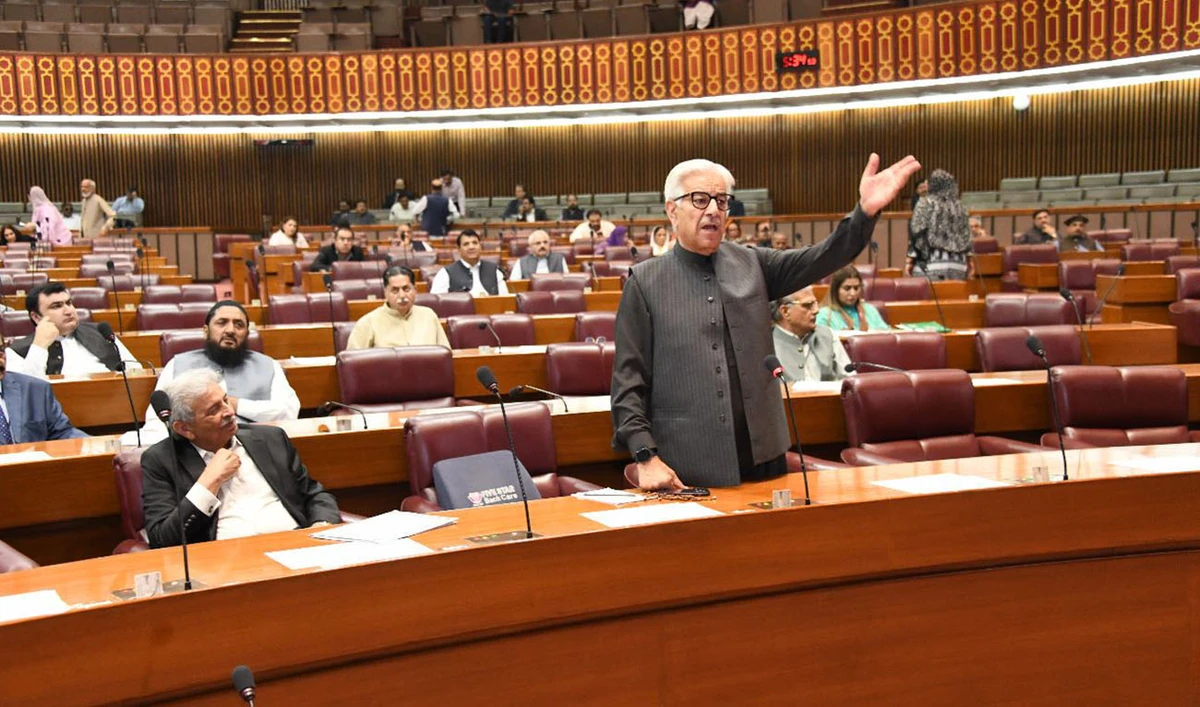
ISLAMABAD: Pakistan’s defense minister Khawaja Asif made a fiery speech in parliament on Tuesday wherein he criticized the judiciary after the Supreme Court demanded record of National Assembly proceedings related to discussions over a law limiting the powers of the country’s top judge before it was passed by the house.
An eight-member apex court bench instructed the attorney general of Pakistan to share the parliamentary proceedings while hearing petitions challenging the Supreme Court (Practice & Procedure) Bill, 2023, saying it wanted to understand the concern of lawmakers who had endorsed the bill.
The law sought to limit the power of Pakistan’s chief justice to solely initiate public interest litigation on his own through suo moto proceedings. It also diluted his administrative power to constitute benches and determine their composition by involving more judges in the process.
Reacting to the apex court’s recent hearing, Pakistan’s defense minister warned that “enough [was] enough.” He maintained that parliamentary proceedings were open to the public and broadcast live on television channels while asking the speaker to write a letter to the court and demand record of its proceedings ahead of some of its recent judgments.
“We will have to defend our institution,” he told lawmakers sitting in the National Assembly, adding: “We will have to rise above our own political differences and fight this war for the supremacy of this institution.”
Asif criticized the judiciary’s past record, saying it had supported military dictators and even allowed them to amend the constitution.
He maintained the Supreme Court judges should be held accountable for its verdicts, saying they had undermined parliamentary supremacy by issuing rulings against democratically elected prime ministers.
Other lawmakers agreed with him while some of them pointed out that parliamentarians and secretariat staff were protected by the constitution and could not be summoned by any court and questioned about anything discussed on the floor of the house.
They asked the speaker not to comply with the court order under the same principle and refuse to share the details of the National Assembly proceedings.
Tensions have been mounting between the government and the top court since the superior judiciary took up a case of election delay in Punjab and Khyber Pakhtunkhwa after their provincial assemblies were dissolved by former prime minister Imran Khan and his allies earlier this year.
The top court instructed the country’s election commission to hold the Punjab polls on May 14 and ordered the central bank to release the required funds for the purpose.
The government maintained, however, the Supreme Court had gone beyond its constitutional mandate by issuing the rulings which challenged the principles of parliamentary supremacy and separation of powers.