

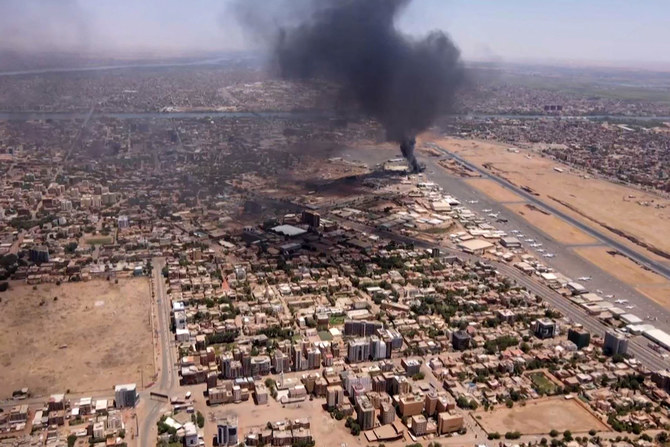
Clashes in Sudan despite calls for Eid ceasefire

Hundreds of people have been killed since the fighting erupted on April 15 between forces loyal to Sudan's army chief Abdel Fattah al-Burhan and his deputy, Mohamed Hamdan Daglo, who commands the paramilitary Rapid Support Forces. (AFP)
Short Url
Updated 21 April 2023
Follow

Clashes in Sudan despite calls for Eid ceasefire

  • At least 413 people have been killed so far in the violent power struggle which broke out last weekend between two previously allied leaders of Sudan’s ruling military junta

KHARTOUM: Sudan’s warring forces clashed again in the nation’s capital early Friday, with bombing and shelling reported in several areas of Khartoum, as they ignored appeals by world powers for an end-of-Ramadan cease-fire.
Both UN Secretary-General Antonio Guterres and US Secretary of State Antony Blinken called separately for a cease-fire of “at least” three days to mark Eid Al-Fitr in the mostly Muslim country, as explosions and gunfire resounded in the capital Khartoum for the sixth straight night.
“On the night of Eid Al-Fitr, several areas of Khartoum were bombed and are still exposed to shelling and clashes between the armed forces and the RSF,” the Central Committee of Sudan Doctors said in a statement.
“We call on all citizens to exercise caution, stay home, close doors and windows and lie down. We also call on these forces to be responsible and immediately stop fighting to protect innocent lives.”

The capital has borne the brunt of some of the fiercest fighting, with most of its five million people sheltering at home without electricity, food or water.
Residents have struggled to sleep for nearly a week and been jolted awake by “the roaring sound of fighter jets and air strikes,” said Nazek Abdalla, a 38-year-old in southern Khartoum.
“We locked our doors and windows, hoping no stray bullets would hit our building, Abdalla added. “We wish the fighting would stop during Eid festivities. We know it will not happen though.”
Blinken “condemned the indiscriminate fighting” in separate conversations with both Burhan and Daglo, his spokesperson said in a Friday statement.
“He urged both military leaders to implement and uphold a nationwide cease-fire and sustain it through at least the end of Eid Al-Fitr, Sunday, April 23,” the statement said.

As battles raged Friday, Burhan appeared on television for the first time since hostilities began, to deliver an Eid address as in previous years.
Sitting behind a desk, dressed in military uniform and backgrounded by two Sudanese flags, he made no mention of a truce.
“For Eid this year, our country is bleeding: destruction, desolation and the sound of bullets have taken precedence over joy,” he said.
“We hope that we will come out of this ordeal more united... a single army, a single people... toward a civilian power.”
After two cease-fires failed to take hold in two days, gunfire continued Thursday night, with columns of black smoke rising from buildings around Khartoum International Airport and the army headquarters.
While many sheltered at home, others were venturing out despite the risks “to protect themselves and their families,” said architect Tagreed Abdin.
Beyond Khartoum, witnesses reported loud explosions in the city of Obeid, in the central state of North Kordofan.
“It reeks of death in some parts of town,” said one witness in Obeid.
The World Health Organization said Friday that 413 people have died and almost 3,551 more had been wounded in the fighting.
The fighting has taken a heavy toll on civilians, with the UN children’s agency UNICEF saying “at least nine children have reportedly been killed.”The World Food Programme (WFP) warned that the violence could plunge millions more into hunger in a country where 15 million people — one-third of the population — already face food insecurity.
It has suspended its Sudan operations after the killing of three WFP workers on Saturday.
Burhan and Daglo’s bitter dispute centered on the planned integration of the RSF into the regular army, a key condition for a final deal aimed at restoring Sudan’s democratic transition.
Around Khartoum and elsewhere, RSF fighters in armored vehicles and pickups mounted with machine guns have taken over the streets.
Many have mounted checkpoints to search cars carrying civilians trying to escape the worst battle zones to safer areas in Khartoum and beyond.
Civilians are becoming increasingly desperate — by Tuesday, thousands had fled the capital, with many reporting streets strewn with corpses.
Medics have warned of a catastrophe, especially in Khartoum, where many hospitals were reportedly caught in the crossfire.
Up to 70 percent of the hospitals in Khartoum and neighboring states have been rendered “out of service” by the fighting, the doctors’ union said.
It has warned the death toll is likely to be far higher than stated, with many wounded unable to reach hospitals.
Several countries’ evacuation plans have been put on hold, with the US Defense Department announcing Thursday that it was deploying forces “nearby in the region” with hopes of “securing and potentially facilitating the departure of US Embassy personnel from Sudan.”
The Sudanese army said 177 Egyptian soldiers were evacuated from the northern city of Meroe to Egypt, which confirmed their arrival. The RSF said later that it handed over another 27 Egyptian soldiers to the Sudanese Red Cross, and Cairo confirmed their arrival at Egypt’s Khartoum embassy.
The United Arab Emirates said it had “led” the mediation for the Egyptians held by the RSF.
Burhan and Daglo toppled autocratic president Omar Al-Bashir together in April 2019 following massive protests against three decades of iron-fisted rule.
In October 2021, they again worked together to oust the civilian government installed after Bashir’s downfall, derailing an internationally backed transition to democracy.


Trump says ‘hopefully’ no need for military action against Iran

Updated 30 January 2026
Follow

Trump says ‘hopefully’ no need for military action against Iran

  • US president said he is speaking with Iran and left open the possibility of avoiding a military operation
  • An Iranian military spokesman warned Tehran’s response to any US action would not be limited

PARIS: US President Donald Trump said on Thursday he hoped to avoid military action against Iran, which has threatened to strike American bases and aircraft carriers in response to any attack.
Trump said he is speaking with Iran and left open the possibility of avoiding a military operation after earlier warning time was “running out” for Tehran as the United States sends a large naval fleet to the region.
When asked if he would have talks with Iran, Trump told reporters: “I have had and I am planning on it.”
“We have a group headed out to a place called Iran, and hopefully we won’t have to use it,” the US president added, while speaking to media at the premiere of a documentary about his wife Melania.
As Brussels and Washington dialed up their rhetoric and Iran issued stark threats this week, UN chief Antonio Guterres has called for nuclear negotiations to “avoid a crisis that could have devastating consequences in the region.”
An Iranian military spokesman warned Tehran’s response to any US action would not be limited — as it was in June last year when American planes and missiles briefly joined Israel’s short air war against Iran — but would be a decisive response “delivered instantly.”
Brig. Gen. Mohammad Akraminia told state television US aircraft carriers have “serious vulnerabilities” and that numerous American bases in the Gulf region are “within the range of our medium-range missiles.”
“If such a miscalculation is made by the Americans, it will certainly not unfold the way Trump imagines — carrying out a quick operation and then, two hours later, tweeting that the operation is over,” he said.
An official in the Gulf, where states host US military sites, said that fears of a US strike on Iran are “very clear.”
“It would bring the region into chaos, it would hurt the economy not just in the region but in the US and cause oil and gas prices to skyrocket,” the official added.
‘Protests crushed in blood’
Qatar’s leader Sheikh Tamim bin Hamad Al-Thani and Iran’s President Masoud Pezeshkian held a call to discuss “efforts being made to de-escalate tensions and establish stability,” the Qatar News Agency (QNA) reported.
The European Union, meanwhile, piled on the pressure by designating the Islamic Revolutionary Guard Corps (IRGC) a “terrorist organization” over a deadly crackdown on recent mass protests.
“’Terrorist’ is indeed how you call a regime that crushes its own people’s protests in blood,” said EU chief Ursula von der Leyen, welcoming the “overdue” decision.
Though largely symbolic, the EU decision has already drawn a warning from Tehran.
Iran’s military slammed “the illogical, irresponsible and spite-driven action of the European Union,” alleging the bloc was acting out of “obedience” to Tehran’s arch-foes the United States and Israel.
Iranian officials have blamed the recent protest wave on the two countries, claiming their agents spurred “riots” and a “terrorist operation” that hijacked peaceful rallies sparked over economic grievances.
Rights groups have said thousands of people were killed during the protests by security forces, including the IRGC — the ideological arm of Tehran’s military.
In Tehran on Thursday, citizens expressed grim resignation.
“I think the war is inevitable and a change must happen. It can be for worse, or better. I am not sure,” said a 29-year-old waitress, speaking on condition of anonymity for fear of reprisals.
“I am not in favor of war. I just want something to happen that would result in something better.”
Another 29-year-old woman, an unemployed resident of an upscale neighborhood in northern Tehran, said: “I believe that life has highs and lows and we are now at the lowest point.”
Trump had threatened military action if protesters were killed in the anti-government demonstrations that erupted in late December and peaked on January 8 and 9.
But his more recent statements have turned to Iran’s nuclear program, which the West believes is aimed at making an atomic bomb.
On Wednesday, he said “time is running out” for Tehran to make a deal, warning the US naval strike group that arrived in Middle East waters on Monday was “ready, willing and able” to hit Iran.
Conflicting tolls
The US-based Human Rights Activists News Agency (HRANA) said it has confirmed 6,479 people were killed in the protests, as Internet restrictions imposed on January 8 continue to slow verification.
But rights groups warn the toll is likely far higher, with estimates in the tens of thousands.
Iranian authorities acknowledge that thousands were killed during the protests, giving a toll of more than 3,000 deaths, but say the majority were members of the security forces or bystanders killed by “rioters.”
Billboards and banners have gone up in the capital Tehran to bolster the authorities’ messages. One massive poster appears to show an American aircraft carrier being destroyed.