

Greater philanthropy in Gaza during Ramadan lifts people’s spirits

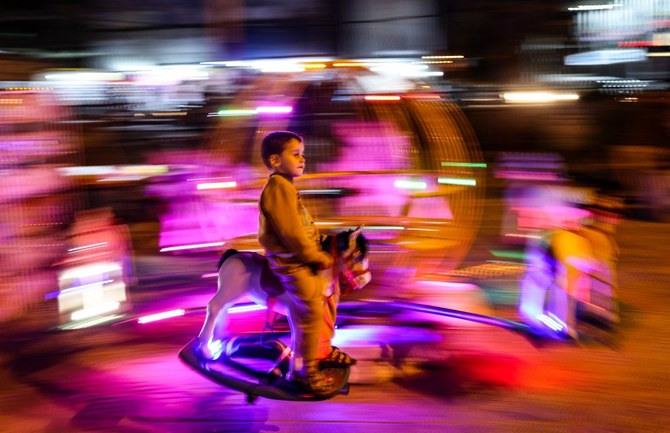
The initiatives involve individuals, various official charities and groups of people seeking to make a difference in the lives of the poor. (FILE/AFP)
Short Url
Updated 19 April 2023
Follow

Greater philanthropy in Gaza during Ramadan lifts people’s spirits

  • Israeli blockade has worsened economic conditions for residents
  • Over 80% of families depend on foreign aid, 70% live in poverty

GAZA: The rise in charity during Ramadan helps to alleviate the harsh economic conditions in the Gaza Strip, particularly for the most vulnerable.

The initiatives involve individuals, various official charities and groups of people seeking to make a difference in the lives of the poor.

The Khalifa bin Zayed Al-Nahyan Foundation is among several organizations that provide tens of thousands of vouchers which can be used at most commercial stores. There are other bodies that distribute food baskets.

Interviewed at a store, Radwa Mahmoud, 62, said. “I received a voucher and I am here to choose the things I need. This is the third time that I have received a voucher over the past years. This is a smart and useful step. It helps us choose our needs (properly).”

“The economic conditions in Gaza are very difficult, we need constant assistance, but during Ramadan, the aid clearly increases. We hope that this aid will be throughout the year and not only in Ramadan,” she told Arab News.

During the month of Ramadan, the aid includes food parcels, cash, vouchers and children’s clothing.

In the Gaza Strip, poverty and unemployment are rising because of the Israeli blockade. For several years now 80 percent of Gazan families have had to depend on foreign aid, with over 250,000 people unemployed, or 50 percent of the working population. Seventy percent of the population live in poverty.

Many of these families depend on Ramadan when there is an increase in cash and other support which helps relieve their difficult living conditions.

The Assembly of Charitable Organizations in Gaza stated in a press release that about 150,000 families have been identified for special support in Ramadan, and aid is expected to reach them before the end of the month. An estimated 220,000 families need regular support, the organization stated.

The organization seeks to coordinate and administer all charity drives to ensure the aid reaches beneficiaries and to achieve transparency, integrity and fair distribution.

Fadi Khalil and members of his hospice initiative, consisting of nine people, provide daily meals, medical support and electricity for 2,000 poor families, particularly those whose breadwinners suffer from debilitating illnesses such as cancer and kidney failure.

Khalil relies on Facebook as the first way to reach those wishing to donate financially, support poor patients, or even communicate with those who need urgent help.

He said Ramadan was particularly special in terms of the increase in philanthropic initiatives, and there was a “luster” to the work carried out in Gaza.

Zaki Madoukh, who also works in the field, said that there are nearly 2,000 individuals and organizations assisting with these initiatives in Ramadan, providing food, cash, medicine and other support.

Madoukh said the holy month sees more people willing to make donations, often double the amount of the entire rest of the year, which also places extra responsibility on organizations to distribute the aid effectively.


First responders enter devastated Aleppo neighborhood after days of deadly fighting

Updated 12 January 2026
Follow

First responders enter devastated Aleppo neighborhood after days of deadly fighting

  • The US-backed SDF, which have played a key role in combating the Daesh group in large swaths of eastern Syria, are the largest force yet to be absorbed into Syria’s national army

ALEPPO, Syria: First responders on Sunday entered a contested neighborhood in Syria’ s northern city of Aleppo after days of deadly clashes between government forces and Kurdish-led forces. Syrian state media said the military was deployed in large numbers.
The clashes broke out Tuesday in the predominantly Kurdish neighborhoods of Sheikh Maqsoud, Achrafieh and Bani Zaid after the government and the Syrian Democratic Forces, the main Kurdish-led force in the country, failed to make progress on how to merge the SDF into the national army. Security forces captured Achrafieh and Bani Zaid.
The fighting between the two sides was the most intense since the fall of then-President Bashar Assad to insurgents in December 2024. At least 23 people were killed in five days of clashes and more than 140,000 were displaced amid shelling and drone strikes.
The US-backed SDF, which have played a key role in combating the Daesh group in large swaths of eastern Syria, are the largest force yet to be absorbed into Syria’s national army. Some of the factions that make up the army, however, were previously Turkish-backed insurgent groups that have a long history of clashing with Kurdish forces.
The Kurdish fighters have now evacuated from the Sheikh Maqsoud neighborhood to northeastern Syria, which is under the control of the SDF. However, they said in a statement they will continue to fight now that the wounded and civilians have been evacuated, in what they called a “partial ceasefire.”
The neighborhood appeared calm Sunday. The United Nations said it was trying to dispatch more convoys to the neighborhoods with food, fuel, blankets and other urgent supplies.
Government security forces brought journalists to tour the devastated area, showing them the damaged Khalid Al-Fajer Hospital and a military position belonging to the SDF’s security forces that government forces had targeted.
The SDF statement accused the government of targeting the hospital “dozens of times” before patients were evacuated. Damascus accused the Kurdish-led group of using the hospital and other civilian facilities as military positions.
On one street, Syrian Red Crescent first responders spoke to a resident surrounded by charred cars and badly damaged residential buildings.
Some residents told The Associated Press that SDF forces did not allow their cars through checkpoints to leave.
“We lived a night of horror. I still cannot believe that I am right here standing on my own two feet,” said Ahmad Shaikho. “So far the situation has been calm. There hasn’t been any gunfire.”
Syrian Civil Defense first responders have been disarming improvised mines that they say were left by the Kurdish forces as booby traps.
Residents who fled are not being allowed back into the neighborhood until all the mines are cleared. Some were reminded of the displacement during Syria’s long civil war.
“I want to go back to my home, I beg you,” said Hoda Alnasiri.