

At Karachi’s Paper Market, a street feast of Bohra cuisine during Ramadan

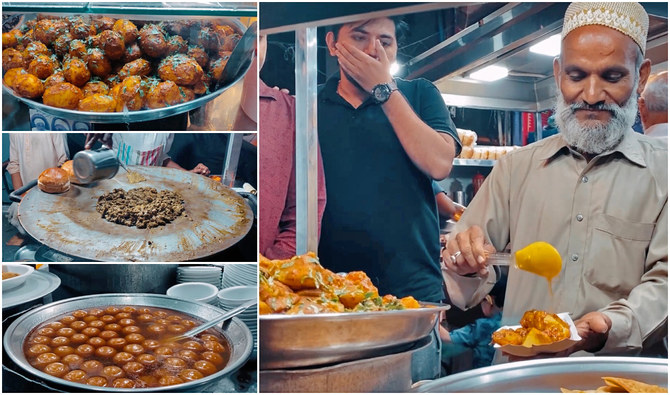
The collage created on April 11, 2023, shows dishes of Bohra cuisine at a food street in Karachi's Paper Market. (AN photos)
Short Url
Updated 11 April 2023
Follow

At Karachi’s Paper Market, a street feast of Bohra cuisine during Ramadan

  • The food street is specifically set up during the Muslim fasting month of Ramadan and serves people until Eid Al-Fitr
  • Bohra cuisine is influenced by several global cooking styles, though its taste is mostly inspired by Gujarati and Arab flavors

KARACHI: As Karachi’s Paper Market lights up in the evening, residents from different neighborhoods of the city get to experience the taste of Bohra food during the holy month of Ramadan. The decades-old, unique recipes not only attract locals but also visitors from the Middle East who enjoy Bohra cuisine due to its mild spices.

Pakistan is home to over 35,000 members of the Dawoodi Bohra community, a Shiite Muslim sect. Many of them set up the Bohra Food Street right in the middle of the Paper Market during the holy month to serve residents of the southern port city between the iftar and sehri meals.

The food street comes to life from the first of Ramadan and continues until the end of the month, featuring both Bohra and non-Bohra vendors. The items available are also a mix of Bohra cuisine and other varieties of local snacks such as gol gappas, chaat, and soups etc.

However, the major attraction of the street remains the unique cuisine specifically made in Bohra households. Some of the notable dishes include malpura, a local variant of pancake, Bohra alu kachori, and sweet samosas, among others.

“People from abroad come to eat here and also take our food back home to Dubai, the United States, and other countries,” one of the vendors, who identified himself only as Saifuddin, told Arab News. “Arabs also like it because there are fewer spices [in our food].”
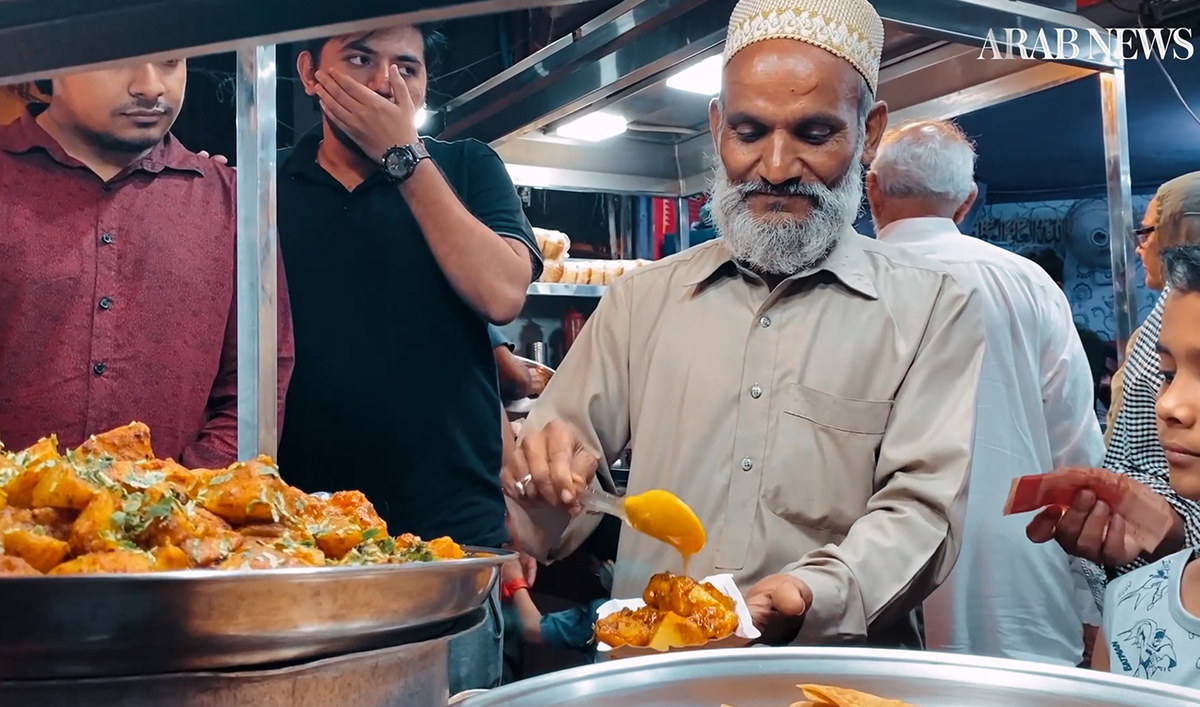


Street food vendor serving Bohra cuisine to customers at the Paper Market in Karachi, Pakistan on April 10, 2023. (AN Photo)

Saifuddin, who sells malpura, set up the stall in 1980 when there were only a couple of vendors in the street. Over time, the number of vendors increased to more than a dozen, and now the market has a large number of them.

Malpura is the top attraction for people coming to the street who wait for their turn to buy it since they are issued token numbers. The dish is made of batter comprising flour, eggs, and sugar. It is then deep-fried and served with creamy sauce.

“We are here all year long, but the rest of the vendors only come during Ramadan,” said Saifuddin. “People come here for sehri as well. The place runs better during Ramadan. We stay here until 2-2:30 am.”

Another highlight of the street is Bohra alu kachori, made of desiccated flatbread, also called papad, which has potato filling. It usually gets sold out nearly three hours before the Ramadan morning meal.

“I have been setting up a stall here for the last 12 to 13 years,” Ali Hussain, another vendor, told Arab News. “Prior to that, my elder brother used to do it. It has been 40 years. It is specifically for Ramadan. Mostly, Bohris come here, but Memons and other [communities] also visit the shop. Whoever eats it comes back. No one leaves the place without trying out our food.”

The process to make Bohra alu kachori is really long, he said, adding it was not possible for everyone to make it.

“Bohra cuisine is unique. I don’t see many communities having such specific qualities in their taste. It’s nice, it’s different,” Asad Javed, a non-Bohra visitor who called himself “a fan of bun kaleji,” told Arab News.
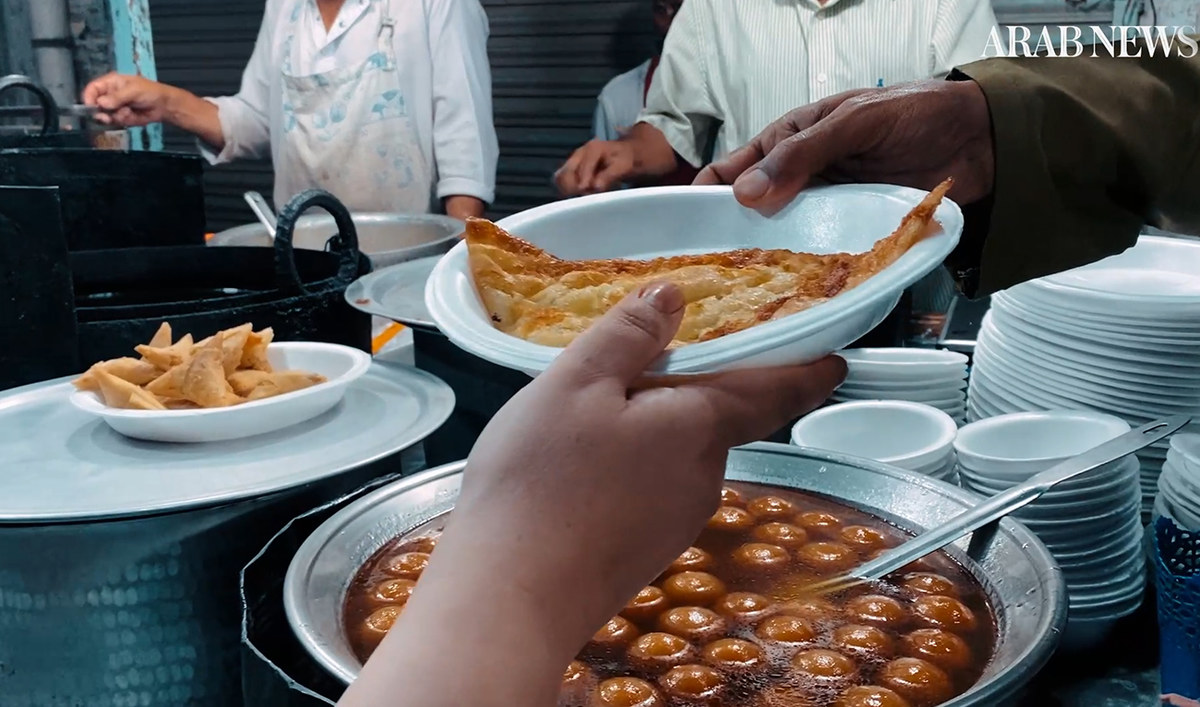


The screengrab shows street food vendor serving Bohra cuisine to customers at the Paper Market in Karachi, Pakistan on April 10, 2023. (AN Photo)

“I don’t see kaleji and these kinds of items in many other communities. But it’s quite common among Bohra communities.”

Sakina Hussain, who belongs to the Bohra community, said that all the items available at the food street were also made by her family and friends at home.

“Even when you eat at our weddings, you will find a touch of home in it,” she continued. “Now, we’ve added Afghani, Turkish, and Italian flavors to Bohra food. We add a Bohra touch and amend these cuisines.”

“People in the Bohra community are known to be foodies, and they keep trying new flavors,” Hussain added. “Bohra alu kachori is a purely Bohra cuisine; you won’t find it anywhere else. You can either get it on order or find it in our homes. Bohra people are often asked to cater and make Bohra dishes for other communities.”

Bohra cuisine is influenced by Gujarati, Arab, and Middle Eastern cooking styles. According to community member Juzer Adam, this journey started from Egypt and spread to India and the rest of the world.

“Our way of cooking is clean,” he said. “The system in the Bohra community is good, and our food is not wasted. Everyone sits and eats together.”


Recipes for Success: Chef Karishma Sakhrani offers advice and a mutton kabab recipe

Updated 05 February 2026
Follow

Recipes for Success: Chef Karishma Sakhrani offers advice and a mutton kabab recipe

DUBAI: Karishma Sakhrani’s path into the kitchen was not a straightforward one. Before food became her full focus, she was working in fashion and business, building a career that looked good on paper but felt incomplete.  

It was not until she reached the finals of “MasterChef India” that the disconnect became impossible to ignore and she decided to pursue food seriously, even without formal culinary training. 

Sakhrani built her skills through repetition and risk — hosting pop-ups, cooking private dinners, developing menus, collaborating with restaurants and moving between cities as opportunities came up.  

Now based in Dubai, Sakhrani runs her own dining concept, Viceroy’s Table, while also collaborating with a number of other restaurants.  

When you started out, what was the most common mistake you made? 

I tried to do too much. I was obsessed with complexity — more elements on the plate, more techniques, more garnishes. I believed that effort automatically translated to excellence. Over time, I realized that restraint is actually the hardest skill to master. The most memorable dishes are often the simplest ones, executed with confidence and consistency. Learning when to stop, when not to add another step or ingredient, was a turning point for me. 

What’s your top tip for amateur chefs? 

Recipes are guides, not rulebooks. Go with your instinct and trust your palate. Ingredients vary, stoves behave differently, and your taste matters. If something needs more salt or acidity, adjust it. Also, don’t rush! Cooking is much more enjoyable when you allow yourself to be present rather than stressed about the outcome. For me, cooking is meditative. I just lose myself in a trance when I’m cooking at home.  

What one ingredient can instantly improve any dish?  

Lemon! A squeeze of lemon can completely transform a dish because acidity wakes everything up; it sharpens flavors, balances richness and adds freshness without overpowering what’s already there. Whether it’s a few drops at the end of a curry, a salad dressing, grilled vegetables, or even a dessert, lemon brings brightness and clarity. It’s often the missing element when a dish tastes flat, and a reminder that balance is just as important as seasoning. 

When you go out to eat, do you find yourself critiquing the food?  

I try not to overanalyze when I’m dining out, but it’s instinctive to notice details. 

What’s the most common issue you see in other restaurants? 

Inconsistency — a dish might be great one visit and disappointing the next. Often, this comes down to lack of attention to basics or rushed execution. Consistency is what builds trust with diners. 

What’s your favorite cuisine or dish to order? 

Pizza. The perfect char, crisp crust, and molten cheese of a wood-fired pizza is impossible to achieve in a regular oven. I also love Japanese food. The precision, balance, and respect for ingredients always impress me. From delicate sushi to rich ramen, it’s about technique meeting simplicity; flavors are subtle, textures matter, and everything feels intentional. 

What’s your go-to dish if you have to cook something quickly at home? 

Spaghetti Aglio e Olio. It’s simple, satisfying, and full of flavor. With just garlic, olive oil, chili, parsley, and spaghetti, you can create something comforting yet vibrant. It hits the spot every time, proving that a few good-quality, basic ingredients can make a dish feel elevated without spending hours in the kitchen. 

What customer behavior most annoys you? 

I’m generally very relaxed, so I don’t get annoyed easily. If anything, it’s when guests make changes to a dish, and then aren’t exactly happy at the end of it: the way a dish is designed is very intentional and thoughtful. 

What’s your favorite dish to cook? 

Believe it or not, my favorite dishes are salads. It might sound simple, but salads are where my creativity really shines. My journey with cooking actually started with a focus on healthy eating, and over time I’ve come to love the challenge of turning basic ingredients into something extraordinary. What excites me about salads is the endless opportunity to experiment with flavors, textures, and colors.  

What’s the most difficult dish for you to get right? 

Desserts are by far the most challenging for me. They demand such precision — temperatures, measurements, timing, and technique all have to align perfectly. Even a tiny misstep can change the texture, consistency, or flavor completely. That’s what makes them so intimidating, but also so fascinating. I genuinely wish I had more time to dedicate to learning and experimenting with them.  

As a head chef, what are you like in the kitchen? 

I’m firm but really calm. I believe kitchens run best on clarity, respect, and accountability rather than fear. High standards don’t need aggression. When people feel supported, they perform better, learn faster, and take pride in their work. 

Chef Karishma’s peshawari mutton chapli kabab recipe 

Chef Karishma’s peshawari mutton chapli kabab. (Supplied) 

Servings: 6–8 kababs 
Prep time: 20 mins 
Cook time: 15 mins 

 Ingredients

Mutton mince (with some fat) – 500g (coarsely ground, not fine) 

Onions – 1 large (finely chopped, water squeezed out) 

Tomato – 1 medium (finely chopped) 

Green chilies – 2–3 (finely chopped) 

Coriander leaves – a handful (chopped) 

Mint leaves – a few (chopped, optional) 

Garlic paste – 1 tsp 

Ginger paste – 1 tsp 

Crushed coriander seeds – 1 tsp 

Pomegranate seeds (anardana) – 1 tsp (crushed) 

Cumin seeds – 1 tsp (roasted & crushed) 

Red chili flakes – 1 tsp (adjust to taste) 

Salt – to taste 

Cornmeal (makai ka atta) – 2–3 tbsp (for binding) 

Egg – 1 (optional, for binding) 

Tomato slices – for topping (optional, very authentic!) 

Oil or ghee – for shallow frying 

Instructions

Mix the mince: 

In a large bowl, combine mutton mince with all the chopped veggies, herbs, spices, and cornmeal. 

Mix well using your hand (the warmth helps blend everything). 

Add egg if needed for extra binding. 

Let the mixture rest in the fridge for 30 mins (helps firm it up). 

Shape the kababs: 

Wet your hands and shape large, flat patties (authentic chapli kababs are wide and a bit thin). 

Optional: press a thin tomato slice into the center of each kabab. 

Fry: 

Heat oil or ghee in a shallow frying pan. 

Fry kababs on medium-high heat until golden brown and cooked through, about 4–5 minutes per side. 

Serve hot: 

Enjoy with naan, chutney, and raw onions or salad.