In Pakistan, no Ramadan iftar meal is complete without pakoras

Muslim devotees buy Iftar food at a market before breaking their fast on the first day of the holy month of Ramadan, in Karachi on March 23, 2023. (Photo courtesy: AFP)
Short Url
Updated 28 March 2023
Follow

In Pakistan, no Ramadan iftar meal is complete without pakoras

  • Crispy and well-seasoned, pakoras are fritters made from most any vegetable deep fried in spicy chickpea batter
  • Traditional pakora sellers expand businesses in Ramadan, seasonal vendors open makeshift stalls to meet demand

ISLAMABAD: Can an iftar meal in Pakistan be complete without pakoras?

Crispy and well-seasoned, pakoras are fritters that can be made from most any vegetable deep fried in spicy chickpea batter and enjoyed with sweet or sour chutney, mint yogurt or dipping sauces. The snack has deep historical roots in the Indian subcontinent but becomes especially popular during the holy month of Ramadan when traditional pakora sellers expand their businesses and new seasonal vendors open makeshift stalls to meet rising demand.

There are many reasons for the deep-fried treats' popularity in Ramadan, not least that they provide the quick energy boost that believers abstaining from food and drink during daylight hours need to break their fast at dusk. The fried snacks are also a common iftar choice due to their low price.

Taimur Adil, a customer standing in line to buy pakoras at the Blue Area commercial area in Islamabad, explained the popularity of pakoras in Ramadan.

“The first is because it's a very calorie-rich snack and you get very hungry during the fast, so, inevitably by the time iftar comes you want to eat something like a pakora … you can't resist it, it's exactly what your body is craving for,” Adil told Arab News.

“The second reason is cultural ... we have been eating this for so many generations that we have come to believe that iftar is not complete without it.”

The ease of making pakoras and the few ingredients required are also attractive features of the snack for those who prefer to make them at home.

“This is an easy recipe that can be prepared at home with just two or three ingredients,” Mrs Tariq Hassan, who was shopping for iftar grocery at Islamabad’s upscale Rana Market, said.

“This is why whether someone belongs to any social class, it is something so easy that it is made in every household.”
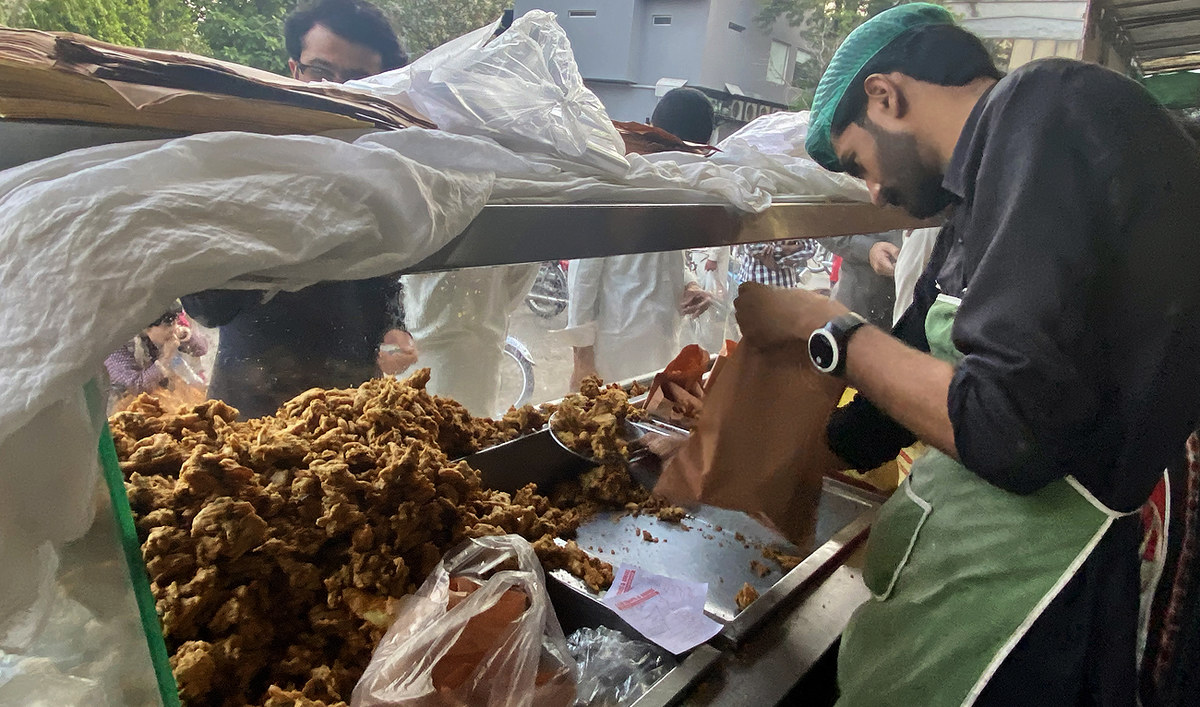


A worker prepares a bag of fritters at a market in Islamabad on March 26, 2023. (AN Photo)

Indeed, all it takes to make pakoras is to first thinly chop up some vegetables, usually potatoes, onions, aubergine, spinach and cauliflower. The batter is prepared with chickpea flour, salt and spices and moistened with water. The vegetables are then dipped in the batter and deep-fried until golden brown.

 In Ramadan, the demand for the easy-to-make snack skyrockets.

Asghar Ali, a vendor at Siddique Sweets and Bakers, said food items like pakoras, samosas, and other savory fried snacks sell very well in the holy month.

“We are doing this business since 1942 and the demand for our samosas and pakoras increases during Ramadan,” he said, adding that sales increased threefold and he had to hire extra employees to keep up with the demand.

“Our regular staff size of 25 people increases to 80 during Ramadan as approximately 120 kilograms of pakoras and 3,000-4,000 samosas are sold daily,” Ali said.

Another seller at Fresco Sweets, Osman Farooqi, said he only introduced pakoras to his menu in Ramadan.

“On regular days, we don't make fritters, only during Ramadan we prepare it, as demand for these items increases by almost 75 percent,” Farooqi told Arab News, saying his employees had to start preparing the batter and vegetables in the morning so that huge quantities of pakoras could be ready by sunset.

“I make pakoras only in Ramadan as it is in high demand,” Amjad Ali, another vendor said. “We sell around 300 kilograms daily at our four branches in Islamabad.”

And many people also only eat pakoras in Ramadan.

Zulifqar Hussain, shopping for pakoras at an Islamabad neighborhood market, said his children only wanted to break their fast with the vegetable fritters.

“On regular days, we use very little pakoras,” he said, “but in Ramadan their demand increases [because] we need saltish things in iftar.”
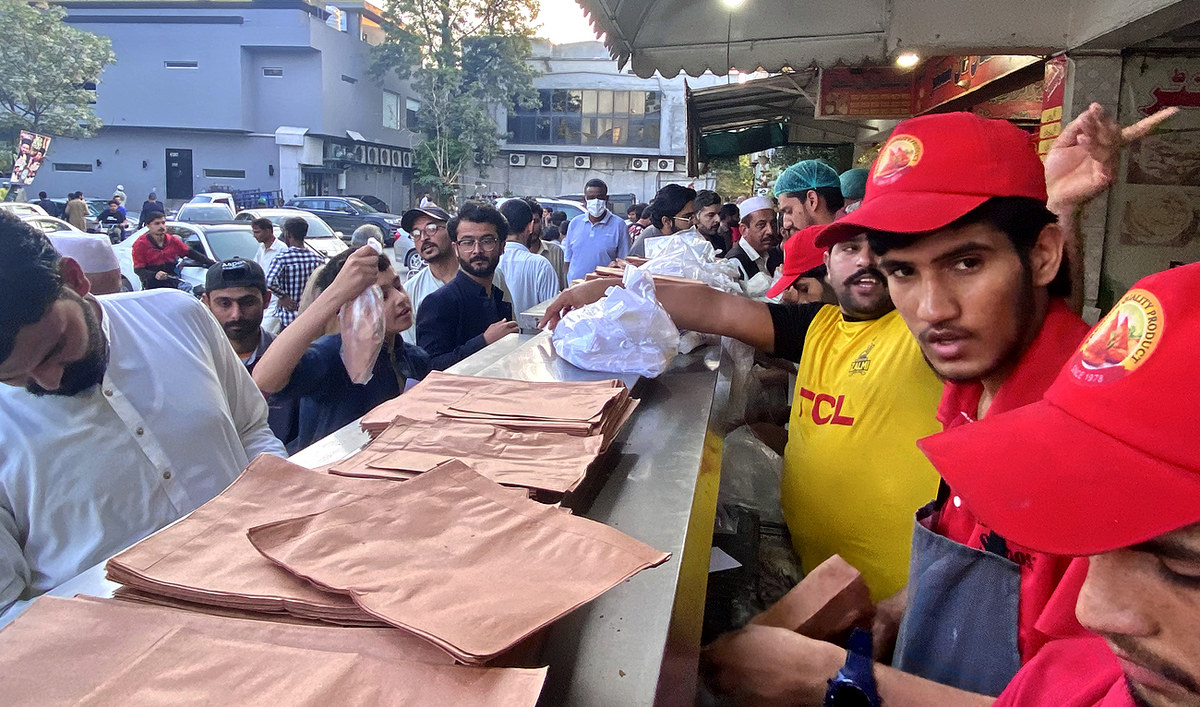



People queue to buy fritters at a market to break their fast during the holy month of Ramadan, in Islamabad on March 26, 2023. (AN Photo)


Akio Fujimoto discusses RSIFF Golden Yusr winner ‘Lost Land’ 

Akio Fujimoto at the Red Sea International Film Festival in Jeddah. (Getty Images)
Updated 19 December 2025
Follow

Akio Fujimoto discusses RSIFF Golden Yusr winner ‘Lost Land’ 

  • The Japanese filmmaker on his groundbreaking Rohingya-language feature

JEDDAH: Some stories demand to be told. Not just as narratives, but as acts of witness.  

Japanese filmmaker Akio Fujimoto’s “Lost Land” is one such story. Billed as the first feature film in the Rohingya language, the movie took home the top prize — the Golden Yusr — at this year’s Red Sea International Film Festival. 

“Lost Land” — which premiered in the Horizons section at this year’s Venice Film Festival, where it won the special jury prize — follows two young Rohingya siblings, Somira and Shafi, fleeing persecution in Myanmar as they undertake a perilous journey d to join their uncle in Malaysia. 

Shomira Rias Uddin (R) and Muhammad Shofik Rias Uddin in 'Lost Land.' (Supplied) 

Presenting the Golden Yusr to Fujimoto, RSIFF jury head, the US filmmaker Sean Baker, said the film “confronts the plight of displaced children with unflinching empathy and poetic urgency.” 

Fujimoto’s journey to this film is a profound narrative of personal reckoning. Having worked in Myanmar for more than a decade, he recognized the unspoken tensions surrounding discussions about refugee experiences but never spoke out himself due to fear of persecution. The 2021 military coup in Myanmar, he said, forced him to confront a lingering sense of guilt about his previous silence on the subject. 

“Looking back on my decade of work, I realized I had been avoiding topics I wanted to focus on as a filmmaker,” Fujimoto said in an interview with Arab News at RSIFF. 

That self-reflection became the catalyst for “Lost Land,” transforming personal hesitation into a powerful act of cinematic storytelling. 

Eschewing traditional casting methods, Fujimoto discovered his lead actors through serendipity during community fieldwork. Shomira Rias Uddin and Muhammad Shofik Rias Uddin, real-life siblings who play the film’s young leads, were found walking near interview locations, compelling the filmmaker to reshape the entire script around their natural chemistry. While the original script was written with two teenage brothers in mind, the discovery of the Rias Uddin siblings led Fujimoto to alter the script significantly. 

Communication between the cast and crew became an intricate dance of translation and cultural bridge-building. With Fujimoto speaking primarily Japanese and some Burmese, the team relied on Sujauddin Karimuddin, a Rohingya translator who did far more than linguistic conversion. “He wasn’t just translating words but conveying messages, creating trust, and establishing a collaborative atmosphere,” said Watanabe, Fujimoto’s translator. 

One of the most remarkable aspects of “Lost Land” is its linguistic significance. Beyond being a narrative, the film serves as a critical instrument of cultural preservation. Karimuddin, who is also a producer on the film, approached his role like a linguistic curator. “As a Rohingya myself, I had the privilege of choosing words carefully, trying to instill poetry, capturing linguistic nuances that are slowly disappearing. So, the film is very important when it comes to the preservation of a people’s language. It was a privilege for me to contribute to it,” he said. 

As they were making the first fiction film focused on Rohingya experiences, the team felt an immense responsibility. “Lost Land” aims to humanize a community often reduced to statistics, giving voice and complexity to individual experiences.

Shomira Rias Uddin and Muhammad Shofik Rias Uddin (R) in 'Lost Land.' (Supplied) 

“In our film, we had around 200 people — including extras — who were all part of the Rohingya community. I felt in order to show their feelings and their voice; it was really important to bring in the Rohingya people and tell the story together with them,” said Fujimoto. 

For Fujimoto, whose previous films include “Passage of Life” (2017) and “Along the Sea” (2020), the film represents more than an artistic achievement. It’s a form of personal and collective redemption. “I can now clearly talk about these people without hesitation,” he said. 

The filmmaker’s future ambitions involve expanding on this project. He sees “Lost Land” as a crucial first step, and hopes to support Rohingya filmmakers in telling their own stories directly. 

“The next phase is bringing narratives from the Rohingya perspective, directed by Rohingya filmmakers,” he said.