

Consumers face tough Ramadan as weekly inflation hits all-time high of 46.65 percent in Pakistan

Muslim devotees buy Iftar food at a market before breaking their fast on the first day of the holy month of Ramadan, in Lahore on March 23, 2023. (AFP/FILE)
Short Url
Updated 26 March 2023
Follow

Consumers face tough Ramadan as weekly inflation hits all-time high of 46.65 percent in Pakistan

  • Prices of most essential commodities have more than doubled since last year amid currency depreciation, global price hike
  • Financial expert say food-price inflation is ‘crushing’ Pakistan’s low-income citizens who now spend more to feed their families

KARACHI: The Pakistan Bureau of Statistics (PBS) announced on Friday weekly inflation reached 46.65 percent on an annual basis during the ongoing week, indicating an unprecedented price hike experienced by low- and middle-income consumers across the country during the holy month of Ramadan.

According to official statistics, the price of onions on an annual basis has increased by 228.28 percent while people have to spend 120.66 percent more to buy wheat flour. The price of tea has also gone up by 94.60 percent, bananas by 89.84 percent, rice by 81.51 percent, and potatoes by 57.21 percent.

The PBS statistics reveal that a 20-kilogram bag of flour, one of the most commonly consumed commodities, has witnessed an increase in price from Rs1,817 to Rs2,586. The flour bag was available for Rs1,172 last year in March.

According to analysts, inflation has escalated further due to a number of factors, including rising demand for food items in Ramadan and depreciation of Pakistan’s national currency.

“This is the highest ever weekly surge in inflation measured by the sensitive price index,” Samiullah Tariq, research director at the Pakistan-Kuwait Investment Company, told Arab News. “Ramadan demand, currency depreciation, and commodities price hike in the international market are key factors that have contributed to historically high inflation.”

Pakistani consumers complain they have been spending bigger chunks of their income on food items in recent months.

“I spend more than half of my salary on food to feed my family,” Muhammad Zeeshan, a private office worker, said. “All my income vanishes before the end of the month once I pay my house rent and utility bills, etc.”

Inflation measured by the Consumer Price Index more than doubled since March last year when it was recorded at 12.7 percent and reached 31.5 percent last month. The high inflation has particularly bothered the salaried class which depends on a fixed income.

“Inflation is a key indicator of the state of a country’s economy,” Dr. Khaqan Najeeb, former adviser to the finance ministry, told Arab News on Friday. “Pakistan’s economy is suffering from the harmful effects of inflationary pressure which is negatively impacting the economic lives of citizens and businesses alike.”

“Rising prices have hit households globally,” he continued. “However, they have a more pronounced impact on Pakistan since the country is heavily dependent on imports like petroleum products, edible oil, machinery, food, vehicles, mobiles, and industrial raw materials.”
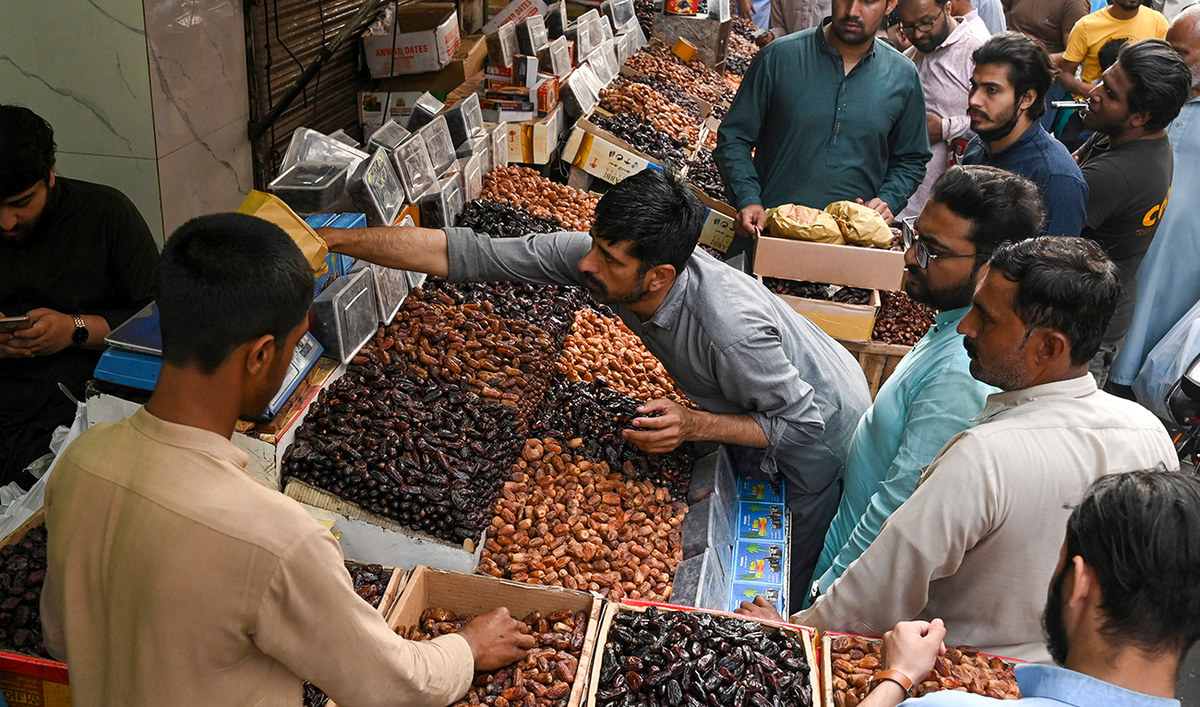


Muslim devotees buy dates at a market before breaking their fast on the first day of the holy month of Ramadan, in Lahore on March 23, 2023. (AFP/File)

Najeeb said Pakistan’s low-income groups were primarily impacted by spiraling food inflation.

“Food-price inflation is crushing Pakistan’s low-income citizens who spend more than half of their incomes to feed their families,” he said. “Low agricultural productivity and the problem of regulated energy prices are two key domestic drivers of inflation in our economy.”

Some people complain about a lack of administrative will to control the prices of food items and other products, pointing out that consumers also suffer when profiteers charge higher rates.

However, the administration of Pakistan’s southern Sindh province says it has taken steps to deal with the issue by promulgating an ordinance that empowers officials from various government departments to check market prices.

“With the enforcement of the ordinance, the relevant department has been empowered to take action against profiteers,” Abdul Rasheed Channa, spokesperson for the province’s chief minister, told Arab News.

“The relevant departments will ensure that goods are being sold at the official rates,” he added. “The teams will raid markets, and the results will be visible in the next couple of days.”

As per a Sindh government notification released on Friday, officials from different departments will inspect the food quality, impose monetary fines, and shut down the businesses of offenders.


Pakistan, Iraq agree on tighter coordination over pilgrims under new regulated travel system

Updated 4 sec ago
Follow

Pakistan, Iraq agree on tighter coordination over pilgrims under new regulated travel system

  • New system requires all Iraq-Iran pilgrimages to be organized by licensed groups under state oversight
  • Long-running “Salar” model relied on informal caravan leaders, leading to overstays and missing pilgrims

ISLAMABAD: Pakistan and Iraq this week agreed to closely coordinate on the management and security of Pakistani pilgrims, as Islamabad rolls out a new, tightly regulated travel system aimed at preventing overstays, undocumented migration and security breaches during religious visits to Iraq and Iran.

The understanding was reached during a meeting between Pakistan’s Interior and Narcotics Control Minister Mohsin Naqvi and Iraq’s Interior Minister General Abdul Amir Al-Shammari on Thursday evening, where both sides discussed measures to facilitate pilgrims while strengthening oversight, Pakistan’s interior ministry said.

The agreement comes as Pakistan dismantles its decades-old pilgrim travel model and replaces it with a centralized, licensed system after authorities confirmed that tens of thousands of Pakistani pilgrims had overstayed or gone missing abroad over the past decade, triggering concerns from host governments.

“You have, for the first time during your tenure, taken effective measures to organize pilgrim groups, which are commendable,” Al-Shammari told Naqvi, according to Pakistan’s interior ministry.

“All pilgrims included in the list provided by Pakistan’s Ministry of Interior will be allowed to enter Iraq,” he added, making clear that only travelers cleared under the new system would be permitted.

Naqvi said Pakistan would strictly enforce return timelines under the revised framework.

“Pilgrims traveling to Iraq will not be allowed to stay beyond the designated period,” he said, adding that relevant authorities in both countries would remain in close coordination.

Both interior ministers also agreed to strengthen information-sharing and joint mechanisms on security cooperation, counterterrorism and the prevention of human smuggling, officials said.

“The safety, dignity, and facilitation of Pakistani pilgrims is the top priority of the Government of Pakistan,” Naqvi said.

Al-Shammari said he would visit Pakistan soon to finalize a joint roadmap to further improve pilgrim facilitation, security coordination and broader bilateral cooperation, according to the interior ministry.

Pakistan’s government has overhauled its pilgrim travel regime this year, abolishing the long-running “Salar” system under which informal caravan leaders managed pilgrimages. The move followed official confirmation that around 40,000 Pakistani pilgrims had overstayed or disappeared in Iran, Iraq and Syria over the past ten years.

Under the new Ziyarat Management Policy, only licensed Ziyarat Group Organizers (ZGOs) are allowed to arrange pilgrimages, with companies held directly responsible for ensuring pilgrims return on time. Authorities have completed security clearance for 585 companies seeking registration, while scrutiny of applications remains ongoing.

Islamabad has also barred overland travel for major pilgrimages, including Arbaeen, citing security risks in Pakistan’s southwestern Balochistan province, meaning all travel to Iraq and Iran is now restricted to regulated air routes.

Tens of thousands of Pakistani pilgrims travel each year to Iraq and Iran to visit some of the most revered shrines in Shia Islam, including the mausoleums of Imam Ali in Najaf and Imam Hussain in Karbala in Iraq, and major religious sites in Mashhad and Qom in Iran. Pilgrimages peak during religious occasions such as Arbaeen, when millions of worshippers converge on Karbala from across the region. The scale of travel, often involving long stays and cross-border movements, has long posed logistical, security and migration-management challenges for Pakistani authorities and host governments alike.