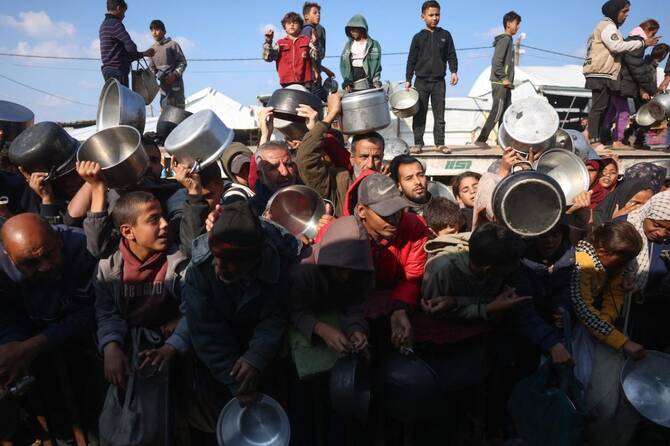
TEL AVIV: The spread of famine has been averted in Gaza yet the situation remains critical with the entire strip still facing starvation, the world’s leading authority on food crises said Friday.
The new report by The Integrated Food Security Phase Classification, or IPC, comes months after the group said famine was occurring in Gaza City and likely to spread across the territory without a ceasefire and an end to humanitarian aid restrictions.
There were “notable improvements” in food security and nutrition following an October ceasefire and no famine has been detected, the report said. Still, the IPC warned the situation remains “highly fragile” and the entire Gaza Strip is in danger of starvation with nearly 2,000 people facing catastrophic levels of hunger through April.
In the worst-case scenario, including renewed conflict and a halt of aid, the whole strip is at risk of famine. Needs remain immense and sustained, expanded and unhindered aid is required, the IPC said.
The Israeli military agency in charge of coordinating aid to Gaza, known as COGAT, said Friday it strongly rejected the findings.
The agency adheres to the ceasefire and allows the agreed amount of aid to reach the strip, COGAT said, noting the aid quantities “significantly exceed the nutritional requirements of the population” in Gaza according to accepted international methodologies, including the United Nations.
The Israeli Foreign Ministry said Friday it also rejects the findings, saying the IPC’s report doesn’t reflect reality in Gaza and more than the required amount of aid was reaching the strip.
Israel’s government has rejected the IPC’s past findings, with Israeli Prime Minister Benjamin Netanyahu calling the previous report an “outright lie.”
The report’s findings come as the shaky US-brokered ceasefire between Israel and Hamas reaches a pivotal point as Phase 1 nears completion, with the remains of one hostage still in Gaza. The more challenging second phase has yet to be implemented and both sides have accused the other of violating the truce.
The IPC in August confirmed the grim milestone of famine for the first time in the Middle East and warned it could spread south to Deir Al-Balah and Khan Younis. More than half a million people in Gaza, about a quarter of its population, faced catastrophic levels of hunger, with many at risk of dying from malnutrition-related causes, the August report said.
Friday’s report said the spread of famine had been offset by a significant reduction in conflict, a proposed peace plan and improved access for humanitarian and commercial food deliveries.
There is more food on the ground and people now have two meals daily, up from one meal each day in July. That situation “is clearly a reversal of what had been one of the most dire situations where we were during the summer,” Antoine Renard, the World Food Program’s director for the Palestinian territories, told UN reporters in a video briefing from Gaza City Thursday.
Food access has “significantly improved,” he said, warning that the greatest challenge now is adequate shelter for Palestinians, many of whom are soaked and living in water-logged tents. Aid groups say nearly 1.3 million Palestinians need emergency shelter as winter sets in.
Displacement is one of the key drivers behind the food insecurity, with more than 70 percent of Gaza’s population living in makeshift shelters and relying on assistance. Other factors such as poor hygiene and sanitation as well as restricted access to food are also exacerbating the hunger crisis, the IPC said.
While humanitarian access has improved compared with previous analysis periods, that access fluctuates daily and is limited and uneven across the strip, the IPC said.
To prevent further loss of life, expanded humanitarian assistance including food, fuel, shelter and health care is urgently needed, according to the group’s experts, who warned that over the next 12 months more than 100,000 children between the ages of 6 months and 5 years are expected to suffer from acute malnutrition and require treatment.
Figures recently released by Israel’s military suggest it has not met the ceasefire stipulation of allowing 600 trucks of aid into Gaza each day, though Israel disputes that finding. American officials with the US-led center coordinating aid shipments into Gaza also say deliveries have reached the agreed levels.
Aid groups say despite increase of assistance, aid is still not reaching everyone in need after suffering two years of war.
“This is not a debate about truck numbers or calories on paper, it’s about whether people can actually access food, clean water, shelter and health care safely and consistently. Right now, they cannot,” said Bushra Khalidi, Oxfam’s policy lead for Israel and the occupied Palestinian territory.
People must be able to rebuild their homes, grow food and recover and the conditions for that are still being denied, she said.

Spread of Gaza famine has been averted yet strip still faces starvation, experts say
https://arab.news/wexkk
Spread of Gaza famine has been averted yet strip still faces starvation, experts say
- The report comes months after the IPC said famine was occurring in Gaza City and was likely to spread across the territory
- The report says there were notable improvements in food security and nutrition following an October ceasefire and no famine has been detected
Palestinian citizens in Israel demand more security from violence
- Protests and strikes are sweeping Israel over record levels of violence targeting the country’s Palestinian citizens
- At least 26 people were killed in January alone, adding to a record-breaking toll of more than 250 last year
KAFR YASIF, Israel: Nabil Safiya had taken a break from studying for a biology exam to meet a cousin at a pizza parlor when a gunman on a motorcycle rode past and fired, killing the 15-year-old as he sat in a black Renault.
The shooting — which police later said was a case of mistaken identity — stunned his hometown of Kafr Yasif, long besieged, like many Palestinian towns in Israel, by a wave of gang violence and family feuds.
“There is no set time for the gunfire anymore,” said Nabil’s father, Ashraf Safiya. “They can kill you in school, they can kill you in the street, they can kill you in the football stadium.”
The violence plaguing Israel’s Arab minority has become an inescapable part of daily life. Activists have long accused authorities of failing to address the issue and say that sense has deepened under Israel’s current far-right government.
One out of every five citizens in Israel is Palestinian. The rate of crime-related killings among them is more than 22 times higher than that for Jewish Israelis, while arrest and indictment rates for those crimes are far lower. Critics cite the disparities as evidence of entrenched discrimination and neglect.
A growing number of demonstrations are sweeping Israel. Thousands marched in Tel Aviv late Saturday to demand action, while Arab communities have gone on strike, closing shops and schools.
In November, after Nabil was gunned down, residents marched through the streets, students boycotted their classes and the Safiya family turned their home into a shrine with pictures and posters of Nabil.
The outrage had as much to do with what happened as with how often it keeps happening.
“There’s a law for the Jewish society and a different law for Palestinian society,” Ghassan Munayyer, a political activist from Lod, a mixed city with a large Palestinian population, said at a recent protest.
An epidemic of violence
Some Palestinian citizens have reached the highest echelons of business and politics in Israel. Yet many feel forsaken by authorities, with their communities marked by underinvestment and high unemployment that fuels frustration and distrust toward the state.
Nabil was one of a record 252 Palestinian citizens to be killed in Israel last year, according to data from Abraham Initiatives, an Israeli nongovernmental organization that promotes coexistence and safer communities. The toll continues to climb, with at least 26 additional crime-related killings in January.
Walid Haddad, a criminologist who teaches at Ono Academic College and who previously worked in Israel’s national security ministry, said that organized crime thrives off weapons trafficking and loan‑sharking in places where people lack access to credit. Gangs also extort residents and business owners for “protection,” he said.
Based on interviews with gang members in prisons and courts, he said they can earn anywhere from thousands to hundreds of thousands of dollars, depending on whether the job is torching cars, shooting at buildings or assassinating rival leaders.
“If they fire at homes or people once or twice a month, they can buy cars, go on trips. It’s easy money,” Haddad said, noting a widespread sense of impunity.
The violence has stifled the rhythm of life in many Palestinian communities. In Kafr Yasif, a northern Israel town of 10,000, streets empty by nightfall, and it’s not uncommon for those trying to sleep to hear gunshots ringing through their neighborhoods.
Prosecutions lag
Last year, only 8 percent of killings of Palestinian citizens led to charges filed against suspects, compared with 55 percent in Jewish communities, according to Abraham Initiatives.
Lama Yassin, the Abraham Initiatives’ director of shared cities and regions, said strained relations with police long discouraged Palestinian citizens from calling for new police stations or more police officers in their communities.
Not anymore.
“In recent years, because people are so depressed and feel like they’re not able to practice day-to-day life ... Arabs are saying, ‘Do whatever it takes, even if it means more police in our towns,’” Yassin said.
The killings have become a rallying cry for Palestinian-led political parties after successive governments pledged to curb the bloodshed with little results. Politicians and activists see the spate of violence as a reflection of selective enforcement and police apathy.
“We’ve been talking about this for 10 years,” said Knesset member Aida Touma-Suleiman.
She labeled policing in Palestinian communities “collective punishment,” noting that when Jews are victims of violence, police often set up roadblocks in neighboring Palestinian towns, flood areas with officers and arrest suspects en masse.
“The only side that can be able to smash a mafia is the state and the state is doing nothing except letting (organized crime) understand that they are free to do whatever they want,” Touma-Suleiman said.
Many communities feel impunity has gotten worse, she added, under National Security Minister Itamar Ben-Gvir, who with authority over the police has launched aggressive and visible campaigns against other crimes, targeting protests and pushing for tougher operations in east Jerusalem and the occupied West Bank.
Israeli police reject allegations of skewed priorities, saying that killings in these communities are a top priority. Police also have said investigations are challenging because witnesses don’t always cooperate.
“Investigative decisions are guided by evidence, operational considerations, and due process, not by indifference or lack of prioritization,” police said in a statement.
Unanswered demands
In Kafr Yasif, Ashraf Safiya vowed his son wouldn’t become just another statistic.
He had just gotten home from his work as a dentist and off the phone with Nabil when he learned about the shooting. He raced to the scene to find the car window shattered as Nabil was being rushed to the hospital. Doctors there pronounced him dead.
“The idea was that the blood of this boy would not be wasted,” Safiya said of protests he helped organize. “If people stop caring about these cases, we’re going to just have another case and another case.”
Authorities said last month they were preparing to file an indictment against a 23-year-old arrested in a neighboring town in connection with the shooting. They said the intended target was a relative, referring to the cousin with Nabil that night.
And they described Nabil as a victim of what they called “blood feuds within Arab society.”
At a late January demonstration in Kafr Yasif, marchers carried portraits of Nabil and Nidal Mosaedah, another local boy killed in the violence. Police broke up the protest, saying it lasted longer than authorized, and arrested its leaders, including the former head of the town council.
The show of force, residents said, may have quashed one protest, but did nothing to halt the killings.


