

Pakistan telecom infrastructure and VC firms flag tax, regulatory constraints, propose remedies

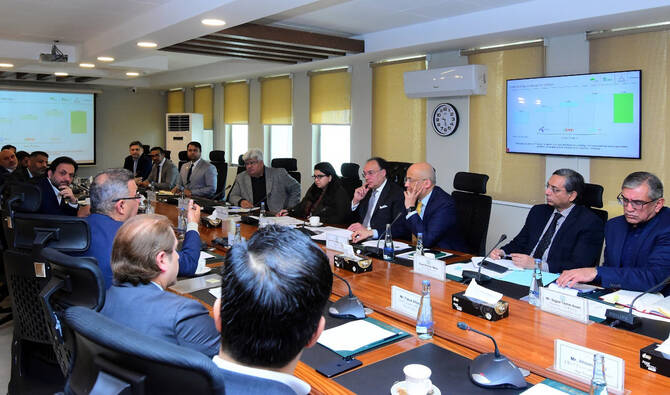
Federal Minister for Finance and Revenue, Muhammad Aurangzeb, holding meeting with a delegation comprising telecommunication infrastructure companies (TOWERCO Pakistan) and Venture Capital Firms (VCs) at the Finance Division in Islamabad, on December 19, 2025. (Ministry of Finance)
Short Url
Updated 19 December 2025
Follow

Pakistan telecom infrastructure and VC firms flag tax, regulatory constraints, propose remedies

  • Finance minister agrees to set up working group to examine proposals, develop recommendations
  • Development comes as Pakistan seeks investment in digital connectivity and technology-led growth

KARACHI: Federal Minister for Finance and Revenue Muhammad Aurangzeb met a delegation of telecom infrastructure companies and venture capital firms on Friday to review sectoral issues, including taxation and regulatory challenges, as the government looks to support investment in digital connectivity and technology-led growth.

Unlike mobile operators that sell voice and data services to consumers, telecom infrastructure companies own and operate physical assets such as mobile towers, which they lease to network operators. The firms operate capital-intensive businesses that rely on long-term investment and face regulatory approvals for tower deployment, power supply and right-of-way permissions.

Tower-related businesses in Pakistan also face tax issues alongside high upfront costs, import duties on equipment and complex provincial and local approval processes as constraints on expansion.

“During the meeting, participants shared an overview of their respective business models, operational dynamics, and on-ground challenges, particularly those related to physical infrastructure deployment and regulatory compliance,” the finance division said in a statement after the meeting.

“Members of the delegation presented a number of proposals aimed at rationalizing and relaxing elements of the existing tax regime to help facilitate further growth, enhance investment flows and support expansion in both the telecommunications infrastructure and venture capital sectors,” it continued.

The finance minister said the government was committed to facilitating private sector-led growth while maintaining fiscal discipline, and stressed the importance of predictable and transparent policies to attract long-term investment in technology and infrastructure.

“It was agreed that a dedicated working group would be constituted, comprising representatives from the Tax Policy Office and other relevant stakeholders, to undertake a detailed examination of the proposals and recommendations presented by the delegation,” the statement said.

“The working group will assess the proposals in detail and develop actionable recommendations,” it added.


Pakistan expresses condolences as Bangladesh’s first female PM passes away

Updated 30 December 2025
Follow

Pakistan expresses condolences as Bangladesh’s first female PM passes away

  • Khaleda Zia passed away in Dhaka after prolonged illness at the age of 80, says her party
  • PM Shehbaz Sharif describes Zia as a “committed friend of Pakistan” in condolence message

ISLAMABAD: Prime Minister Shehbaz Sharif on Tuesday expressed condolences over the passing of Bangladesh’s first female prime minister, Khaleda Zia, describing her as a committed friend of Islamabad. 

In a statement on Tuesday, the Bangladesh Nationalist Party (BNP) announced its leader Zia had passed away at the age of 80 after prolonged illness. She died at the Evercare Hospital in Dhaka, where the former prime minister was admitted on Nov. 23 with symptoms of a lung infection, according to The Daily Star, a Bangladesh news website.

“Deeply saddened by the passing of Begum Khaleda Zia, Chairperson of the BNP and former Prime Minister of Bangladesh,” Sharif wrote on social media platform X. 

“Her lifelong service to Bangladesh and its growth and development leaves a lasting legacy.”

Sharif said his government and people stand with the people of Bangladesh during this difficult time. 

“Begum Zia was a committed friend of Pakistan,” he added. 

Pakistan and Bangladesh used to be part of the same country before the latter seceded into the separate nation of Bangladesh after a bloody civil war in 1971. 

Ties between the two countries have remained mostly strained since then. However, Islamabad enjoyed better relations with Dhaka under Zia’s government compared to when Bangladesh was led by her arch-rival, Sheikh Hasina. 

Hasina was ousted after a violent uprising last year, leading to improved relations between Islamabad and Dhaka. 

Despite years of ill health and imprisonment, Zia vowed in November to campaign in elections set for February 2026.

The BNP is widely seen as a frontrunner, and Zia’s son Tarique Rahman, who returned only on Thursday after 17 years in exile, is seen as a potential prime minister if they win a majority.

-With additional input from AFP