


ISLAMABAD: The Islamabad High Court on Monday granted interim bail to former prime minister Imran Khan in seven different cases till April 6, with some of them relating to clashes that broke out between his supporters and law enforcers earlier this month during his court appearance.
Hundreds of Khan supporters clashed with police on March 18 as the former premier led a caravan to the Pakistani capital from the eastern city of Lahore to appear before an Islamabad district court in a case involving the sale of state gifts.
The clashes left several people injured on both sides and forced the court to adjourn proceedings of the case, popularly known as the Toshakhana reference, until March 30, but Khan was booked in seven more cases over the clashes.
Since his ouster from power in April last year, the former premier has been booked in over a hundred cases. Charges against him range from terrorism and sedition to corruption in the sale of gifts given by foreign dignitaries during his time in office. Khan has been evading arrest in all cases by obtaining bails from relevant courts.
The former prime minister’s legal team filed for bail in the IHC in cases relating to clashes between his supporters and law enforcers on March 18, when he appeated before a court at the Islamabad Judicial Complex.
A two-member bench of the high court comprising IHC Chief Justice Aamer Farooq and Justice Miangul Hassan Aurangzeb heard the former premier’s petition and granted him interim bail till April 6.
During the hearing, Khan’s security was also discussed after his lawyer, Salman Safdar, pointed out that the former premier was facing an “acute security threat” pointing out that an attempt on his life was made during an anti-government rally in November last year.
The court asked the government to clarify why it had withdrawn the Pakistan Tehreek-e-Insaf (PTI) leader’s security.
“Imran Khan has security concerns which could be genuine,” the chief justice remarked. “He has been attacked as well.”
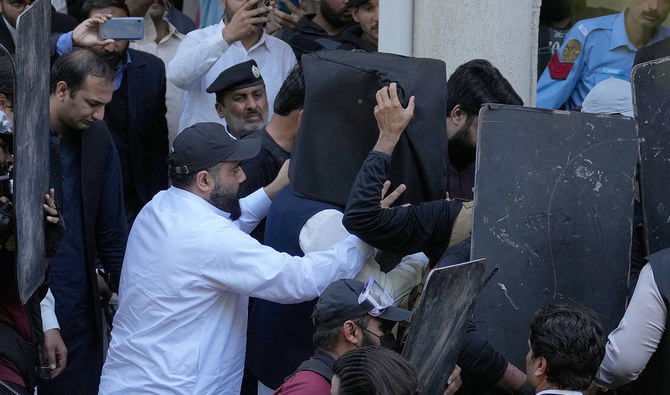
Heavy contingents of Islamabad police and the paramilitary Frontier Constabulary force were deployed in and around the high court before Khan’s appearance to avoid any untoward incident.
The former premier covered with a bulletproof jacket for his safety as he was escorted to the courtroom. At one point during the hearing, Khan wanted to speak but the court did not allow him to do so.
“I want to say something,” Khan said as he approached a rostrum in the courtroom, but the bench declined to allow him the opportunity.
“Please be seated,” the chief justice remarked.
In an informal chat with reporters inside the courtroom, Khan said doors for negotiations were always open for politicians, adding that he is ready to talk with Prime Minister Shehbaz Sharif’s government.
The ex-premier has refused to recognize PM Sharif’s government and has been pressurizing the coalition government to declare elections across the country. The government has repeatedly denied his demands and said polls would be held as per schedule, later this year.
“Negotiations can be held [with the government], but on a one-point agenda only: hold elections,” Khan said. “There is no rule of law in the country,” he said, condemning the recent arrests of his aides, which includes his nephew Hassaan Niazi and social media adviser, Azhar Mashwani, whom he says has been “abducted.”
The Islamabad administration imposed Section 144 (ban on public gatherings and display of weapons) in the federal capital before Khan’s hearing, with the capital police beefing up security measures around the court.
Police arrested around 13 workers of Khan’s party, including his official photographer, for allegedly violating Section 144.
Khan left for his Zaman Park residence in Lahore with a motorcade after the hearing.


