Syria begins circulating new post-Assad currency bills

1 / 3
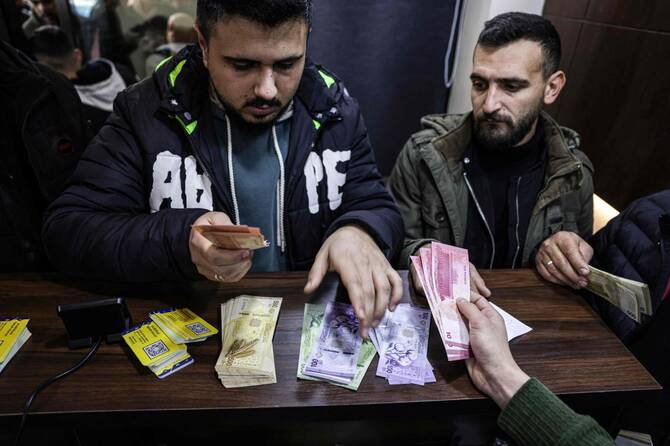
A Syrian citizen exchanges old banknotes for new banknotes released and distributed by the Central Bank, at a money exchange in the capital Damascus on Saturday. (AFP)
2 / 3
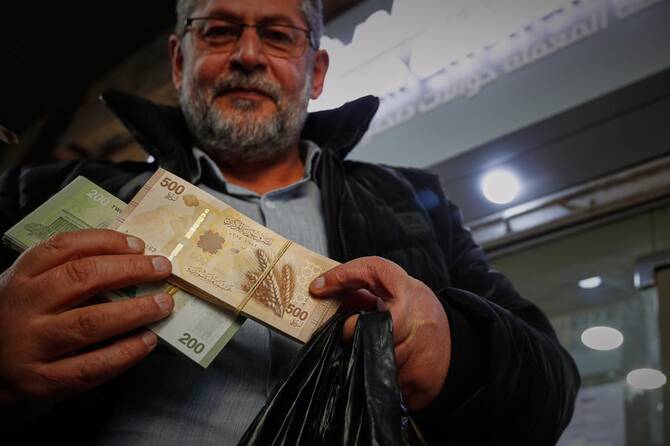
A man displays 500, and 200-pound notes from Syria's newly circulating currency outside a currency exchange office in Damascus. (AP)
3 / 3
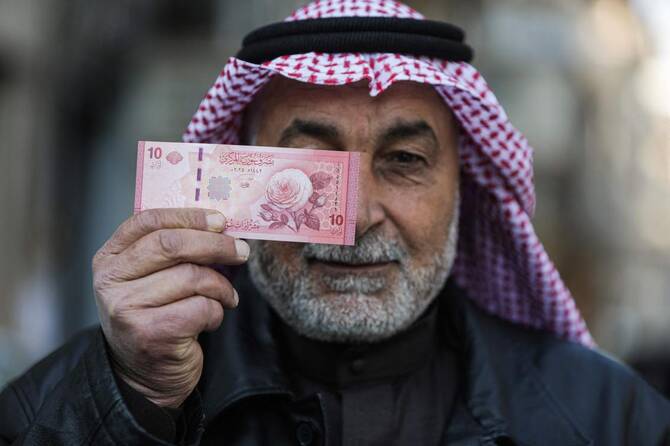
A Syrian citizen shows off a new banknote released and distributed by the Central Bank, in the capital Damascus on Saturday. (AFP)
Short Url
Updated 03 January 2026
Follow

Syria begins circulating new post-Assad currency bills

  • Presidential decree said new Syrian currency will be issued by removing two zeros from the nominal value of the old currency
  • Central Bank govenor says Syrians can now exchange old Syrian pounds with new banknotes

DAMASCUS, Syria: Syria started the process of circulating new currency bills on Saturday as the nation seeks to stabilize the economy as it recovers from the fall of Bashar Assad’s government.
A decree issued earlier this week by President Ahmad Al-Sharaa said that “old Syrian currency” will be gradually withdrawn from circulation according to a timetable set by the central bank and through designated exchange centers.
Central Bank Governor Mokhles Nazer posted on X that after months of preparations, the exchange of old Syrian pounds with new banknotes officially began Saturday morning.


A Syrian citizen shows off a new banknote released and distributed by the Central Bank, in the capital Damascus on Saturday. (AFP)

The presidential decree posted on the SANA state news agency stipulates that “new Syrian currency” will be issued by removing two zeros from the nominal value of the old currency. It means every 100 Syrian pounds of the old currency will now equate to one Syrian pound.
The largest denomination of the old currency was 5,000 Syrian pound, while under the new currency it is 500 pounds.
The US dollar was selling at exchange shops in Damascus on Saturday for 11,800 pounds for the old banknotes, some of which bear the images of Assad and his late father and predecessor, Hafez Assad.
At the start of Syria’s conflict in mid-March 2011, the US dollar was worth 47 Syrian pounds.
Since insurgent groups led by Al-Sharaa’s Hayat Tahrir Al-Sham marched into Damascus in December 2024 to end the Assad family’s 54-year rule, work has been ongoing by the country’s new authorities to improve the economy battered by years of war and Western sanctions.
The US and the European Union have removed most of the sanctions imposed on Syria during Assad’s rule.


Libya’s security authorities free more than 200 migrants from ‘secret prison’, two security sources say

Updated 58 min 33 sec ago
Follow

Libya’s security authorities free more than 200 migrants from ‘secret prison’, two security sources say

  • Security authorities had found an underground prison, nearly three meters deep, which the sources said was run by a Libyan human trafficker

BENGHAZI: Libya’s security authorities have freed more than 200 migrants from what they described as a secret prison in the town of Kufra in the southeast of the country after they ​were held captive in inhuman conditions, two security sources from the city told Reuters on Sunday.
The security sources, speaking on condition of anonymity, said that the security authorities had found an underground prison, nearly three meters deep, which the sources said was run by a Libyan human trafficker.
One of the sources said this person had not yet been detained.
“Some of the freed migrants were ‌held captive up ‌to two years in the underground cells,” ‌this ⁠source ​said.
The ‌other source said what the operation had found was “one of the most serious crimes against humanity that has been uncovered in the region.”
“The operation resulted in a raid on a secret prison within the city, where several inhumane underground detention cells were uncovered,” one of the sources added.
The freed migrants are from sub-Saharan Africa, mainly from Somalia ⁠and Eritrea, including women and children, the sources said. Kufra lies in eastern Libya, ‌about 1,700 kilometers (1,000 miles) from the capital ‍Tripoli.
Libya has become a transit ‍route for migrants fleeing conflict and poverty to Europe via dangerous ‍routes across the desert and over the Mediterranean since the toppling of Muammar Qaddafi in a NATO-backed uprising in 2011.
The oil-based Libyan economy is also a draw for impoverished migrants seeking work, but security throughout the ​sprawling country is poor, leaving migrants vulnerable to abuses.
At least 21 bodies of migrants were found in a ⁠mass grave in eastern Libya last week, with up to 10 survivors in the group bearing signs of having been tortured before they were freed from captivity, two security sources told Reuters.
Libya’s attorney general said in a statement on Friday the authorities in the east of the country had referred a defendant to the court for trial in connection with the mass grave on charges of “committing serious violations against migrants.”
In February last year, 39 bodies of migrants were recovered from about 55 mass graves in Kufra. The town houses ‌tens of thousands of Sudanese refugees who fled the conflict that erupted in Sudan in 2023.