

Pakistan regulator bans coverage of rallies, gatherings ahead of ex-PM Khan court appearance

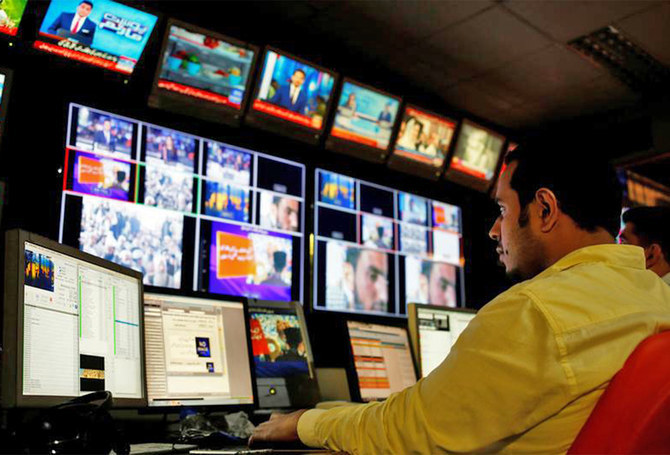
An employee works at the control room of a television channel in Karachi, Pakistan, on April 11, 2018. (REUTERS/File)
Short Url
Updated 27 March 2023
Follow

Pakistan regulator bans coverage of rallies, gatherings ahead of ex-PM Khan court appearance

  • Khan is scheduled to appear before an Islamabad court to seek pre-arrest bail in multiple cases
  • Regulator says footage of mobs, attacks on police aired live ‘created chaos and panic among viewers’

ISLAMABAD: The Pakistan Electronic Media Regulatory Authority (PEMRA) has barred television news channels from live and recorded coverage of rallies or public gatherings by any party, organization and individual in the Pakistani capital of Islamabad, the regulator said on Monday, ahead of a court appearance by former prime minister Imran Khan.

The court ban comes after Khan supporters clashed with police earlier this month outside his Zaman Park residence in Lahore as well as outside a judicial complex in Islamabad where the former premier had appeared before a judge. The scenes of violence and chaos were widely televised

On Monday, in an advisory titled “Prohibition order on live coverage under Section 27 of PEMRA Ordinance 2002,” the regulator said it had observed that satellite TV channels were showing live footage and images of violent mobs attacking police and law enforcement agencies.

PEMRA said such footage or images were broadcast on TV “without any editorial oversight” during a recent standoff between supporters of a political party and law enforcement agencies in Lahore and Islamabad, wherein a violent mob used petrol bombs, injured unarmed policemen and torched police vehicles.  

The live telecast of such footage on different satellite TV channels “created chaos and panic among the viewers and police,” the electronic media regulator said.

“The competent authority while exercising powers vested under Section 27(a) of the PEMRA Ordinance 2002, as amended by PEMRA (Amendment) Act 2007, hereby prohibits live/recorded coverage of any kind of rally, public gathering, procession by any party, organization and individual, etc. in Islamabad Capital Territory (ICT) for today i.e. March 27, 2023,” PEMRA said.

In case of non-compliance, the media watchdog said the license of the TV channel would be suspended under Section 30(3) of PEMRA Ordinance 2002 without any show-cause notice, along with other enabling provisions of law.

The development came ahead of Khan’s appearance before an Islamabad court today, Monday, to request pre-arrest bail in cases registered against him over March 18 clashes between his supporters and the police in the Pakistani capital.

On March 18, hundreds of Khan supporters clashed with police as the former premier led a motorized caravan to the Pakistani capital from the eastern city of Lahore to appear before an Islamabad district court in a graft case.  

Several people were injured on both sides during the clashes that forced the court to adjourn proceedings of the case, popularly known as the Toshakhana reference, until March 30.  

Prior to that, Khan supporters had clashed with police in Lahore, when law enforcers attempted to arrest the ex-PM following the issuance of his non-bailable warrants in the Toshakhana case.


Pakistan plans 3,000 EV charging stations as green mobility push gathers pace

Updated 14 January 2026
Follow

Pakistan plans 3,000 EV charging stations as green mobility push gathers pace

  • Roadmap unveiled by energy efficiency regulator and a private conglomerate amid early-stage EV rollout
  • New EV Policy and related plans aim to install 3,000 EV stations by 2030, including 240 stations in current fiscal year

ISLAMABAD: Pakistan’s energy efficiency regulator and a private conglomerate have unveiled an approved roadmap to establish 3,000 electric vehicle (EV) charging stations across the country, state-run Associated Press of Pakistan (APP) reported on Tuesday.

The announcement comes as Pakistan looks to build out basic EV charging infrastructure, which remains limited and unevenly distributed, largely concentrated in major cities. Despite policy commitments to promote electric mobility as part of climate and energy-efficiency goals, the absence of a nationwide charging network has slowed broader EV adoption.

Pakistan’s EV ecosystem is still at a formative stage, with progress constrained by regulatory approvals, grid connectivity issues and coordination challenges among utilities, regulators and fuel retailers. Expanding charging infrastructure is widely seen as a prerequisite for scaling electric transport for both private and commercial use.

According to APP, the roadmap was presented during a meeting between Malik Group Chief Executive Officer Malik Khuda Baksh and National Energy Efficiency and Conservation Authority Managing Director and Additional Secretary Humayon Khan.

“Baksh ... in a meeting with Khan, unveiled the approved roadmap for establishing 3,000 electric vehicle charging stations across Pakistan,” APP reported. “Khan reaffirmed the authority’s full institutional backing and pledged to expand the initiative to 6,000 EV charging stations nationwide.”

The discussion reviewed hurdles delaying the rollout, including EV charger imports, customs duties, regulatory documentation and inter-agency coordination.

APP said Khan welcomed the proposal and sought recommendations for “internationally compliant EV charger brands,” while asking for a detailed “issue-and-solutions report within three days” to facilitate timely implementation of the national green mobility initiative.

Despite the issuance of 13 licenses by NEECA and the arrival of five EV charging units at designated sites, progress has been slowed by procedural bottlenecks, officials said. These include delays in electricity connections, prolonged installation of separate meters and pending no-objection certificates from power distribution companies and oil marketing firms, which continue to stall operational readiness.

Pakistan’s electric vehicle ecosystem is still in its early stages, with charging infrastructure far behind levels seen in more advanced markets. The government’s New Energy Vehicle Policy and related plans aim to install 3,000 EV charging stations by 2030, including 240 stations planned in the current fiscal year, but actual deployment remains limited and uneven, mostly clustered in major cities and along key urban corridors.

Despite regulatory backing, including the 2024 Electric Vehicles Charging Infrastructure and Battery Swapping Stations framework, progress has been slow. Many proposed stations have yet to become operational due to delays in grid connections and approvals, and public maps of nationwide charging coverage are not yet available.

Private players are beginning to install more chargers, and there are over 20 public EV charging points reported in urban centers, offering both slower AC chargers and faster DC options. However, such infrastructure is still sparse compared with the growing number of electric vehicles and the government’s long-term targets.