In massive Lahore rally, ex-PM Khan lays out 10-point recovery plan to ‘save’ Pakistan

Protected by a bulletproof barrier, former Prime Minister Imran Khan speaks during a rally in Lahore, Pakistan, on March 26, 2023, to pressure the government of Shahbaz Sharif to agree to hold snap elections. (AP)
Short Url
Updated 26 March 2023
Follow

In massive Lahore rally, ex-PM Khan lays out 10-point recovery plan to ‘save’ Pakistan

  • The South Asian country of 220 million has for months been embroiled in political and economic crises
  • The ex-premier taunts the country’s military establishment, says there is no ‘easy way’ out of current situation 

ISLAMABAD: Former prime minister Imran Khan on Sunday laid out a 10-point recovery plan to steer Pakistan out of an economic crisis as he addressed a massive public gathering in the eastern city of Lahore. 

The former premier said the country’s revenue collected via taxes was far lesser than its expenses and the other major problem was higher outflow of dollars than the inflows, which increased pressure on the rupee and gave rise to inflation. 

He detailed a 10-point economic recovery plan to steer the country out of the crisis, stressing the need to increase exports and investment, and providing a conducive environment to businesspersons through mid- and long-term planning. 

“Overseas Pakistanis are the biggest asset of the country. If we fix our governance system, rule of law... then our governance system will safeguard their capital,” Khan said. 
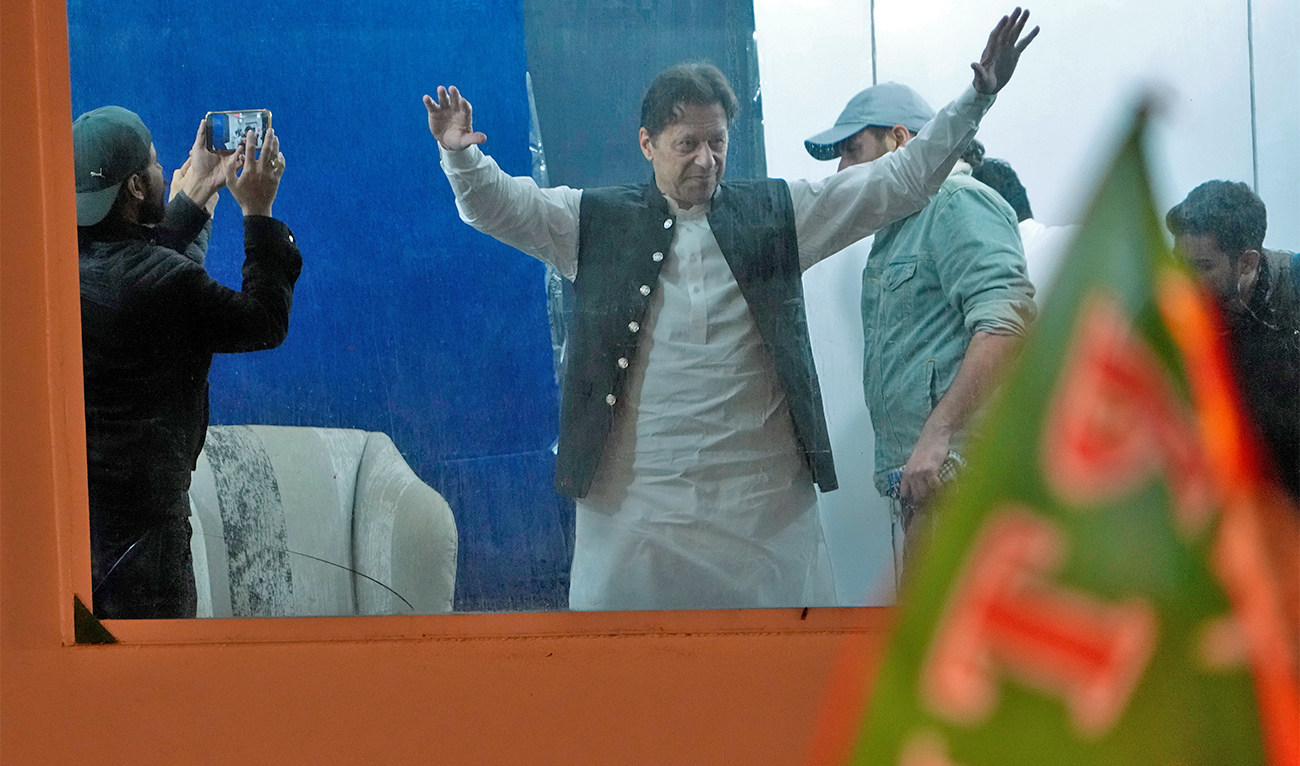


Protected by a bulletproof barrier, former Prime Minister Imran Khan waves to supporters during a rally in Lahore, Pakistan, on March 26, 2023, to pressure the government of Shahbaz Sharif to agree to hold snap elections. (AP)

But to bring those reforms, the ex-premier said, the country’s governance system needed to be fixed and rule of law was supposed to be established. 

As long as the country won’t have an enabling environment for investment, no government could bring that money to Pakistan, he said. 

“Dollars flow in with increasing exports, but we never tried it,” he said. “We will divert the whole country toward exports. Whoever would bring dollars to the country by selling goods, they will be provided facilities.” 

Other points of Khan’s recovery plan included the promotion of information technology (IT), tourism, mineral exploration and agriculture in the South Asian country of 220 million. 

While laying out his plan, Khan also taunted the country’s all-powerful military about whether they had a plan to ‘save’ Pakistan. 

“I ask Pakistan’s establishment that this is clear you have decided... we won’t let Imran Khan win. All this drama, election delay, the attack on my house, there is only one aim that we won’t let Imran Khan come to power,” he said. 

“Fine, do not let [me] come to power, but tell [me] do you have any program to steer the country out of this destruction? Is there a roadmap? I challenge that the people sitting at the helm neither have the capability nor the will.”  
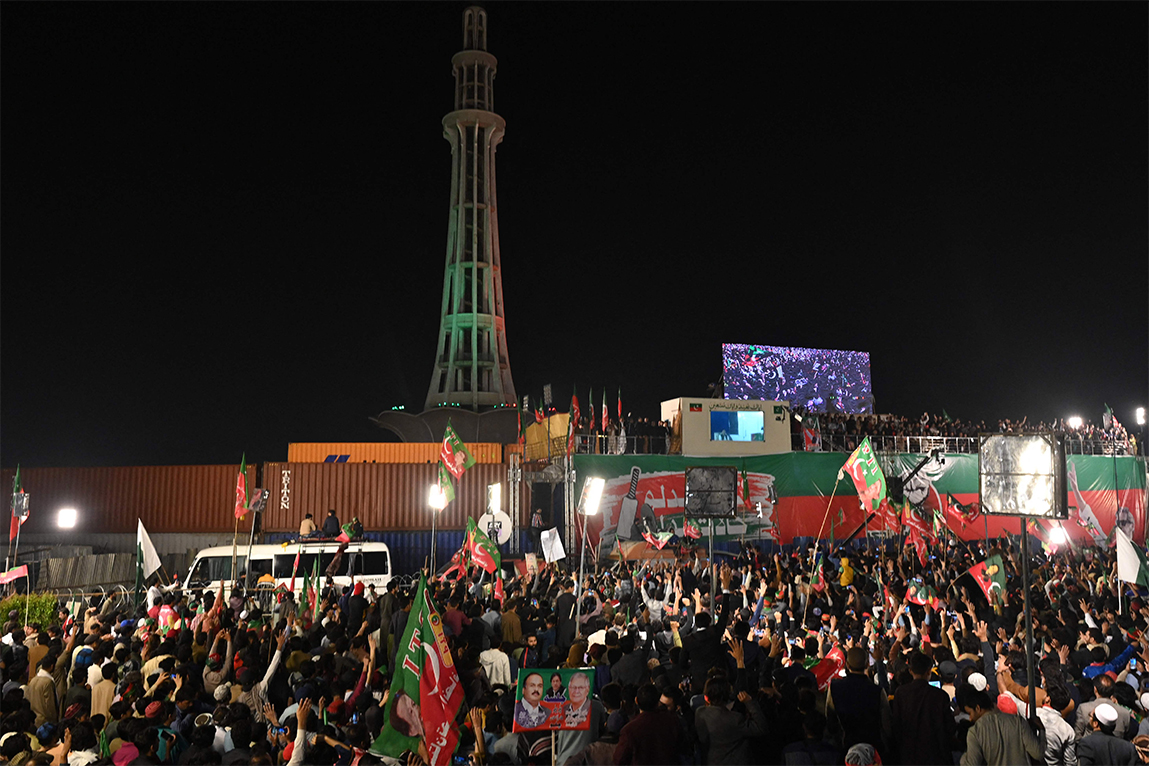


Supporters of Pakistan's former prime minister Imran Khan gather at a rally in Lahore early on March 26, 2023. (AFP)

The former premier said there was no “easy way” to take the country out of this difficult situation. 

“Only someone with public mandate can make difficult decisions, someone who came through the vote of people, whom the people trust in,” he said. 

“A party that would form government through public mandate, through the vote of public, that would be the first step. When a government would come for five years, then the people, business community would have the confidence that there is political stability.” 

Khan, who was ousted in a parliamentary vote of no-confidence in April last year, has been at loggerheads with the coalition government of PM Shehbaz Sharif and the country’s powerful military establishment. 

The former premier accuses the coalition and former army chief Gen (retired) Qamar Javed Bajwa of orchestrating his ouster as part of a United States-backed “foreign conspiracy.” All three deny the allegation. 

Since his removal from office, Khan has been agitating against the government and criticizing the military through his fiery speeches at rallies and pushing for early elections in the country which are otherwise slated to take place by October. 

The ex-prime minister is also facing dozens of cases, with charges against him ranging from terrorism to sedition. 


Top Pakistani clerics warn government against sending troops to Gaza to disarm Hamas

Updated 21 sec ago
Follow

Top Pakistani clerics warn government against sending troops to Gaza to disarm Hamas

  • Pakistani clerics raise alarm over reports of pressure on Muslim nations to provide troops for Gaza stabilization force under Trump peace plan
  • Islamabad has previously said that it is willing to join the international stabilization force but ‘not ready’ to play any role in disarming Hamas

ISLAMABAD: A group of Pakistan’s top religious and political leaders on Monday warned the government against sending Pakistani troops to Gaza to disarm Palestinian group Hamas, amid discussions over a proposed International Stabilization Force (ISF) for the Palestinian territory.

The representative gathering, chaired by prominent scholar Mufti Taqi Usmani, brought together leaders from Deobandi, Barelvi, Ahl-e-Hadees and Shia schools of thought, alongside leaders of the country’s main religio-political parties, Jamiat Ulema-e-Islam-Fazl (JUI-F) and Jamaat-e-Islami (JI).

The international stabilization force, which is to be composed of troops from Muslim countries, is the cornerstone of President Donald Trump’s peace plan for Gaza announced in Sept. Islamabad has previously said it is willing to join the ISF but “not ready” to play any role in disarming Hamas. Hamas’s Gaza chief Khalil Al-Hayya said this month the group had a “legitimate right” to hold weapons, while Israel has repeatedly insisted that Hamas be disarmed.

In a joint statement issued after the meeting in the port city of Karachi on Monday, Pakistani clerics raised alarm over reports that international pressure is mounting on Muslim-majority nations to provide troops for the transitional security force in Gaza, following Israel-Hamas ceasefire.

“In such circumstances, demands are being made to Muslim countries that they send their forces there to disarm Hamas,” the statement said. “Several Muslim governments have already refused this, and pressure is being increased on Pakistan.”

Last month, the United Nations Security Council approved Washington’s plan, which called for a yet-to-be-established Board of Peace as a transitional authority that Trump would head, and the stabilization force, which would be empowered to oversee borders, provide security and demilitarize the territory.

The gathering of Pakistani clerics urged Islamabad to resist any diplomatic overtures from Washington regarding troop deployment.

“This gathering, with full emphasis, demands the Government of Pakistan refrain from sending its forces to disarm Hamas and that it should not yield to any pressure in this regard,” the statement said.

The assembly expressed complete support for the liberation of Palestine and described the effort as a “duty of every Muslim.”

It said that Pakistan’s armed forces are “imbued with the spirit of jihad” and that the “notion of placing them against any sacred struggle for the liberation of Baitul Muqaddas or Palestine is impossible for the nation to accept.”

The religious leaders characterized the proposal as a “conspiracy” from which the government must “protect the country.”

Pakistani foreign office spokesperson Tahir Andrabi and the prime minister’s spokesperson for foreign media, Mosharraf Zaidi, did not respond to Arab News requests for comment on the statement.

Washington reportedly views Pakistan as a prime candidate for the ISF, given its experience in high-intensity border conflicts and internal counter-insurgency operations.

Last week, Pakistan’s foreign office said that Islamabad had not taken any decision on joining the proposed stabilization force for Gaza and had received no formal request from the US or any other country in this regard.

“I am not aware of any specific request made to Pakistan. We will inform you about any development if it takes place,” Andrabi told reporters.

He also sought to distance the government from rumors of a pending visit by Pakistan’s defense forces chief, Field Marshal Asim Munir, to the US to meet President Trump.