

IMF demands funding assurances from multilateral bodies, China, UAE, Saudi Arabia to unlock bailout

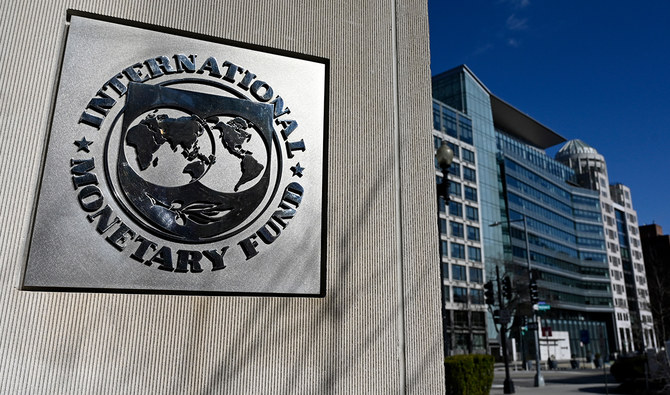
The seal for the International Monetary Fund is seen in Washington, DC, on January 26, 2022. The Omicron variant of Covid-19 is creating an obstacle course for the global economy, which will slow growth this year, notably in the world's two largest economies, the IMF said January 25, 2022. (AFP/FILE)
Short Url
Updated 24 March 2023
Follow

IMF demands funding assurances from multilateral bodies, China, UAE, Saudi Arabia to unlock bailout

  • Pakistan is desperately awaiting $1.2 billion bailout tranche from IMF as part of $7 billion program
  • Release of IMF funds will offer some relief to South Asian country reeling from a severe dollar crunch

KARACHI: The International Monetary Fund (IMF) has said Pakistan needed to secure financing assurances from multilateral institutions as well as friendly countries like China, UAE and Saudi Arabia to unlock a critical bailout loan the South Asian country desperately needs to avert an economic meltdown.

Pakistan and the IMF have been engaged in talks to reach a staff level agreement for a bailout package of $1.1 billion that has been delayed since November mainly over issues related to fiscal policy adjustments.

The latest deal will also unlock other bilateral and multilateral financing avenues for Pakistan to shore up its foreign exchange reserves, which have fallen to four weeks worth of import cover.

The IMF wants Pakistan to get assurance for up to $7 billion to fund this fiscal year’s balance of payments gap. Finance Minister Ishaq Dar has been saying it should be around $5 billion.

Speaking to reporters on Thursday, IMF communications director Julie Kozack said a staff level agreement would follow after financing assurances, which were a “standard feature” of all IMF programs.

“Aside from support provided by the IMF, Pakistan’s Extended Fund Facility supported program receives financing from other multilateral institutions, including the World Bank, the ADB (Asian Development Bank), and the AIIB (Asian Infrastructure Investment Bank) and bilateral partners, notably China, Saudi Arabia, and the UAE,” Kozack told reporters.

“So, we do need to ensure that we have those financing assurances in place in order for us to be able to take the next step with Pakistan.”

Kozack said Pakistan’s economy faced multiple challenges, including slowing growth, high inflation and large financing needs, all made worse by devastating floods last summer that had caused over $30 billion in losses to the economy.

“[Pakistani] authorities are committed to implementing the necessary reforms,” she said.

“They’ve started to implement decisive actions to stabilize the economy and restore confidence … Timely financial assistance from external partners will be critical to support the authorities’ policy efforts and ensure the successful completion of the review.”

The Pakistan government has implemented several fiscal measures, including devaluing the rupee, lifting subsidies and raising energy prices as preconditions for the IMF agreement, which the finance minister said this month was “very close”.


Death toll in Pakistan wedding suicide blast rises to six

Updated 24 January 2026
Follow

Death toll in Pakistan wedding suicide blast rises to six

  • Attack targeted members of local peace committee in Khyber Pakhtunkhwa’s Dera Ismail Khan
  • Peace committees are community-based groups that report militant activity to security forces

PESHAWAR: The death toll from a suicide bombing at a wedding ceremony in northwestern Pakistan rose to six, police said on Saturday, after funeral prayers were held for those killed in the attack a day earlier.

The bomber detonated explosives during a wedding gathering in the Dera Ismail Khan district of Khyber Pakhtunkhwa province, injuring more than a dozen, some of them critically.

“The death toll has surged to six,” said Nawab Khan, Superintendent of Police for Saddar Dera Ismail Khan. “Police have completed the formalities and registered the case against unidentified attackers.”

“It was a suicide attack and the Counter Terrorism Department will further investigate the case,” he continued, adding that security had been stepped up across the district to prevent further incidents.

No militant group has claimed responsibility for the blast so far.

Khan cautioned against speculation, citing ongoing militancy in the area, and said the investigation was being treated with “utmost seriousness.”

The explosion targeted the home of a member of a local peace committee, which is part of community-based groups that cooperate with security forces and whose members have frequently been targeted by militants in the past.

Some media reports also cited a death toll of seven, quoting police authorities.

Emergency officials said several of the wounded were taken to hospital soon after the blast.

Militant attacks have intensified in parts of Khyber Pakhtunkhwa since the Taliban returned to power in neighboring Afghanistan in 2021, with Islamabad accusing Afghan authorities of “facilitating” cross-border assaults, a charge Kabul denies.