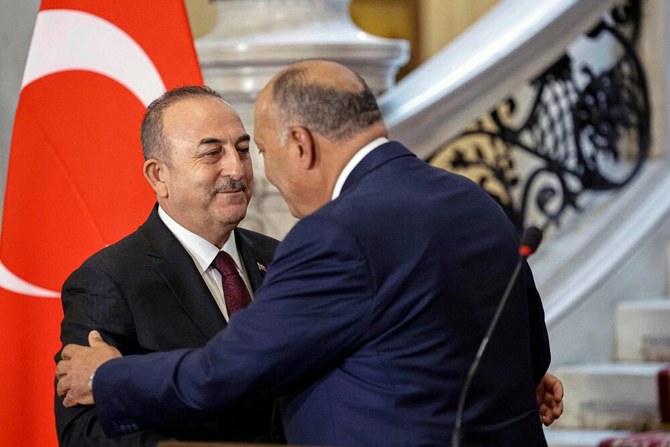
ANKARA: After the meeting of Turkish and Egyptian foreign ministers in Cairo on Saturday — the first such visit after a decade of strained ties — the question now is: How might this dialogue translate into action?
Turkish Foreign Minister Mevlut Cavusoglu and his Egyptian counterpart Sameh Shoukry discussed several issues, including Libya — where they support opposing sides, Cyprus and maritime disagreements in the Eastern Mediterranean.
A possible delimitation of maritime boundaries between Turkiye and Egypt in the East Med remains the most critical shared interest between the two countries. If settled, it could be a game-changer for the region.
Turkiye will upgrade its diplomatic relations with Egypt to the ambassadorial level “as soon as possible,” Cavusoglu said.
Turkiye has hosted several dissident Egyptians, including activists, since late 2013, but they are not eligible for full refugee status.
Last month, Turkish companies reportedly pledged to invest about $500 million in Egypt to help the country overcome its financial crisis. Turkish companies are active in the textile, iron and steel, glass and domestic-appliance sectors in Egypt.
Dalia Ziada, director of the Cairo-based MEEM Center for Middle East and Eastern Mediterranean Studies, told Arab News: “Despite their common history and culture, Egypt and Turkiye have several differences in terms of political ideology. Seeing them coming together today to overcome these differences and find a way to compromise, based on their bilateral and regional interests, is phenomenal, and should be applauded and encouraged.
“The diplomatic upgrade of relations between the two countries is one step in that direction. However, what we really need most in the next phase is people-to-people diplomacy. What really matters will be seen in the long term. State leadership can change at any moment, but the people will always remain.”
Turkiye is no longer a political safe haven for Egyptian dissidents. Several were arrested by Turkish authorities for social-media posts and broadcasts supporting calls for anti-government protests in Egypt. Since 2021, Ankara has been urging Egyptian opposition media channels operating in Turkiye to tone down their criticism of the Egyptian government. Muslim Brotherhood-affiliated Egyptian satellite TV channel Mekameleen TV moved its operations from Turkiye last year.
“Turkish authorities officially prevented them from using Turkish territory as a launchpad to attack the Egyptian state,” Ziada said. “That was a great step. These opposition groups are mainly financially supported by the Muslim Brotherhood, which is becoming weak because of several divisions in its leadership and between the leadership and the grassroots (supporters),” she added.
Ismail Numan Telci, deputy director at Ankara-based think-tank ORSAM, said the normalization of ties between the two countries would increase their mutual diplomatic roles and influences in the region.
“It will also enable them to develop their economic and military potential. It will help Turkish companies to be more active in some sectors in Egypt and facilitate the trade of Turkish goods to Egypt,” he told Arab News, adding that he believes the two countries are likely to reach an understanding on the East Med and energy routes.
He continued: “I think that Egypt can revise its stance on Libya following its high-level consultations with Turkiye, because both countries give priority to regional stability and the promotion of peace. Therefore, they can reach a consensus on the Libyan conflict and work together toward this goal.”


![]()

Talks boost diplomatic reconciliation between Turkiye and Egypt
Short Url
https://arab.news/jyaz2
Talks boost diplomatic reconciliation between Turkiye and Egypt
- Turkiye will upgrade its diplomatic relations with Egypt to the ambassadorial level “as soon as possible,” Cavusoglu said
- Last month, Turkish companies reportedly pledged to invest about $500 million in Egypt to help the country overcome its financial crisis


Latest updates




© 2026 SAUDI RESEARCH & PUBLISHING COMPANY, All Rights Reserved And subject to Terms of Use Agreement.