SYDNEY: Former Australian Prime Minister Paul Keating on Wednesday launched a blistering attack on his nation’s plan to buy nuclear-powered submarines from the United States to modernize its fleet, saying “it must be the worst deal in all history.”
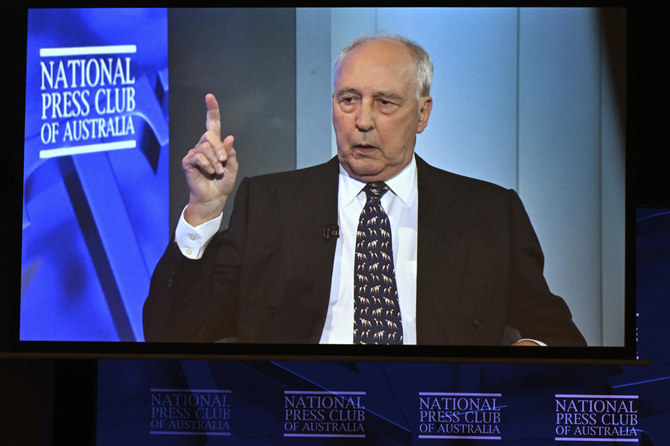
Speaking at a National Press Club event, Keating said the submarines wouldn’t serve a useful military purpose.
“The only way the Chinese could threaten Australia or attack it is on land. That is, they bring an armada of troop ships with a massive army to occupy us,” Keating said. “This is not possible for the Chinese to do.”
He added that Australia would sink any such Chinese armada with planes and missiles.
“The idea that we need American submarines to protect us,” Keating said. “If we buy eight, three are at sea. Three are going to protect us from the might of China. Really? I mean, the rubbish of it. The rubbish.”
Australia’s deal — announced Monday in San Diego by US President Joe Biden, Australian Prime Minister Anthony Albanese and British Prime Minister Rishi Sunak — came amid growing concern about China’s military buildup and influence in the Indo-Pacific. Biden emphasized that the submarines wouldn’t carry nuclear weapons of any kind.
Australian Defense Minister Richard Marles said the deal was necessary to counter the biggest conventional military buildup in the region since World War II.
“We have to take the step of developing the capability to operate a nuclear-powered submarine so that we can hand over a much more self-reliant nation to our children and to our grandchildren,” Marles said.
China said Tuesday the US, Australia and the United Kingdom were traveling “further down the wrong and dangerous path for their own geopolitical self-interest” in inking the deal, which has been given the acronym AUKUS.
Keating served as prime minister for more than four years in the 1990s. He was from the Labour Party, the same party as Albanese.
Keating said the submarine deal was the worst international decision by the Labour Party in more than 100 years, when it unsuccessfully tried to introduce conscription during World War I.
Keating also mocked the cost of the deal, which Australian officials have estimated at between $178 billion and $245bn (A$268bn and A$368bn) over three decades. Australian officials say the deal will create 20,000 jobs.
“For $360 billion, we’re going to get eight submarines,” Keating said. “It must be the worst deal in all history.”
At the Press Club event, Keating was questioned about whether his own ties to China had influenced his views.
He said he had no commercial interests in China and had stopped serving on a bank board five years ago.
“I was on the China Development Bank board for 13 years, and 10 years as chairman,” Keating said, adding that his fee, or honorarium, was $5,000 a year.
Keating also lashed out at some journalists at the event, telling one reporter her question “is so dumb, it’s hardly worth an answer” and another that “you should hang your head in shame” over his newspaper’s recent coverage of China’s perceived threat to Australia.
“For the record, Mr. Keating, we’re very proud of our journalism and we think that it has made an important contribution to the national debate,” responded the second journalist, Matthew Knott from The Sydney Morning Herald.


Former Australian PM Paul Keating says subs ‘worst deal in all history’
https://arab.news/6s27m
Former Australian PM Paul Keating says subs ‘worst deal in all history’

- Former Australian leader: Submarines would not serve a useful military purpose
- Deal comes amid growing concern about China’s military buildup and influence in the Indo-Pacific


Ethiopia accuses Eritrea of arming rebels in escalating war of words
- The charge by Ethiopia’s federal police escalates a feud between Ethiopia and Eritrea
- The two countries fought a three-year border war that broke out in 1998
ADDIS ABABA: Ethiopian police said they had seized thousands of rounds of ammunition sent by Eritrea to rebels in Ethiopia’s Amhara region, an allegation Eritrea dismissed as a falsehood intended to justify starting a war.
The charge by Ethiopia’s federal police escalates a feud between Ethiopia and Eritrea, longstanding foes who reached a peace deal in 2018 that has since given way to renewed threats and acrimony.
The police said in a statement late on Wednesday they had seized 56,000 rounds of ammunition and arrested two suspects this week in the Amhara region, where Fano rebels have waged an insurgency since 2023.
“The preliminary investigation conducted on the two suspects who were caught red-handed has confirmed that the ammunition was sent by the Shabiya government,” the statement said, using a term for Eritrea’s ruling party.
Eritrea’s Information Minister Yemane Gebremeskel told Reuters that Ethiopian Prime Minister Abiy Ahmed’s Prosperity Party (PP) was looking for a pretext to attack.
“The PP regime is floating false flags to justify the war that it has been itching to unleash for two long years,” he said.
In an interview earlier this week with state-run media, Eritrean President Isaias Afwerki said the Prosperity Party had declared war on his country. He said Eritrea did not want war, but added: “We know how to defend our nation.”
The two countries fought a three-year border war that broke out in 1998, five years after Eritrea won its independence from Ethiopia. They signed a historic agreement to normalize relations in 2018 that won Ethiopia’s Abiy the Nobel Peace Prize the following year. Eritrean troops then fought in support of Ethiopia’s army during a 2020-22 civil war in Ethiopia’s northern Tigray region.
But relations soured after Asmara was frozen out of the peace deal that ended that conflict. Since then, Eritrea has bristled at repeated public declarations by Abiy that landlocked Ethiopia has a right to sea access — comments many in Eritrea, which lies on the Red Sea, view as an implicit threat of military action.
Abiy has said Ethiopia does not seek conflict with Eritrea and wants to address the issue of sea access through dialogue.


