

Japan’s new rocket fails after engine issue, in blow to space ambitions

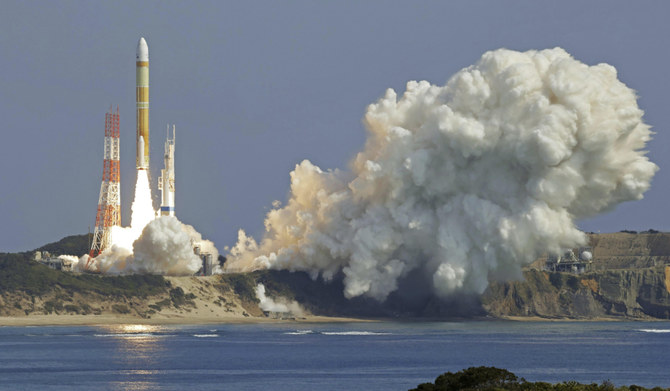
The 57-meter-tall H3 rocket lifted off without a hitch but upon reaching space, the rocket’s second-stage engine failed to ignite, forcing mission officials to manually destroy the vehicle. (AP)
Short Url
Updated 07 March 2023
Follow

Japan’s new rocket fails after engine issue, in blow to space ambitions

  • Blow to Japan’s efforts to cut the cost of accessing space and compete against Elon Musk’s SpaceX
  • Japan’s first new rocket in three decades was carrying the ALOS-3, a disaster management land observation satellite

TOKYO: Japan’s new medium-lift rocket failed on its debut flight in space on Tuesday after the launcher’s second-stage engine did not ignite as planned, in a blow to its efforts to cut the cost of accessing space and compete against Elon Musk’s SpaceX.

The 57-meter-tall H3 rocket lifted off without a hitch from the Tanegashima space port, a live-streamed broadcast by the Japan Aerospace Exploration Agency (JAXA) showed.

But upon reaching space, the rocket’s second-stage engine failed to ignite, forcing mission officials to manually destroy the vehicle.

“It was decided the rocket could not complete its mission, so the destruct command was sent,” a launch broadcast commentator from JAXA said. “So what happened? It’s something we will have to investigate looking at all the data.”

The failed attempt followed an aborted launch last month.

“Unlike the previous cancelation and postponement, this time it was a complete failure,” said Hirotaka Watanabe, a professor at Osaka University with expertise in space policy.

“This will have a serious impact on Japan’s future space policy, space business and technological competitiveness,” he added.

Japan’s first new rocket in three decades was carrying the ALOS-3, a disaster management land observation satellite, which was also equipped with an experimental infrared sensor designed to detect North Korean ballistic missile launches.

H3 builder Mitsubishi Heavy Industries Ltd. (MHI) said it was confirming the situation surrounding the rocket with JAXA and did not have an immediate comment.

MHI has estimated that the H3’s cost per launch will be half that of its predecessor, the H-II, helping it win business in a global launch market increasingly dominated by SpaceX’s reusable Falcon 9 rocket.

A company spokesperson said earlier that it was also relying on the reliability of Japan’s previous rockets to gain business.

In a report published in September, the Center for Strategic and International Studies put the cost of a Falcon 9 launch to low Earth orbit at $2,600 per kilogram. The equivalent price tag for the H-II is $10,500.

A successful launch on Tuesday would have put the Japanese rocket into space ahead of the planned launch later this year of the European Space Agency’s new lower-cost Ariane 6 vehicle.

Powered by a new simpler, lower-cost engine that includes 3D-printed parts, the H3 is designed to lift government and commercial satellites into Earth orbit and will ferry supplies to the International Space Station.

As part of Japan’s deepening cooperation with the United States in space, it will also eventually carry cargo to the Gateway lunar space station that US space agency NASA plans to build as part of its program to return people to the moon, including Japanese astronauts.


EU leaders to reassess US ties despite Trump U-turn on Greenland

Updated 22 January 2026
Follow

EU leaders to reassess US ties despite Trump U-turn on Greenland

  • Diplomats stressed that, although Thursday’s emergency EU talks in Brussels would now lose some of their urgency, the longer-term issue of how to handle the relationship with the US remained

BRUSSELS: EU leaders will rethink their ties with the US at an emergency summit on Thursday after Donald Trump’s threat of tariffs and even military action to ​acquire Greenland badly shook confidence in the transatlantic relationship, diplomats said.
Trump abruptly stepped back on Wednesday from his threat of tariffs on eight European nations, ruled out using force to take Greenland, a semi-autonomous territory of NATO ally Denmark, and suggested a deal was in sight to end the dispute.
German Chancellor Friedrich Merz, welcoming Trump’s U-turn on Greenland, urged Europeans not to be too quick to write off the transatlantic partnership.
But EU governments remain wary of another change of mind by a mercurial president who is increasingly seen as a bully that Europe will have to stand up to, and they are focused on coming up with a longer-term plan on how to deal with the ‌United States under this ‌administration and possibly its successors too.
“Trump crossed the Rubicon. He might do ‌it ⁠again. ​There is no ‌going back to what it was. And leaders will discuss it,” one EU diplomat said, adding that the bloc needed to move away from its heavy reliance on the US in many areas.
“We need to try to keep him (Trump) close while working on becoming more independent from the US It is a process, probably a long one,” the diplomat said.
EU RELIANCE ON US
After decades of relying on the United States for defense within the NATO alliance, the EU lacks the needed intelligence, transport, missile defense and production capabilities to defend itself against a possible Russian attack. This gives the US substantial leverage.
The US ⁠is also Europe’s biggest trading partner, making the EU vulnerable to Trump’s policies of imposing tariffs to reduce Washington’s trade deficit in goods, and, as in ‌the case of Greenland, to achieve other goals.
“We need to discuss where ‍the red lines are, how we deal with this bully ‍across the Atlantic, where our strengths are,” a second EU diplomat said.
“Trump says no tariffs today, but does ‍that mean also no tariffs tomorrow, or will he again quickly change his mind? We need to discuss what to do then,” the second diplomat said.
The EU had been considering a package of retaliatory tariffs on 93 billion euros ($108.74 billion) on US imports or anti-coercive measures if Trump had gone ahead with his own tariffs, while knowing such a step would harm Europe’s economy as well ​as the United States.
WHAT’S THE GREENLAND DEAL?
Several diplomats noted there were still few details of the new plan for Greenland, agreed between Trump and NATO Secretary General Mark Rutte late on ⁠Wednesday on the sidelines of the World Economic Forum in Davos, Switzerland.
“Nothing much changed. We still need to see details of the Greenland deal. We are a bit fed up with all the bullying. And we need to act on a few things: more resiliency, unity, get our things together on internal market, competitiveness. And no more accepting tariff bullying,” a third diplomat said.
Rutte told Reuters in an interview in Davos on Thursday that under the framework deal he reached with Trump the Western allies would have to step up their presence in the Arctic.
He also said talks would continue between Denmark, Greenland and the US on specific issues.
Diplomats stressed that, although Thursday’s emergency EU talks in Brussels would now lose some of their urgency, the longer-term issue of how to handle the relationship with the US remained.
“The approach of a united front in solidarity with Denmark and Greenland while focusing on de-escalation and finding an off-ramp has worked,” a fourth EU diplomat said.
“At the ‌same time it would be good to reflect on the state of the relationship and how we want to shape this going forward, given the experiences of the past week (and year),” he said.