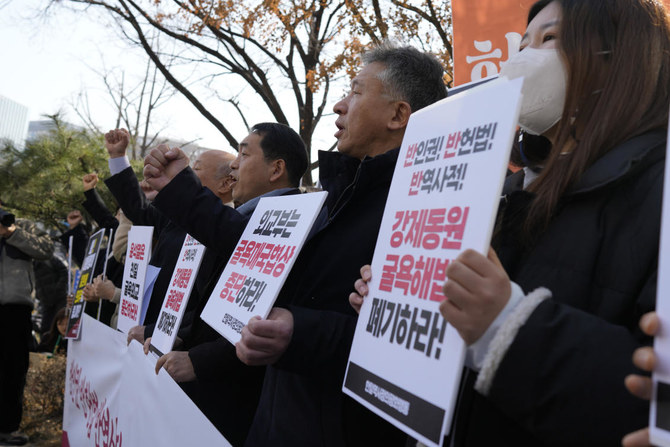
WASHINGTON: US top diplomat Antony Blinken on Sunday applauded plans announced by South Korea to compensate victims of Japan’s forced wartime labor, as Seoul looks to forge closer ties with Tokyo.
South Korea and Japan are “two of the United States’ most important allies, and we are inspired by the work they have done to advance their bilateral relations,” the Secretary of State said in a statement.
The trilateral relationship is “central to our shared vision of a free and open Indo-Pacific region,” he added.
“We applaud (Seoul and Tokyo) for their courage and vision, and call on the international community to join our commendation of this momentous achievement.”
The decision by Seoul comes as South Korea and Japan have ramped up security cooperation in the face of growing threats from nuclear-armed North Korea.
But bilateral ties have long been strained over Tokyo’s brutal 1910-45 colonial rule of the Korean peninsula.
Around 780,000 Koreans were conscripted into forced labor by Japan during the 35-year occupation, according to data from Seoul, not including women forced into sexual slavery by Japanese troops.
Seoul’s plan is to take money from major South Korean companies that benefited from a 1965 reparations deal with Tokyo and use it to compensate victims, South Korea’s Foreign Minister Park Jin said.
Victims have criticized the proposal because it falls far short of their demand for a full apology from Tokyo and direct compensation from the Japanese companies involved.


US top official hails ‘historic’ South Korea announcement on Japan
https://arab.news/4uteh
US top official hails ‘historic’ South Korea announcement on Japan

- Decision by Seoul comes as South Korea and Japan have ramped up security cooperation in the face of growing threats from nuclear-armed North Korea


Shamima Begum’s case revived after top European court’s intervention
- European Court of Human Rights challenges British govt’s citizenship deprivation order
- Begum, 26, left London as a teenager to marry a Daesh fighter, with concerns she was trafficked
LONDON: The longtime appeal by Shamima Begum to return to the UK has been revived after the European Court of Human Rights challenged the British government’s block on her return.
The 26-year-old, who left east London aged 15 and traveled to Daesh-held territory in Syria in 2015, had her British citizenship stripped by the then home secretary, Sajid Javid, The Times reported.
The Strasbourg court’s intervention means the UK must now consider if it acted unlawfully under the framework of the European Convention of Human Rights in stripping her citizenship in 2019.
Begum traveled with two friends to Syria. There, she became a child bride to Dutch national Yago Riedijk and had three children who all died as infants.
The court is examining whether the 2019 decision breached the ECHR’s Article Four, which prohibits slavery, servitude and forced labor.
As part of the examination, it could be found that the UK failed in its duty to identify Begum as a potential victim of trafficking and protect her from harm.
Begum’s journey to Syria made national headlines in the UK. The Times newspaper later discovered her whereabouts at a prison camp in Syria operated by Kurdish security forces, where she remains today.
In stripping her citizenship, Javid said the decision was “conducive to the public good.”
He also argued she was eligible for Bangladeshi nationality through her parents, to avoid rendering her stateless.
However, Bangladesh has said repeatedly that Begum is not a citizen of the country.
Begum’s lawyers, from the firm Birnberg Peirce, filed a submission to the Strasbourg court which argued that the UK failed to ask fundamental questions before stripping her citizenship, including concerns over child trafficking.
Gareth Peirce said the UK could now confront previously ignored questions as a result of the court’s intervention, providing “an unprecedented opportunity.”
She added: “It is impossible to dispute that a 15-year-old British child was lured and deceived for the purposes of sexual exploitation.
“It is equally impossible not to acknowledge the catalogue of failures to protect a child known to be at risk.”
The Strasbourg court’s move meant that it was “impossible now not to have real hope of a resolution,” she said, adding that the Begum case raised profound questions about the UK’s responsibility to victims of grooming and trafficking.
Despite years of litigation, Begum has failed to overturn the citizenship deprivation order. She has stated her desire to return to Britain.
In 2020, the Special Immigration Appeals Commission found that conditions in the camp where she is held, Al-Roj, were inhuman and degrading, but that national security considerations prevented any change to her case.
Later, the Supreme Court ruled that Begum was ineligible to return to Britain to take part in the appeal against her citizenship deprivation.
The Strasbourg court could reject appeals by Begum’s lawyers after considering the UK Home Office’s response to its questions.
If the latest appeal is upheld, however, ministers would have to “take account” of the court’s judgment. The court’s rulings are technically binding but lack an enforcement mechanism.
The Strasbourg court is now set to consider written submissions from both sides before deciding whether the case should proceed to a full hearing. A final judgment could take many months.
A Home Office spokesman said: “The government will always protect the UK and its citizens. That is why Shamima Begum — who posed a national security threat — had her British citizenship revoked and is unable to return to the UK.
“We will robustly defend any decision made to protect our national security.”
Maya Foa, CEO of Reprieve, a charity that has campaigned for the return of women and children from Syria, said: “This case only reached the European court because successive UK governments failed to take simple steps to resolve a common problem.
“While our security allies have all been bringing their people home, Britain has been burying its head in the sand. Casting British men, women and children into a legal black hole is a negligent policy that betrays a lack of faith in our justice system.”


