Palestinians cautiously watching anti-Netanyahu protests in Israel

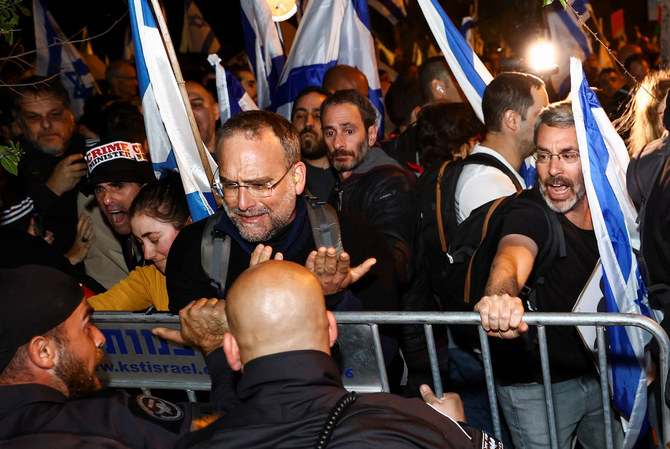
People push a barrier in front of police during a demonstration, as Netanyahu’s nationalist coalition government presses on with its contentious judicial overhaul, in Jerusalem. (File/Reuters)
Short Url
Updated 05 March 2023
Follow

Palestinians cautiously watching anti-Netanyahu protests in Israel

  • Tens of thousands of Israelis are demonstrating against PM’s plan to overhaul legal system
  • Israeli Supreme Court has power to annul laws enacted by Knesset against Palestinians, expert says

RAMALLAH: Palestinians in the occupied territories and inside Israel are cautiously watching the escalation of angry mass protests by Israelis.

Tens of thousands of Israelis are demonstrating against Prime Minister Benjamin Netanyahu’s contentious plan to overhaul the country’s legal system, as the government presses on with the proposed changes.

The protesters oppose legislation that Netanyahu and his right-wing and religious allies hope to pass that would limit the Supreme Court’s powers to rule against the legislature and executive, while giving lawmakers decisive powers in appointing judges.

Supporters of the move say the Supreme Court needs to be reined in from overreaching into the political sphere. But its critics say the plan will weaken the courts, endanger civil liberties and harm the economy, along with Israel’s ties to its Western allies.

Some Palestinians are wary as the policies of the extreme right-wing Israeli government are related to judicial reforms and might affect their political and existential future, while others are optimistic about the protests and support them.

Others consider the demonstrations an internal problem for Israel in which they should not show interest.

However, Palestinians in general agree that everything that happens in Israeli politics directly affects them, be it security, life, economics or even politics, as they live under Israeli occupation.

Esmat Mansour, a Palestinian expert on Israeli affairs, told Arab News: “A large part of the reforms that are intended to be implemented will weaken the Israeli judiciary, which is a destination for Palestinians to file grievances and appeals against the Israeli occupation’s measures against them.”

Some of the laws enacted by the Knesset (Israel’s parliament) and the military decisions taken by the Israeli army against Palestinians in the occupied territories could be annulled by the Israeli Supreme Court, he added.

Most Palestinians do not trust the Israeli judiciary and tend not to go to Israel’s courts to challenge the occupation’s moves against them.

Mansour said Israel’s Supreme Court canceled the deportation of dozens of Palestinians to Marj Al-Zuhur in Lebanon in 1993.

It also supported changing the route of the separation wall that Israel built between it and the West Bank over Palestinian lands and evacuating the random outpost of Amona near the settlement of Ofra, east of Ramallah, four years ago, he added.

Similarly, it evacuated the outpost of Avitar near Jabal Abu Sbeih, south of Nablus, in the fall of last year, Mansour said.

“Therefore, when this extreme right-wing government passes legislation that weakens the Israeli judiciary, this enables the Israeli government, army and settlers to persist in their attacks against the Palestinians.”

Israeli public opinion was the most important audience for the Palestinians because it elected and overturned governments, Mansour said.

Another Palestinian expert agreed, saying that the Israeli protests “leave the Palestinians with some hope that there are those in Israel who oppose the annexation of the West Bank and the elimination of the two-state solution.”

Another observer said that the Supreme Court had in the past responded to a Palestinian petition regarding the deportation of Palestinians abroad and the return of Palestinian bodies Israel was holding.

A senior Fatah leader, who asked not to be named, told Arab News: “We do not want to interfere with their internal disputes, especially since they do not revolve around our situation and our future. The Israeli Supreme Court was established to provide legal cover for the occupation’s crimes against our people.”

Palestinian sources told Arab News that the Israeli organizers of the demonstrations had asked Palestinians in Israel not to join the anti-Netanyahu rallies so as not to intimidate members of the Israeli right-wing who were taking part in them.

The silence of the Palestinian Authority and the Palestinians living inside Israel on the demonstrations was due to their desire not to be used by the Israeli right to criticize the protest organizers and weaken their position, sources said.


Halt to MSF work will be ‘catastrophic’ for people of Gaza: MSF chief

Updated 36 sec ago
Follow

Halt to MSF work will be ‘catastrophic’ for people of Gaza: MSF chief

GENEVA: Israel’s ban on Doctors Without Borders’ humanitarian operation in Gaza spells deeper catastrophe for the Palestinian territory’s people, the head of the medical charity told AFP on Monday.
Israel announced on Sunday that it was terminating all the activities in Gaza and the West Bank by the organization, known by its French acronym MSF, after it failed to provide a list of its Palestinian staff.
MSF slammed the move, which takes effect on March 1, as a “pretext” to obstruct aid.
“This is a decision that was made by the Israeli government to restrict humanitarian assistance into Gaza and the West Bank at the most critical time for Palestinians,” MSF secretary-general Christopher Lockyear warned in an interview with AFP at the charity’s Geneva headquarters.
“We are at a moment where Palestinian people need more humanitarian assistance, not less,” he said. “Ceasing MSF activities is going to be catastrophic for the people of the Gaza Strip and the West Bank.”
MSF has been a key provider of medical and humanitarian aid in Gaza, particularly since war broke out after Hamas’s October 7, 2023 attack on Israel.
The charity says it currently provides at least 20 percent of hospital beds in the territory and operates around 20 health centers.
In 2025 alone, it carried out more than 800,000 medical consultations, treated more than 100,000 trauma cases and assisted more than 10,000 infant deliveries.
It also provided more than 700 million liters of water, Lockyear pointed out.
’Impossible choice’
Israel announced in December that it planned to prevent 37 aid organizations, including MSF, from working in Gaza for failing to submit detailed information about their Palestinian employees. The move drew widespread condemnation from NGOs and the United Nations.
It had alleged that two MSF employees had links with Palestinian militant groups Hamas and Islamic Jihad, which the medical charity vehemently denies.
“If Israel has any evidence of such things, then they should share that evidence,” Lockyear said, insisting that “there’s been no proof given to us.”
He decried “an orchestrated campaign to delegitimize us,” calling on other countries to defend efforts to bring desperately-needed humanitarian aid into Gaza.
“They should be speaking to Israel, pressuring Israel to ensure that there is a reverse of any banning of humanitarian organizations.”
Lockyear said MSF, which counts around 1,100 staff inside Gaza, had been trying to engage with Israeli authorities for nearly a year over the requested lists.
But it had been left with “an impossible choice,” he said.
“We’ve been forced to choose between the safety and security of our staff and being able to reach patients.”
’Can only get worse’
The organization said it decided not to hand over staff names “because Israeli authorities failed to provide the concrete assurances required to guarantee our staff’s safety, protect their personal data, and uphold the independence of our medical operation.”
Lockyear insisted that was a “very rational” decision, pointing out that 15 MSF staff had been killed in Gaza during the war, out of more than 500 humanitarian workers and more than 1,700 medical workers killed in the Strip.
Lockyear highlighted that without independent humanitarian organizations in Gaza, an already “catastrophic” situation “can only get worse.”
“We need to increase massively the humanitarian assistance that’s going into Gaza,” he said, “not restrict it, not block it.”