

A year after military operation, Israel faces a more dangerous security situation

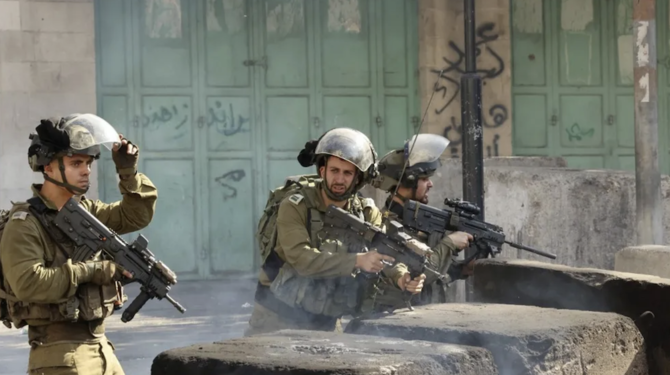
Members of Israeli security forces take position amid clashes with Palestinian protesters in the city center of Hebron in the West Bank. (AFP/File Photo)
Short Url
Updated 05 March 2023
Follow

A year after military operation, Israel faces a more dangerous security situation

  • The operation started in February 2022 with the assassination of three Palestinians in Nablus
  • Israeli military experts say the West Bank was the only front where Israel could have achieved victory

RAMALLAH: A year after conducting the wide-scale military operation in the West Bank “Break the Wave,” the Israeli security apparatus seems to have achieved little. The situation is more dangerous and violent than before the operation, defense experts told Arab News.

The operation started in February 2022 with the assassination of three Palestinians in Nablus — Adham Mabrouka, Ashraf Mubaslat, and Mohammed Dakhil — and continued with terrible violence, spreading into Gaza.

The Israeli campaign of arrests disrupted the lives of more than 7,000 Palestinians from the West Bank and Jerusalem. A total of 139 Palestinians were killed and thousands were injured, while dozens of homes were destroyed. However, the campaign failed to eliminate perpetrators of individual attacks.

Israeli military experts say the West Bank was the only front where Israel could have achieved victory. The same could not be said about its confrontations with Lebanese Hezbollah, Gaza rulers Hamas, or Iran. But a year later, the West Bank has become the biggest security challenge for the Israeli army, following the Iranian threat, as it deployed 46 divisions there — 80 percent of its total military strength.

The operation tried to achieve three goals:

i) To thwart individual or organized Palestinian attacks before they occur, which requires accurate intelligence but was not achieved due to the escalation of individual attacks and the expansion of armed groups across the West Bank.

ii) To achieve deterrence through security operations by arresting everyone related to the perpetrators or planners of attacks, demolishing their homes and deporting their families.

iii) To address weaknesses in the segregation wall between Israel and the West Bank, which enables armed attackers and other Palestinians to breach the barrier.

Since the beginning of 2023, the death toll of Israeli soldiers and settlers has risen to 15 — almost half of the 33 deaths in Israel during the entire year of 2022.

Esmat Mansour, a Palestinian expert on Israeli affairs, told Arab News that the Israeli military operation failed to achieve the objectives it set out to accomplish a year ago.

It also failed to eliminate Palestinian military groups, prevent armed attacks against Israeli targets, and transfer Israeli-Palestinian confrontation to the West Bank, as former Israeli Defense Minister Benny Gantz said he preferred a military confrontation between a Palestinian gunman and an Israeli soldier in Jenin instead of a coffee shop in Tel Aviv.

Mansour said that security coordination between Israel and the Palestinian Authority had stopped and that Israel’s control over the security situation in the West Bank had diminished.

“I believe that the Israeli operation has failed to achieve the goals for which it was launched and that the presence of an extreme right-wing government compounds the failure of the military operation and may lead to the start of a third intifada,” Mansour said.

The escalation of Palestinian attacks and the expansion of Palestinian cells — whether through the Lions’ Den, the Jenin Brigade, the Jerusalem Brigades, the Al-Qassam Brigades, the Al-Aqsa Martyrs Brigades, the Tulkarem Brigade or the Jab’a Brigade —constituted a blow to the Israeli security system.

A year on, the army, Israel’s internal spy network Shin Bet and the police hop from one plan to another, while Palestinian resistance groups, previously confined to Jenin and now present in Nablus, Jericho and Tulkarem, have increased.

Meanwhile, to contain growing Palestinian military attacks against the Israeli targets, the US, Jordan and Egypt attended a summit in Aqaba, Jordan, on Feb. 26 with the participation of the Palestinian Authority.

While the summit was in progress, a Palestinian shot dead two Israeli settlers near Nablus. Later in the evening, hundreds of extremist settlers raided Hawara town and launched arson attacks with impunity, targeting civilian houses and cars.


Palestinians attempt to use Gaza’s Rafah Border crossing amidst delays

Updated 08 February 2026
Follow

Palestinians attempt to use Gaza’s Rafah Border crossing amidst delays

  • The Rafah Crossing opened to a few Palestinians in each direction last week, after Israel retrieved the body of the last hostage held in Gaza and several American officials visited Israel to press for the opening

CAIRO: Palestinians on both sides of the crossing between Gaza and Egypt, which opened last week for the first time since 2024, were making their way to the border on Sunday in hopes of crossing, one of the main requirements for the US-backed ceasefire. The opening comes as Prime Minister Benjamin Netanyahu is expected to travel to Washington this week, though the major subject of discussion will be Iran, his office said.
The Rafah Crossing opened to a few Palestinians in each direction last week, after Israel retrieved the body of the last hostage held in Gaza and several American officials visited Israel to press for the opening. Over the first four days of the crossing’s opening, just 36 Palestinians requiring medical care were allowed to leave for Egypt, plus 62 companions, according to United Nations data.
Palestinian officials say nearly 20,000 people in Gaza are seeking to leave for medical care that they say is not available in the war-shattered territory. The few who have succeeded in crossing described delays and allegations of mistreatment by Israeli forces and other groups involved in the crossing, including and an Israeli-backed Palestinian armed group, Abu Shabab.
A group of Palestinian patients and wounded gathered Sunday morning in the courtyard of a Red Crescent hospital in Gaza’s southern city of Khan Younis, before making their way to the Rafah crossing with Egypt for treatment abroad, family members told The Associated Press.
Amjad Abu Jedian, who was injured in the war, was scheduled to leave Gaza for medical treatment on the first day of the crossing’s reopening, but only five patients were allowed to travel that day, his mother, Raja Abu Jedian, said. Abu Jedian was shot by an Israeli sniper while he was building traditional bathrooms in the central Bureij refugee camp in July 2024, she said.
On Saturday, his family received a call from the World Health Organization notifying them that he is included in the group that will travel on Sunday, she said.
“We want them to take care of the patients (during their evacuation),” she said. “We want the Israeli military not to burden them.”
The Israeli defense branch that oversees the operation of the crossing did not immediately confirm the opening.
A group of Palestinians also arrived Sunday morning at the Egyptian side of the Rafah crossing border to return to the Gaza Strip, Egypt’s state-run Al-Qahera News satellite television reported.
Palestinians who returned to Gaza in the first few days of the crossing’s operation described hours of delays and invasive searches by Israeli authorities and an Israeli-backed Palestinian armed group, Abu Shabab. A European Union mission and Palestinian officials run the border crossing, and Israel has its screening facility some distance away.
The crossing was reopened on Feb. 2 as part of a fragile ceasefire deal that stopped the war between Israel and Hamas. Amid confusion around the reopening, the Rafah crossing was closed Friday and Saturday.
The Rafah crossing, an essential lifeline for Palestinians in Gaza, was the only crossing not controlled by Israel prior to the war. Israel seized the Palestinian side of Rafah in May 2024, though traffic through the crossing was heavily restricted even before that.
Restrictions negotiated by Israeli, Egyptian, Palestinian and international officials meant that only 50 people would be allowed to return to Gaza each day and 50 medical patients — along with two companions for each — would be allowed to leave, but far fewer people than expected have crossed in both directions.