
‘No limits’ to cooperation with UAE: Italian PM

1 / 4
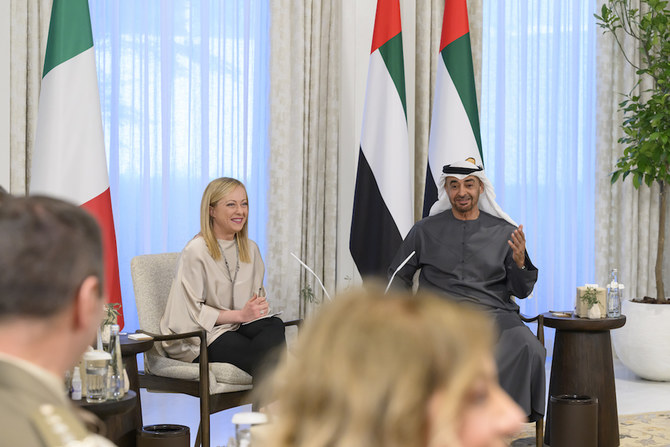
Giorgia Meloni was received at the presidential palace in Abu Dhabi by UAE President Sheikh Mohamed bin Zayed Al-Nahyan. (WAM)
2 / 4
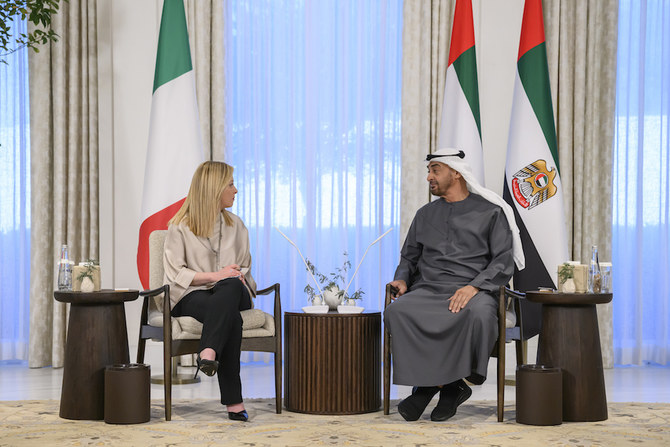
Giorgia Meloni was received at the presidential palace in Abu Dhabi by UAE President Sheikh Mohamed bin Zayed Al-Nahyan. (WAM)
3 / 4
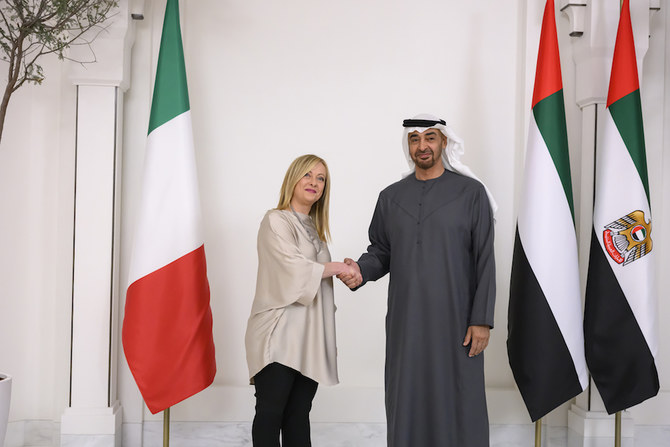
Giorgia Meloni was received at the presidential palace in Abu Dhabi by UAE President Sheikh Mohamed bin Zayed Al-Nahyan. (WAM)
4 / 4
Giorgia Meloni was received at the presidential palace in Abu Dhabi by UAE President Sheikh Mohamed bin Zayed Al-Nahyan. (WAM)
Short Url
Updated 04 March 2023
Follow

‘No limits’ to cooperation with UAE: Italian PM

  • Meetings in Abu Dhabi ‘went really well,’ Giorgia Meloni tells briefing attended by Arab News
  • Agreements signed on strategic partnership, climate change, energy

ROME: There are “no limits to what we can do together with the UAE,” Italy’s prime minister said on Saturday during a press briefing attended by Arab News.

“Our cooperation can and will be reinforced,” added Giorgia Meloni, who was received at the presidential palace in Abu Dhabi by UAE President Sheikh Mohamed bin Zayed Al-Nahyan.

She said all the meetings she had in Abu Dhabi “went really well, even beyond my positive initial expectations.”

Foreign Minister Antonio Tajani and Claudio Descalzi, CEO of energy company Eni, were part of the Italian delegation.

Energy and environmental sustainability, sustainable economic growth, stability in Libya, social unrest in Tunisia and the war in Ukraine were among the main issues discussed.

A source in the Italian prime minister’s office told Arab News that “so many points were found in common,” and that “Meloni believes the UAE can play a huge diplomatic role on those issues.”

Tajani and his UAE counterpart Sheikh Abdullah bin Zayed Al-Nahyan signed a strategic partnership agreement.

A declaration on enhanced cooperation in the context of this year’s UN Climate Change Conference, which will be hosted by the UAE, was signed by Tajani and Sultan Ahmed Al-Jaber, Emirati minister of industry and advanced technology, and president-designate of the conference.

A cooperation agreement was signed between Eni and the Abu Dhabi National Oil Co.


Morocco residents begin returning to northwest as flood waters recede

Updated 8 sec ago
Follow

Morocco residents begin returning to northwest as flood waters recede

RABAT: Moroccan authorities began organizing the gradual return of residents to the city of Ksar El Kebir ​and other flood-hit northwestern areas as weather conditions improved, state media showed on Monday.
Authorities backed by the army had helped evacuate 188,000 people since early February, to protect them from overflowing river waters that swept across 110,000 hectares in the northwest.
Most residents of Ksar El ‌Kebir, 213 ‌km north of Rabat, ​are now ‌allowed ⁠to ​return home, ⁠except for those living in a few neighborhoods, the interior ministry said on Monday.
Investment plan to upgrade infrastructure
Train and bus rides were offered free of charge to help transport residents who had sought shelter with relatives in other ⁠cities, or in centers and camps ‌provided by authorities, state ‌TV showed.
Morocco plans to spend ​3 billion dirhams ($330 million) ‌to upgrade infrastructure and support flood-affected residents, farmers ‌and shop-owners in the inundated areas, the prime minister’s office said last week, declaring the hardest-hit municipalities disaster areas.
The Oued Makhazine dam, which had reached 160 percent ‌of capacity, was forced to gradually release water downstream after exceptional inflows, leading to ⁠rising ⁠water levels in the Loukous river which inundated Ksar El Kebir and surrounding plains.
Rainfall this winter was 35 percent above the average recorded since the 1990s and three times higher than last year, official data showed.
Morocco’s national dam-filling rate rose to nearly 70 percent from 27 percent a year earlier, with several large dams being partially emptied to absorb new inflows.
The exceptional rainfall ended ​a seven-year drought ​that had pushed the country to ramp up investments in desalination.