

Experts warn ex-PM Khan’s arrest could worsen current political turmoil in Pakistan 

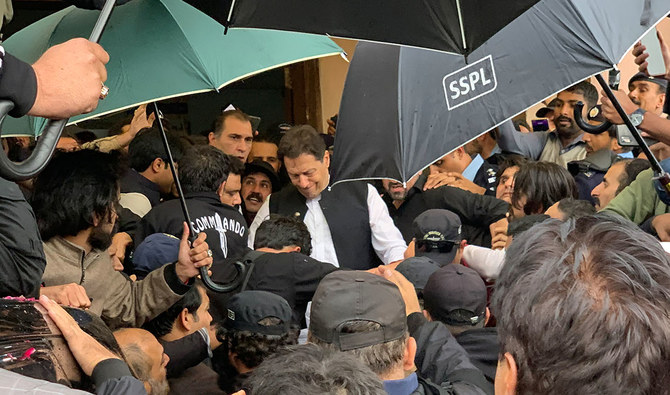
Pakistan's former Prime Minister Imran Khan (C) leaves after appearing at the court in Islamabad on February 28, 2023. (Photo courtesy: AFP)
Short Url
Updated 28 February 2023
Follow

Experts warn ex-PM Khan’s arrest could worsen current political turmoil in Pakistan 

  • An Islamabad court on Tuesday issued non-bailable warrants for the ex-PM in case of sale of state gifts 
  • Analysts say possible conflict could potentially become violent and justify the postponement of elections 

ISLAMABAD: After the issuance of non-bailable arrest warrants for former prime minister Imran Khan, political and legal experts on Tuesday said the development could exacerbate the existing political turmoil and have detrimental effects on the South Asian country at a time when it was already dealing with economic and security challenges. 

An Islamabad court issued non-bailable arrest warrants for Khan due to his persistent absence in a case relating to the sale of state gifts while he was the prime minister, local media widely reported on Tuesday. 

Khan’s ouster itself from power in a parliamentary vote of no-confidence last year has led to political and economic uncertainty in Pakistan. His supporters have held protests and demanded early national elections, while the country struggles to avoid a potential default amid depleting forex reserves, currency devaluation and decades-high inflation. 

“The political situation is set to escalate as a result of this move, regardless of whether Khan is arrested or not,” Ahmed Bilal Mehboob, president of the Islamabad-based Pakistan Institute of Legislative Development and Transparency, told Arab News. 

A political crisis at this time could be extremely dangerous for Pakistan as the government already expressed concerns about militancy and insufficient funds to maintain law and order during elections, he said. 

“Khan is seeking to reclaim his position through elections, but his opponents are attempting to prevent this by delaying the elections and this conflict could potentially become violent and provide a justification for the postponement of the elections,” Mehboob said. 

“If a situation arises that threatens law and order, the government will have a stronger reason to postpone the elections.” 

Mehboob said the former premier’s popularity remained unaffected, despite his numerous political controversies, including the latest one in which he avoided going to jail himself but urged supporters to “fill prisons.” 

Former Attorney General Anwar Mansoor Khan said Khan could file an appeal against the order in the high court. 

“Following the issuance of non-bailable arrest warrants, Khan has two options either file an appeal against it in the Islamabad High Court to set aside the order, or surrender before the court which issued the warrants due to his absence,” he told Arab News. 

“The legal procedure for the administration is to arrest Khan and present him before the court.” 

The former attorney-general said Khan wanted to lead the party by remaining outside as it would be difficult for him to pass on instructions from the jail. 

Rabbiya Bajwa, vice president of the Lahore High Court Bar Association, said the court could withdraw the warrants, if Khan appeared before it. 

“If he will present himself before the court then the court can withdraw the warrants and if he is arrested then he has the option to file post-arrest bail as well,” she told Arab News. 

Bajwa, however, said the former premier’s arrest would not lead to a turmoil, despite his popularity among the masses. 

“It is not an exceptional situation as we have witnessed such things in the past, when popular leaders were arrested and no major turmoil happened,” she added. 

Fareeha Idrees, a political analyst and anchorperson, said certain forces wanted to arrest Khan, but they were cautious about the potential consequences of the move. 

“As far as I can tell, whatever actions have been taken against Khan have backfired,” she told Arab News. 

Recent surveys suggested that Khan’s public support and popularity had increased despite all these actions, according to Idrees. Putting Khan in jail would not have any significant political impact and the authorities would likely seek to disqualify him before taking any further action. 

“At some point, they will arrest him, and as per my conversation with Khan, he was clear that he will be arrested,” she added. 


Pakistan says inflation to remain within 5-6 percent range in January

Updated 4 sec ago
Follow

Pakistan says inflation to remain within 5-6 percent range in January

  •  Current account projected to remain in deficit, says Finance Division in monthly economic outlook
  •  Pakistan suffered a financial crisis in 2023, marked by inflation of 38 percent, depleted forex reserves

KARACHI: Inflation is expected to remain within the 5-6 percent range in January, Pakistan’s Finance Division said in its monthly economic outlook report on Tuesday, saying that the country’s economy is well positioned to sustain growth momentum in FY2026. 

Consumer Price Index (CPI) inflation was recorded at 5.6 percent year-on-year (YoY) basis in December 2025 as compared to 6.1 percent in November 2025 and 4.1 percent in December 2024. 

“Inflation is expected to remain within the range of 5.0-6.0 percent in January,” the Finance Division said. 

“On the external front, the current account is projected to remain in a deficit; however, robust remittance inflows and steady performance in IT and services exports are likely to cushion external pressures.”

The report said that the “positive trajectory” of the economy reflects the impact of the government’s prudent policies, ongoing structural reforms and easing of monetary conditions due to subsiding inflationary pressures.

Earlier, Pakistan’s finance ministry adviser Khurram Schehzad said S&P Global Market Intelligence’s latest macroeconomic forecast for Pakistan broadly aligns with projections issued by the State Bank of Pakistan, signaling easing inflation, manageable external balances and a gradual recovery in economic growth.

The assessment came amid stabilizing macroeconomic indicators after Pakistan went through a prolonged financial crisis marked by record inflation of 38 percent, depleted foreign exchange reserves and repeated balance-of-payments pressures, culminating in emergency support from the International Monetary Fund.

Tighter monetary policy, fiscal consolidation and external financing have since helped stabilize prices and ease pressure on the external account, prompting more measured assessments from international credit rating agencies.

“S&P’s projections broadly align with SBP’s outlook, with slight differences on growth and the current account but a shared assessment of easing inflation and gradual economic improvement,” Schehzad said in a statement.

According to S&P, inflation is expected to average 5.1 percent in 2026 and edge up slightly to 5.6 percent in 2027, staying within the SBP’s projected range of 5 percent to 7 percent over the next two years.

On the external front, S&P forecast a current account deficit of 0.5 percent of gross domestic product in 2026, broadly in line with the central bank’s expectation that the deficit will remain between 0 percent and 1 percent of GDP in the fiscal year.

Economic growth is projected to strengthen gradually, with S&P forecasting real GDP growth of 3.5 percent in fiscal year 2026, rising to 4.4 percent the following year. The SBP has projected growth of 3.75 percent to 4.75 percent for FY26.

Both S&P and SBP projections echo the government’s assessment that macroeconomic conditions are stabilizing, as Pakistan seeks to attract foreign investment and push toward export-led growth.