

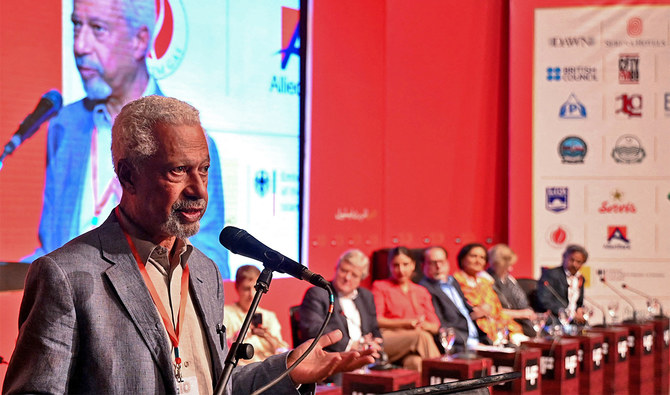

LAHORE: The Lahore Literary Festival (LLF) marked its tenth anniversary this weekend with a three-day event and its most prestigious and eclectic lineup of writers and intellectuals to date, with memory, migration, refugees, travel and cross-cultural exchanges among the many themes discussed.
The galaxy of luminaries at the festival taking place at Lahore’s famed Alhamra Arts Council from Feb. 24-26 include Nobel Laureate Abdulrazak Gurnah, Booker Prize winners Shehan Karunatilaka and Damon Galgut, as well as a Michelin Starred Chef, magical realist writers from Argentina and intellectuals specializing in the poetry of the Caribbean.
The trend toward the global isn’t entirely new for LLF which, since it was established in 2013, has held festivals in London and New York. In 2021, the festival was held virtually due to the pandemic, and last year’s attendance still looked a bit weary following the long-standing viral outbreak. But this year’s commemorative edition of the festival has seen packed halls, with the schedule including performances, recitals, screenings, book signings, and an exhibition by modern artist Wardha Shabbir.
“The LLF is a great festival, for new writers, for new readers, so many renowned writers and intellectuals are gathered here,” columnist Nabeel Najam told Arab News. “It’s a great festival to improve our way of thinking.”
Top panels on Saturday included one featuring Suvir Saran, the only non-European chef to have been awarded a Michelin Star in New York.
“I’m here in Pakistan for the first time, in Lahore, for the Lahore Literature Festival, the people are amazing, the welcome I’ve received is incredible,” Saran, whose mother was from Lahore and father from Lucknow, told Arab News.
“I think our people, the way we live, the way we love, the way we share, it’s something epic.”
Saran, who is perhaps best known for bringing Indian cooking to the American kitchen, explained his work thus:
“My career spans many recipes, many countries, many traditions and even religions. I make mosaics.”
In a way, he said, the cultural mosaic of his work was just a continuation of his upbringing.
But the star of the show this season was the 2021 winner of the Nobel Prize in Literature, Tanzanian-born British novelist Abdulrazak Gurnah, who moved to the United Kingdom in the 1960s as a refugee during the Zanzibar Revolution.
Gurnah won the prestigious award for writing about colonialism, displacement and the immense cost refugees pay to escape trauma.
For themes so serious, his introduction at Saturday’s session could not have been more cheerful.
“A big hello to being in Pakistan,” he said in his remarks on stage to loud applause. “It’s lovely to [finally] be here.”
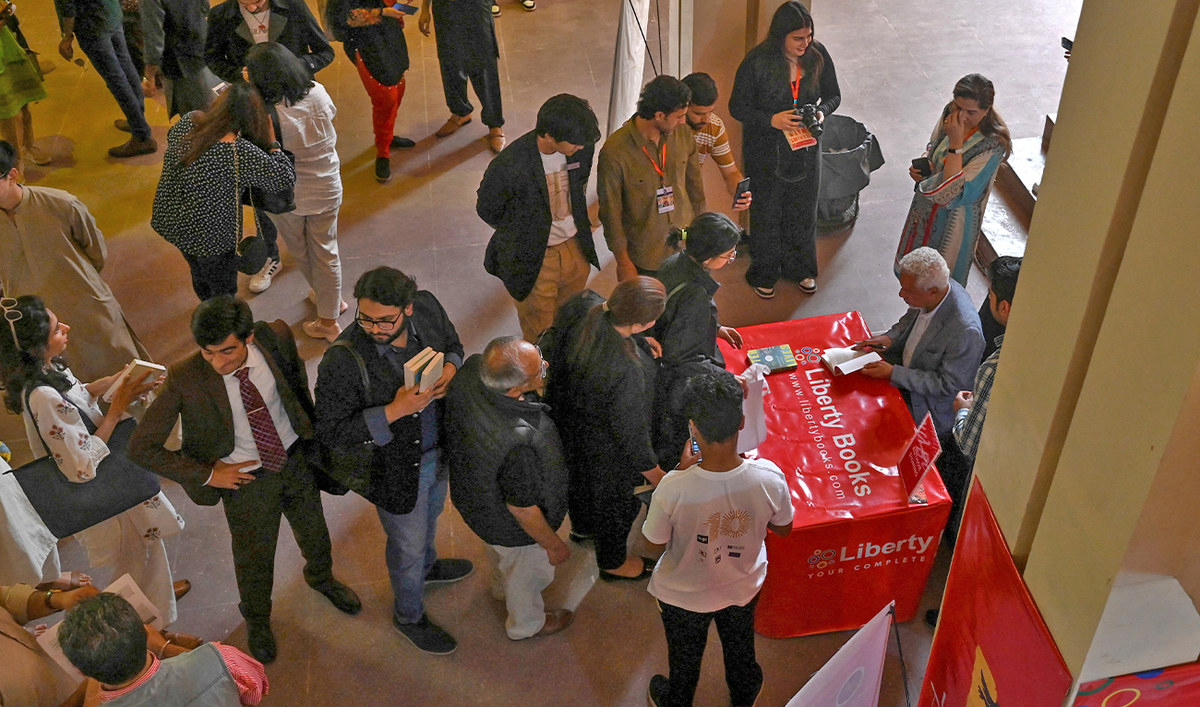
Tanzanian-born British novelist and academic and Nobel Prize in Literature in 2021, Abdulrazak Gurnah (R) gives autographs to participants during the second day session at the Lahore Literary Festival in Lahore on February 25, 2023. (AFP)
Gurnah too spoke from cross-cultural fertilization, explaining that for thousands of years people had been coming across the Indian Ocean toward Zanzibar.
“Right in our harbor they descended,” he told a packed hall. “It felt like you were in touch with the great world even though we were a tiny island [a trade center in the Arabian Sea]. People from Somalia, Iran, Saudi Arabia, India, all came to us. I spoke Swahili but my father also spoke Arabic.”
Indeed, the first thing Gurnah said he read was the Holy Qur’an.
“Later we were sent to colonial government schools,” he said. “The colonial schools were in English because the teachers were all Europeans.”
He described the teachers as “strange-looking” people who spoke “a strange language.”
Then came the Zanzibar Revolution of the 1960s in which the island’s Black African majority overthrew the sultan and his predominantly Arab government.
“It was quite an upheaval,” Gurnah added. “I was about 13. There was terror, man prisoners were taken and killed.”
It was the same trauma that he later brought to his books.
Also having written about agony and turmoil is South African author Damon Galgut whose novel, “The Promise,” won The Booker Prize in 2021, and who spokes about continuing racism in his country.
“Thirty years into democracy in South Africa, black people are still largely relegated to domestic help and the millions of white people are not aware of the inner lives of black South Africans,” Galgut said. “They are [practically] invisible.”
“I’m not filled with great hope for South Africa,” he said. “Even the highly educated university going white South Africans can be quite racist. Which is what the book is about.”
In a session called “Chasing Tale,” Sri Lankan Muslim sociologist Ameena Hussein explored the oral history of the famed Muslim travel writer Ibn Battuta, explaining that in writing her non-fiction work, “Chasing Tall Tales and Mystics,” she was also tracing the history of her own Muslim family.
“This book is a personal journey,” she said. “I had to rely on oral narratives because so little about the Moroccan traveler is written,” she told the audience. “And through him I found out a lot about Islam in my country.”
Much like Pakistan, Hussein said, Sri Lanka was going through a turbulent time with its own minorities.
“In writing this book, I began to understand my place in this country,” she said. “Muslims have lived there for a thousand years but are still marginalized.”
Many attendees said Hussein’s session, and others at the festival, had broadened their horizon.
“After this session, I realized that the place where we are in right now, it’s merely a small fraction of this universe, this world is very large,” Iqra Kiran, who had just attended a session on travel writing by Pakistani women writers, said.
“And when you hear travelogues and people’s stories, you live their journeys [through them].”


