

Pakistan PM condemns Israel’s siege of Khan Yunis leading to large-scale Palestinian displacement

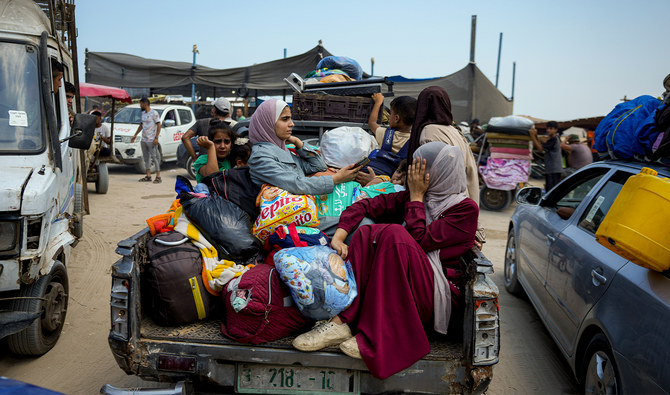
Palestinians displaced by the Israeli air and ground offensive on the Gaza Strip flee from parts of Khan Younis, following an evacuation order by the Israeli army to leave parts of the southern area of Gaza Strip's second largest city, on July 27, 2024. (AP)
Short Url
Updated 27 July 2024
Follow

Pakistan PM condemns Israel’s siege of Khan Yunis leading to large-scale Palestinian displacement

  • Israel ordered the evacuation of the city on Monday, causing international displacement affecting over 150,000 people
  • Shehbaz Sharif asks the international community to hold Israel accountable for its ‘war crimes’ and bring it to justice

ISLAMABAD: Prime Minister Shehbaz Sharif on Saturday condemned Israel for besieging the southern Gaza city of Khan Yunis, saying it had uprooted more than 150,000 Palestinians and disrupted food supplies to the area.
The Israeli military ordered the evacuation of parts of the city after announcing on Monday that its military would “forcefully operate” in the area.
The United Nations said a day earlier that the intensified hostilities in Khan Yunis had fueled another wave of internal displacement in Gaza that had affected about 182,000 people.
Israel announced during the week it had recovered the bodies of five captives who had been captured by Hamas on October 7, saying its forces had also killed nearly “100 terrorists.”
“The brutality in Khan Younis has displaced over 150,000 Palestinians,” the prime minister said in a statement released by his office in Islamabad. “The siege of Khan Younis has disrupted the supply of food and other essential items in the area. A humanitarian crisis is unfolding in Palestine.”
The statement said Sharif condemned Israel’s action in Khan Yunis and expressed concern over the situation.
He asked the international community, including the United Nations, to fulfill its responsibilities to end Israel’s military campaign.
“Israeli forces are committing the grave crime of genocide against Palestinians,” he continued. “We reiterate the demand for the implementation of the recent decisions of the International Court of Justice regarding Palestine and the UN resolutions.”
Sharif said his government had sent 1,200 tons of relief goods through six Pakistan Air Force planes and 1,500 tons via three ships to Palestine.
He also highlighted special arrangements made by his country for Palestinian medical students to continue their education in Pakistan.
“The international community should hold Israel accountable for its war crimes and bring it to justice,” he added.
Israel launched its air and ground offensive targeting Gaza last October following a surprise attack by Hamas in which around 1,200 people were killed and more than 250 were taken hostages.
The Palestinian group said its attack was in response to the deteriorating condition of Palestinian people living under occupation.
Israel’s response was widely viewed as disproportionate by the international community in which over 39,000 people, mostly women and children, have died.
Israel was taken to the International Court of Justice (ICJ) by South Africa on the allegation of committing genocide where other nations joined the proceedings as well.

With input from AP


Pakistani, Bangladeshi officials discuss trade, investment and aviation as ties thaw

Updated 28 December 2025
Follow

Pakistani, Bangladeshi officials discuss trade, investment and aviation as ties thaw

  • Pakistan and Bangladesh were once one nation, but they split in 1971 as a result of a bloody civil war
  • Ties between Pakistan, Bangladesh have warmed up since last year and both nations have resumed sea trade

ISLAMABAD: Pakistan's High Commissioner to Bangladesh Imran Haider on Sunday met Chief Adviser Muhammad Yunus in Dhaka, the latter's office said on, with the two figures discussing trade, investment and aviation.

Pakistan and Bangladesh were once one nation, but they split in 1971 as a result of a bloody civil war, which saw the part previously referred to as East Pakistan seceding to form the independent nation of Bangladesh.

Ties between Pakistan and Bangladesh have warmed up since former prime minister Sheikh Hasina’s ouster as a result of a student-led uprising in August 2024. Relations remain frosty between Dhaka and New Delhi over India’s decision to grant asylum to Hasina.

Pakistan has attempted to forge closer ties with Bangladesh in recent months and both South Asian nations last year began sea trade, followed by efforts to expand government-to-government commerce.

"During the meeting, both sides discussed ways to expand cooperation in trade, investment, and aviation as well as scaling up cultural, educational and medical exchanges to further strengthen bilateral relations between the two South Asian nations," Yunus's office said in a statement on X.

In 2023-24 Pakistan exported goods worth $661 million to Bangladesh, while its imports were only $57 million, according to the Trade Development Authority of Pakistan. In Aug. this year, the Pakistani and Bangladeshi commerce ministries signed a memorandum of understanding to establish a Joint Working Group on Trade, aiming to raise their bilateral trade volume to $1 billion in the financial year that began in July.

The Pakistani high commissioner noted that bilateral trade has recorded a 20 percent growth compared to last year, with business communities from both countries actively exploring new investment opportunities, according to the statement.

He highlighted a significant increase in cultural exchanges, adding that Bangladeshi students have shown strong interest in higher education opportunities in Pakistan, particularly in medical sciences, nanotechnology, and artificial intelligence. Haider also said that Dhaka-Karachi direct flights are expected to start in January.

"Chief Adviser Professor Muhammad Yunus welcomed the growing interactions between the two countries and emphasized the importance of increased visits as well as cultural, educational and people-to-people exchanges among SAARC (South Asian Association for Regional Cooperation) member states," the statement read.

"Professor Yunus also underscored the need to further boost Bangladesh–Pakistan trade and expressed hope that during Mr. Haider’s tenure, both countries would explore new avenues for investment and joint venture businesses."