

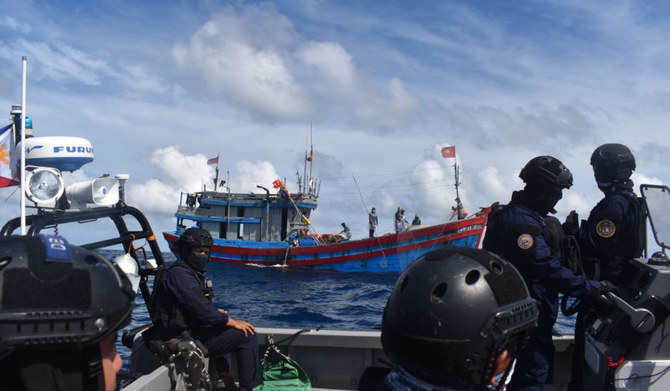

MANILA: The Philippines accused Beijing on Friday of destabilizing peace in the South China Sea and moved to bolster the presence of its forces in the region amid rising tensions.
China claims the strategic and resource-rich South China Sea almost in its entirety and its military activity in the disputed maritime territory has been increasing, encroaching on the Philippine part of the waters, the West Philippine Sea.
Earlier this week, Philippine President Ferdinand Marcos Jr. summoned Beijing’s ambassador to Manila after a Chinese vessel used a military-grade laser to block a coast guard ship in the area.
The incident came days after the Philippines granted the US expanded access to its military bases, providing American forces with a strategic footing as tensions grow not only over the disputed South China Sea but also self-ruled Taiwan.
The Philippine Department of Foreign Affairs called on Beijing to restrain its activity, which it said was “damaging and dangerous.”
“It is also destabilizing in terms of stability and peace in the region,” the department’s spokesperson, Teresita Daza, said in a media briefing.
The Philippine Coast Guard has beefed up its forces in the South China Sea in a move it announced on Friday followed “the directive of President Ferdinand ‘Bongbong’ Marcos Jr. to strengthen and increase the Philippine Coast Guard’s presence and operations” in the region.
Huang Xilian, China’s envoy to Manila, said during a press conference on Friday that there was a “lack of communication.”
“I think both sides should exercise restraint and refrain from taking any unilateral and provocative actions. You know by the end of the day, that water is a disputed area…We have a different account of what happened and also a different understanding,” he said
Tensions have been on the rise despite Marcos’ state visit to Beijing last month, during which he agreed with his Chinese counterpart Xi Jinping to establish an inter-government hotline on maritime issues.
“We activated communication between two coastguards, and we are also exploring some new mechanisms,” Huang said.
“With the many instances that have happened, we do believe that we need to resolve these through ‘friendly consultations’ not to have the issue hyped up and be escalated to such a situation.”


