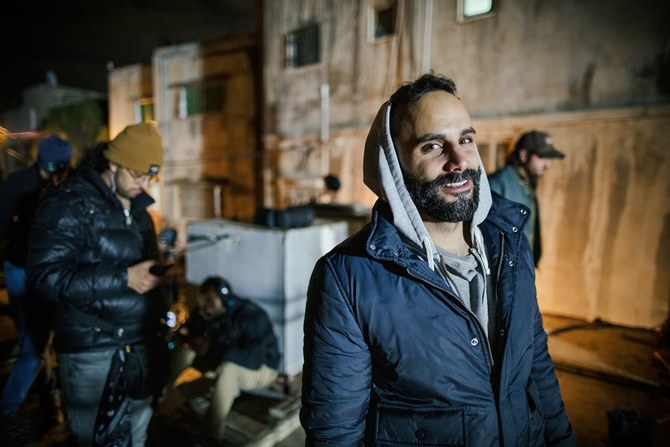

DUBAI: So far in 2023, no film has garnered as much interest — or generated as much debate — across the region as Jordanian filmmaker Bassel Ghandour’s directorial debut, “The Alleys.” A little over a month on from its release on Netflix, the crime caper is still the second-most-popular piece of media on the platform in Jordan, successfully weathering a conservative campaign against it to become the best-received film set in Jordan since the 2014 Oscar-nominated period thriller “Theeb,” which was also written by Ghandour.
“For me, the silver lining of that controversy was to see so many people come out and defend it fiercely. Whether they liked the film or not, they defended the idea that the issues we tackle in ‘The Alleys’ exist in Jordanian society — this is a representative piece of art,” Ghandour tells Arab News.
“Our film was in no way made to provoke; it was made to reflect the real-world place that it depicts. But this experience has emboldened me to take more risks in the stories I want to tell—because it proves that our method works,” he continues.
That method was born during the early stages of making “Theeb” over 10 years ago. The film, set between present-day Jordan and Saudi Arabia in 1916, follows a young Bedouin boy tasked with guiding a group of British soldiers to a Roman well near the Ottoman railway. It was inspired by Ghandour’s love of the westerns of Sergio Leone, and he dreamed up a world in which the Bedouins of Jordan operated similarly, approaching his friend Naji Abu Nowar to work on it with him.
“We did three drafts of the script and they just weren’t good enough. It lacked authenticity. It was clearly the work of two writers who lived in the city trying to write a story about life in the desert,” says Ghandour.
“We realized the best thing for us to do was to move down into the Wadi Rum desert where the film was set, live with a local Bedouin tribe, and immerse ourselves in that world. We spent a year there, and that is when the story finally came alive.”
Their efforts turned “Theeb” into a global success, garnering Jordan’s first-ever Oscar nomination and setting Ghandour on a course to finally direct his first feature, a dream he’d had since the days when he first truly fell in love with filmmaking, working on the set of the Academy-Award winning film “The Hurt Locker” in 2008 as a crewmember.
For “The Alleys,” however, he knew not to make the same mistake twice. He would not try to fit a world he barely knows into a film language he was enamored with. He had learned, instead, that human beings are more than an aesthetic. His approach was in the spirit of filmmakers such as David Simon — the man behind what is often hailed as the best TV show of all time, “The Wire” — whose work involved years of research and journalism on the streets of the city he had chosen to depict.
For “The Alleys,” Ghandour wanted to explore the East Amman neighborhood of Jabal Al Natheef, enlisting the help of his friend who had lived there, Mahmoud Abu Faha, who ultimately became an executive producer on the project, to dive deeper into its intricacies.
“There was a long process of research and it was directly inspired by the stories we heard on the street — and the culture of gossip that exists to spread those stories around. Some stories we heard were obviously exaggerated, some clearly false, so we not only went around listening to every story we could, but also dug deep into how true each of the stories was, getting snippets from all these different people living in the neighborhood, and then exploring the most interesting threads,” says Ghandour.
Ghandour took in as much as he could, and as he got ideas for how to fictionalize it all and turn it into a coherent narrative, he would write. He went through draft after draft, making sure after each solo writing period to then give a reality check to everything he’d come up with.
“I would put in a narrative, and then I would take it back to Mahmoud, and he would vet it all, as well as try to find parallels to real things he knew or had heard. He would correct me when something was off — he was always my barometer — and then I would go back and write again,” says Ghandour. “It was a long process.”
The film ultimately became as labyrinthian as the place that inspired it, following a young man with a secret lover, and his disapproving mother who enlists a gangster to put a stop to the romance, with disastrous results. Every detail, ultimately, was painstakingly stress-tested by the people who knew the area best.
“In the final stretch, once we had a narrative we were satisfied with, it was then about making sure the dialogue was as authentic to East Amman as possible, and every subtle difference in inflection and language was reflected. I want the film to do well, of course, but if that stamp of approval wasn’t there from the people in that neighborhood, then I’d have felt that I’d failed,” says Ghandour. “I had to make sure that everyone who worked on the film from that area could say, ‘This is true. This exists. This resonates.’ This is something we are proud of.”
While Ghandour went in with as few preconceived notions as possible, he did ultimately feel that he had discovered the truth of how that world operates, and that, ultimately, the more granular his approach got, the more relatable the material became.
“This neighborhood operates like a beehive, and that intimacy is both positive and negative. There’s camaraderie, there’s a support system, there’s beautiful energy, but there’s also tension. People put up social masks to present a certain persona of themselves, and that’s true across the Arab world,” he says.
Ghandour is now living in London, and is currently developing a few projects — one set in Palestine, one in Saudi Arabia, and another in London. The London film is the one he’s now currently working hardest on, once again deeply immersed in the collaborative process of figuring out how a city operates, and understanding the people who navigate it.
“I moved to London because I’m ready for a new chapter in my life. I’m ready to explore new things. And it’s been so good for me to get to know this city now through this new project,” he says. “While it’s still too early to know which project may happen next, I’m so excited to see what the future holds.”